FreeQAs
 Request Exam  Contact
  • Home
  • View All Exams
  • New QA's
  • Upload
PRACTICE EXAMS:
  • Oracle
  • Fortinet
  • IBM
  • Juniper
  • Microsoft
  • Cisco
  • Citrix
  • CompTIA
  • VMware
  • ISC
  • SAP
  • EMC
  • PMI
  • HP
  • Salesforce
  • Other
  • Oracle
    Oracle
  • Fortinet
    Fortinet
  • IBM
    IBM
  • Juniper
    Juniper
  • Microsoft
    Microsoft
  • Cisco
    Cisco
  • Citrix
    Citrix
  • CompTIA
    CompTIA
  • VMware
    VMware
  • ISC
    ISC
  • SAP
    SAP
  • EMC
    EMC
  • PMI
    PMI
  • HP
    HP
  • Salesforce
    Salesforce
  1. Home
  2. CIPS Certification
  3. L4M2 Exam
  4. CIPS.L4M2.v2023-10-26.q54 Dumps
  • ««
  • «
  • …
  • 2
  • 3
  • 4
  • 5
  • 6
  • 7
  • 8
  • 9
  • 10
  • 11
  • …
  • »
  • »»
Download Now

Question 26

Which of the following statements is the best definition of 'value engineering?

Correct Answer: B
Value Engineering (VE) is concerned with new products. It is applied during product development. The focus is on reducing costs, improving function or both, by way of teamwork-based product evaluation and analysis. This takes place before any capital is invested in tooling, plant or equipment.
This is very significant, because according to many reports, up to 80% of a product's costs (throughout the rest of its life-cycle), are locked in at the design development stage. This is under-standable when you consider the design of any product determines many factors, such as tooling, plant and equipment, labour and skills, training costs, materials, shipping, installation, maintenance, as well as decommissioning and recycle costs.
LO 3, AC 3.4
insert code

Question 27

An automotive manufacturer is sourcing rubber components from Company A.
The specification given to the supplier state that the component should be 1 meter long, without mentioning the tolerance. Enthusiast with the opportunity, engineers at Company A work hard to cut the components with tolerance at only +/- 1mm. The head and tail of the component is then joined together to form a circular band. After that it is stretched over another component. To fit this purpose, the rubber component can be at any length from 80cm to 110cm. This is an example of...?

Correct Answer: D
This questions is intended to ask students about types of waste in Lean principles.
Lean was born out of manufacturing practices but in recent time has transformed the world of knowledge work and management. It encourages the practice of continuous improvement and is based on the fundamental idea of respect for people. Womack and Jones defined the five principles of Lean manufacturing in their book "The Machine That Changed the World". The five principles are considered a recipe for improving workplace efficiency and include: 1) defining value, 2) mapping the value stream, 3) creating flow, 4) using a pull system, and 5) pursuing perfection.
Lean principles aim to eliminate waste in processes. The eight wastes of Lean principles are:
- Defects
- Over-production
- Waiting
- Not using talent
- Transport and handling
- Inventory
- Motion waste
- Excess processing
In the scenario, the component is processed more than necessary. The engineers try to make them as accurate as possible with very little tolerance. In fact, the component does not need to be that precise. This excesses buyer's requirements and incurs costs for both buyer and supplier. The scenario is an example of over processing (or excess processing).
Overprocessing is one of the seven wastes of lean manufacturing (or 7 mudas); Overprocessing is adding more value to a product than the customer actually requires such as painting areas that will never be seen or be exposed to corrosion.
Overprocessing as one of the seven wastes is caused by having unclear standards and specifications, many operators will try to do the best job possible and will not always be aware of what truly adds value to the product or even the end use. They will therefore often expend time polishing and finishing components that do not require it.
Reference:
- CIPS study guide page 153-156
- Waste of Overprocessing; causes, costs, examples solutions, symptoms (leanmanufactur-ingtools.org) LO 3, AC 3.4
insert code

Question 28

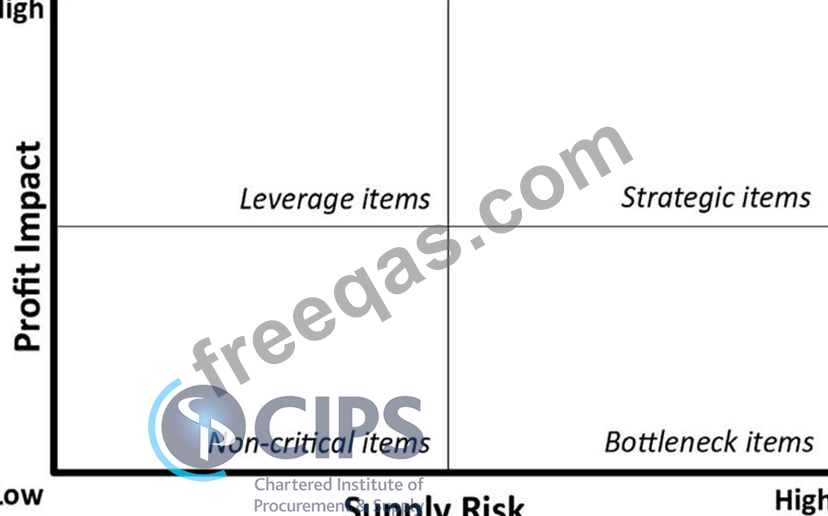
A procurement team is categorising their purchased items into four quadrants of Kraljic's supply chain portfolio matrix. They realise that there are some low-value items which come from very few suppliers in the market. The organisation is critically dependent on these suppliers. The team plans to reduce the dependence by finding alternative sources. Is this a right course of action?
Correct Answer: A
According to Kraljic portfolio matrix, the low-value items with high supply risk are bottleneck items.

The purchasing strategy that is commonly recommended for these products is primarily based on acceptance of the dependence and reduction of the negative effects of the unfavourable position. An alternative strategy suggested by purchasing practitioners is to find other suppliers and move towards the non-critical quadrant.
- Accept dependence, reduce negative consequences: The main focus of this strategy is to assure supply, if necessary even at additional cost. Examples of this strategy are keeping extra stocks of the materials concerned or developing consigned stock agreements with suppliers. By performing a risk analysis firms can identify the most important bottleneck products and consider the implications. A possible action for dealing with unexpected bad dependence positions for certain products is to employ contingency planning.
- Reduce dependence and risk, find other solutions: This strategy is geared towards reducing the dependence on the supplier. The most common way to achieve this is to broaden the specifications of the product or to search for new suppliers.
The procurement team in the scenario has selected reducing dependency by finding alternatives. This is a right strategy for bottleneck item.
Reference:
- CIPS study guide page 82-84
- Purchasing strategies in the Kraljic matrix-A power and dependence perspective, Marjolein C.J. Caniels, Cees J. Gelderman LO 2, AC 2.1
insert code

Question 29

Which of the following are typically included in a conformance specification? Select TWO that apply.

Correct Answer: B,E
A conformance specification is a specification that defines the technical and physical characteristics and/or measurements of a product, such as physical aspects (e.g. dimensions, colour, and surface finish), design details, material properties, energy requirements, processes, maintenance requirements and operational requirements.
On the other hand, performance specification typically includes list of output or outcome or func-tional requirements. Brand name can be a part of performance specification because brand is a re-minder of quality that customers remember. For example, when talking about Roll Royce, people will think about an elegant car.
Reference:
LO 3, AC 3.1
insert code

Question 30

EV Inc is facing the following challenges:
1. The capital investment is enormous.
2. Most of company's working capital is in form of inventories, which include raw materials, work-in-progress and finished goods.
3. Competitors are increasingly deploying robotics and automation to boost productivity.
Which of the below business sectors does EV Inc belong to?


Correct Answer: B
Every sector among the options requires intensive capital investment. However, only manufacturing and retails bury much of their working capital in form of inventory. Raw materials and WIP only present in manufacturing sector.
The manufacturing industry is undergoing massive change, rivaling the Industrial Revolution that began in England and continued on Detroit's assembly lines. But today's revolution is "smart," thanks to factories using artificial intelligence and robots.
A new trend is the "cobot" - a collaborative robot designed to work with humans. One company called Moduform uses them to make furniture in the U.S. The company credits using cobots for reducing their staffing turnover, since the robots do mundane repetitive tasks that bore humans, while people can now do cognitive tasks requiring judgment and diversified responsibilities. Other innovations include 3D printing, Artificial Intelligence and automation.
Today's artificial intelligence manufacturing revolution improves performance in two key areas of manufacturing: productivity and quality control.
Reference:
- The Key Characteristics of Manufacturing (bizfluent.com)
- CIPS study guide page 74-76
LO 2, AC 2.1
insert code
  • ««
  • «
  • …
  • 2
  • 3
  • 4
  • 5
  • 6
  • 7
  • 8
  • 9
  • 10
  • 11
  • …
  • »
  • »»
[×]

Download PDF File

Enter your email address to download CIPS.L4M2.v2023-10-26.q54 Dumps

Email:

FreeQAs

Our website provides the Largest and the most Latest vendors Certification Exam materials around the world.

Using dumps we provide to Pass the Exam, we has the Valid Dumps with passing guranteed just which you need.

  • DMCA
  • About
  • Contact Us
  • Privacy Policy
  • Terms & Conditions
©2026 FreeQAs

www.freeqas.com materials do not contain actual questions and answers from Cisco's certification exams.