FreeQAs
 Request Exam  Contact
  • Home
  • View All Exams
  • New QA's
  • Upload
PRACTICE EXAMS:
  • Oracle
  • Fortinet
  • Juniper
  • Microsoft
  • Cisco
  • Citrix
  • CompTIA
  • VMware
  • SAP
  • EMC
  • PMI
  • HP
  • Salesforce
  • Other
  • Oracle
    Oracle
  • Fortinet
    Fortinet
  • Juniper
    Juniper
  • Microsoft
    Microsoft
  • Cisco
    Cisco
  • Citrix
    Citrix
  • CompTIA
    CompTIA
  • VMware
    VMware
  • SAP
    SAP
  • EMC
    EMC
  • PMI
    PMI
  • HP
    HP
  • Salesforce
    Salesforce
  1. Home
  2. CIPS Certification
  3. L6M2 Exam
  4. CIPS.L6M2.premium Dumps

Free CIPS L6M2 Exam Dumps Questions & Answers

Exam Code/Number:L6M2Join the discussion
Exam Name:Global Commercial Strategy
Certification:CIPS
Question Number:40
Publish Date:Jan 12, 2026
Rating
100%
Page: 1 / 8
Total 40 questions
Captcha image

Question 1

SIMULATION
Analyse the GE McKinsey Matrix as a tool to influence directional policy

Correct Answer:
Analysis of the GE McKinsey Matrix as a Tool to Influence Directional Policy Introduction The GE McKinsey Matrix is a strategic tool used by businesses to prioritize investments, allocate resources, and influence directional policy. It expands on the BCG Matrix by evaluating business units or product portfolios based on two dimensions:
Industry Attractiveness (external factors such as market growth, competition, and profitability).
Business Unit Strength (internal factors such as brand strength, financial performance, and operational efficiency).
The matrix helps organizations decide where to invest, grow, or divest, making it a valuable tool for influencing long-term strategic direction.
1. Explanation of the GE McKinsey Matrix
The GE McKinsey Matrix categorizes business units into nine strategic zones, guiding investment decisions:
| Industry Attractiveness →

Example:
Apple's iPhone (High Industry, Strong Business Unit) → Invest & Grow
Microsoft's Bing Search Engine (Low Industry, Weak Business Unit) → Divest or Harvest ❌
2. How the GE McKinsey Matrix Influences Directional Policy
1. Investment Prioritization
✅ Identifies which business units deserve more investment.
✅ Helps companies allocate resources to high-potential markets.
Example: Amazon invests heavily in AWS (Cloud Computing) due to high industry growth and strong business positioning.
2. Market Entry and Expansion Decisions
✅ Assists in geographical and market expansion decisions.
✅ Helps assess whether to enter emerging industries.
Example: Tesla entered renewable energy (solar panels, batteries) due to high industry potential.
3. Strategic Exit or Divestment Decisions
✅ Identifies low-performing divisions that should be divested.
✅ Prevents financial losses by exiting declining markets.
Example: GE sold its financial services division (GE Capital) to refocus on industrial manufacturing.
4. Balancing Risk and Portfolio Diversification
✅ Encourages a balanced portfolio of high-growth and stable businesses.
✅ Ensures companies avoid over-reliance on a single product or market.
Example: Google (Alphabet) maintains a diverse portfolio of AI, search, and cloud businesses to balance risk.
3. Advantages and Limitations of the GE McKinsey Matrix
✅ Advantages
✔ More detailed than the BCG Matrix - Considers multiple industry and business factors.
✔ Helps with long-term strategic planning - Guides investment, expansion, and divestment.
✔ Balances risk and growth - Prevents over-reliance on a single revenue source.
❌ Limitations
✖ Subjective analysis - Industry attractiveness and business strength are difficult to quantify.
✖ Complex implementation - Requires detailed data collection and industry research.
✖ No direct action plan - Only provides guidance on resource allocation, not execution strategies.
4. Conclusion
The GE McKinsey Matrix is a powerful tool for influencing directional policy by helping companies prioritize investments, expand into attractive markets, and exit underperforming businesses. However, it should be used alongside financial analysis and market research to ensure strategic success.

Question 2

SIMULATION
Discuss how the following can impact upon supply chain operations and business strategy:
1) Discrimination, equality and diversity
2) Redundancy and dismissal
3) Working time and payment

Correct Answer:
Impact of Employment Policies on Supply Chain Operations and Business Strategy Introduction Employment policies such as discrimination, equality and diversity, redundancy and dismissal, and working time and payment have a significant impact on supply chain operations and business strategy. These factors influence employee productivity, legal compliance, reputation, and operational efficiency.
For businesses operating in global supply chains, ensuring compliance with employment laws and ethical workforce practices is crucial to maintaining sustainability, cost efficiency, and risk management.
1. Impact of Discrimination, Equality, and Diversity on Supply Chain Operations and Business Strategy Discrimination laws and diversity and inclusion (D&I) policies ensure fair treatment in the workplace.
✅ Impact on Supply Chain Operations
Companies must prevent workplace discrimination across hiring, promotions, and supplier engagement.
Non-compliance with equality laws can lead to legal penalties, reputational damage, and operational disruptions.
Supply chain leaders must promote diverse supplier partnerships and inclusive hiring practices.
Example: Many multinational corporations, such as Unilever and IBM, have supplier diversity programs that prioritize working with minority-owned and women-owned businesses.
✅ Impact on Business Strategy
Encourages innovation and diverse perspectives in problem-solving.
Enhances brand reputation and customer loyalty through ethical business practices.
Helps businesses attract top global talent by fostering an inclusive workplace.
Strategic Action: Businesses should implement anti-discrimination training and diversity recruitment strategies to create a fair and inclusive work environment.
2. Impact of Redundancy and Dismissal on Supply Chain Operations and Business Strategy Redundancy and dismissal policies regulate how companies terminate employment due to economic downturns, automation, or restructuring.
✅ Impact on Supply Chain Operations
Workforce reductions can disrupt production schedules and supplier relationships.
Companies must ensure fair redundancy policies to prevent legal claims or industrial action.
Automation may lead to worker displacement, requiring retraining programs.
Example: Ford's decision to restructure operations in the UK resulted in job losses, requiring compliance with UK redundancy laws and union negotiations.
✅ Impact on Business Strategy
Must balance cost-cutting measures with employee morale and brand reputation.
Need to comply with national and international labor laws to avoid legal action.
Investing in employee retraining and redeployment can reduce negative effects of redundancy.
Strategic Action: Businesses should establish clear redundancy frameworks, provide severance packages, and offer outplacement support for affected employees.
3. Impact of Working Time and Payment on Supply Chain Operations and Business Strategy Working time regulations and fair wage policies impact labor costs, productivity, and compliance.
✅ Impact on Supply Chain Operations
Ensuring compliance with working time laws (e.g., UK Working Time Regulations 1998) prevents overworking employees.
Failure to meet minimum wage and overtime regulations can lead to legal disputes.
Supply chains must ensure fair pay for workers in offshore factories to meet ethical sourcing standards.
Example: The UK National Minimum Wage Act ensures fair wages, while the Modern Slavery Act (2015) prevents exploitation in global supply chains.
✅ Impact on Business Strategy
Fair wages enhance employee motivation and reduce turnover.
Complying with wage and hour laws prevents reputational risks and fines.
Ethical pay practices attract conscious consumers and investors.
Strategic Action: Businesses should conduct regular wage audits and ensure global supplier compliance with fair labor laws.
Conclusion
Employment policies related to discrimination, redundancy, and working time/pay significantly impact supply chain operations and business strategy. Companies must ensure:
✅ Diversity and equality policies to foster innovation and enhance reputation.
✅ Ethical redundancy and dismissal processes to maintain legal compliance.
✅ Fair wages and working hours to improve productivity and worker well-being.
By aligning HR policies with supply chain strategy, businesses can enhance efficiency, reduce risks, and build a sustainable competitive advantage.

Question 3

SIMULATION
XYZ is a high fashion clothing designer and wishes to complete a benchmarking exercise. Discuss priority dimensions to be measured in the benchmarking exercise and propose a strategy for completing the exercise

Correct Answer:
Benchmarking Exercise for XYZ - A High Fashion Clothing Designer
Introduction
Benchmarking is a strategic performance measurement tool that helps businesses compare their processes, products, and strategies with industry leaders to identify areas for improvement.
As a high fashion clothing designer, XYZ must focus on key priority dimensions such as product quality, supply chain efficiency, sustainability, brand positioning, and customer engagement. A structured benchmarking strategy ensures that XYZ can achieve competitive advantage, optimize operations, and align with industry best practices.
1. Priority Dimensions to be Measured in Benchmarking
XYZ should focus on the following five key benchmarking dimensions to enhance its competitiveness in the luxury fashion market:
1. Product Quality and Design Innovation
✅ Why it's important?
High fashion brands compete on premium materials, craftsmanship, and exclusivity.
Quality affects brand reputation, pricing strategy, and customer loyalty.
Example: XYZ can benchmark against Gucci or Chanel by comparing fabric sourcing, production techniques, and unique design elements.
2. Supply Chain Efficiency and Lead Times
✅ Why it's important?
Speed-to-market is critical in high fashion, especially for seasonal collections.
Efficient supply chains reduce costs and enhance inventory management.
Example: Zara benchmarks against luxury brands to optimize supply chains while maintaining affordability.
Key Metrics to Benchmark:
Supplier lead times (raw materials to finished goods).
Production cycle time (design to retail store).
Logistics and distribution efficiency.
3. Brand Positioning and Market Perception
✅ Why it's important?
A high fashion brand's success depends on prestige, exclusivity, and perceived value.
Benchmarking against top competitors helps XYZ maintain a premium brand image.
Example: XYZ can compare its marketing strategies, social media presence, and celebrity endorsements with Louis Vuitton or Dior.
Key Metrics to Benchmark:
Brand awareness and perception (customer surveys).
Pricing strategy compared to competitors.
Effectiveness of marketing campaigns and influencer collaborations.
4. Sustainability and Ethical Sourcing
✅ Why it's important?
Consumers expect eco-friendly, ethically produced fashion.
Sustainable brands gain a competitive edge and attract Gen Z and millennial buyers.
Example: Stella McCartney's ethical fashion model is a benchmark for sustainable materials and responsible sourcing.
Key Metrics to Benchmark:
Use of sustainable materials (organic, recycled fabrics).
Ethical supplier compliance with fair labor practices.
Carbon footprint reduction in production and logistics.
5. Customer Engagement and Experience
✅ Why it's important?
Luxury brands thrive on personalized customer experiences and loyalty programs.
Omnichannel retail (physical stores + digital platforms) enhances sales and retention.
Example: Burberry's digital transformation provides a seamless luxury online shopping experience.
Key Metrics to Benchmark:
Online vs. in-store customer engagement levels.
AI-driven personalization in e-commerce.
Customer service responsiveness and return policies.
2. Proposed Strategy for Completing the Benchmarking Exercise
To complete the benchmarking process successfully, XYZ should follow a structured benchmarking approach using the 5-step process:
Step 1: Identify Benchmarking Objectives
Define what XYZ wants to achieve (e.g., reducing lead times, improving sustainability).
Select benchmarking partners (competitors, industry leaders, cross-industry comparisons).
Step 2: Data Collection & Research
Use primary and secondary research to gather data:
Primary Research: Surveys, interviews, supplier audits.
Secondary Research: Competitor reports, industry data, fashion indexes.
Example: Studying annual sustainability reports from high fashion brands to benchmark against sustainability best practices.
Step 3: Analyze Performance Gaps
Compare XYZ's current performance metrics with industry benchmarks.
Identify gaps and improvement opportunities (e.g., faster supply chain, better brand marketing).
Example Analysis:
XYZ's supply chain lead time = 60 days vs. benchmark brand = 30 days → Strategy needed for optimization.
Step 4: Develop and Implement Improvement Strategies
Set SMART objectives (Specific, Measurable, Achievable, Relevant, Time-bound).
Adjust supply chain processes, brand positioning, marketing strategies, and customer experience initiatives.
Example Action Plan:
Supply Chain: Partner with local European suppliers to reduce lead times.
Sustainability: Introduce organic cotton & cruelty-free leather in the next collection.
Step 5: Continuous Monitoring and Review
Regularly review benchmarking outcomes.
Adjust strategies to remain competitive in the evolving high fashion market.
Example: Chanel adapts marketing campaigns every season to maintain exclusivity and desirability.
Conclusion
Benchmarking allows XYZ to measure product quality, supply chain efficiency, brand positioning, sustainability, and customer engagement against high fashion industry leaders. A structured 5-step benchmarking process ensures that XYZ continuously improves its strategic performance and maintains a competitive edge.

Question 4

SIMULATION
Explain how culture and historic influences can impact upon a business's strategic decisions and positioning within the marketplace

Correct Answer:
How Culture and Historic Influences Impact Strategic Decisions and Market Positioning A business's strategic decisions and positioning within the marketplace are shaped by both organizational culture and historical influences. These factors affect how a company develops strategy, interacts with customers, manages employees, and competes globally.
1. The Role of Organizational Culture in Strategic Decisions
Organizational culture is the shared values, beliefs, and behaviors within a company. It influences decision-making, innovation, and competitive advantage.
How Culture Affects Strategy
✅ Risk Appetite - A culture that embraces innovation (e.g., Google) will invest in R&D, while risk-averse cultures (e.g., traditional banks) focus on stability.
✅ Decision-Making Speed - Hierarchical cultures (e.g., Japanese firms) rely on consensus, while Western firms (e.g., Apple) may have centralized decision-making.
✅ Customer Engagement - A customer-centric culture (e.g., Amazon) leads to investment in personalization and AI-driven recommendations.
Example:
Toyota's Kaizen Culture (Continuous Improvement) has shaped its lean manufacturing strategy, giving it a competitive advantage in cost efficiency.
2. How Historic Influences Shape Business Strategy
Historical events, past business performance, economic trends, and industry evolution shape how businesses position themselves in the marketplace.
How History Affects Strategy
✅ Legacy of Innovation or Conservatism - Companies with a history of innovation (e.g., IBM, Tesla) continuously push boundaries, while firms with traditional roots (e.g., British banks) focus on risk management.
✅ Economic Crises and Financial Stability - Businesses that survived financial crises (e.g., 2008 recession) tend to develop risk-averse financial strategies.
✅ Market Reputation and Consumer Perception - A strong historical reputation can be leveraged for branding (e.g., Rolls-Royce's luxury image).
Example:
Lego nearly went bankrupt in the early 2000s, leading it to redefine its strategy, focus on digital gaming partnerships, and revive its brand.
3. The Influence of National and Corporate Culture on Global Positioning When expanding globally, businesses must align their strategies with different cultural expectations.
How Culture Affects Global Market Entry
✅ Consumer Preferences - Fast food chains adapt menus for local cultures (e.g., McDonald's in India offers vegetarian options).
✅ Negotiation & Communication Styles - Business negotiations in China emphasize relationships ("Guanxi"), while Western firms prioritize efficiency.
✅ Leadership and Management Approaches - German firms emphasize engineering precision, while Silicon Valley firms prioritize agility and experimentation.
Example:
IKEA modifies store layouts in different countries-small apartments in Japan vs. large home spaces in the U.S.
4. Strategic Positioning Based on Cultural & Historic Factors
A company's historical and cultural influences define its positioning strategy:

Conclusion
A business's strategic decisions and market positioning are deeply influenced by organizational culture, national culture, and historical performance. Companies that leverage their cultural strengths and adapt to market history can achieve long-term competitive advantage.

Question 5

SIMULATION
Currency Options and Currency Swaps are instruments used in foreign exchange. Explain the advantages of using these derivatives compared to the use of spot transactions

Correct Answer:
Comparison of Currency Options, Currency Swaps, and Spot Transactions in Foreign Exchange Introduction In international trade and finance, companies dealing with foreign currencies use various financial instruments to manage exchange rate risks. The three main instruments are:
Currency Options - Provide the right (but not obligation) to exchange currency at a fixed rate in the future.
Currency Swaps - A contract to exchange currency flows over a set period.
Spot Transactions - A simple immediate currency exchange based on the current market rate.
While spot transactions offer simplicity, currency options and swaps provide better risk management and flexibility.
1. Currency Options (Flexible Risk Management Tool)
Definition
A currency option gives the holder the right, but not the obligation, to exchange a currency at a predetermined rate on or before a specific date.
✅ Types of Options:
Call Option - Right to buy a currency at a fixed rate.
Put Option - Right to sell a currency at a fixed rate.
Example: A UK importer buying goods from the US purchases a GBP/USD call option to protect against an increase in the exchange rate.
Advantages of Currency Options Over Spot Transactions
✔ Risk Protection - Protects against adverse currency movements while maintaining upside potential.
✔ Flexibility - No obligation to execute the transaction if the exchange rate is favorable.
✔ Ideal for Hedging Future Payments - Useful for businesses with uncertain future cash flows in foreign currencies.
❌ Disadvantages
✖ Premium Costs - Buying options requires upfront payment.
✖ Complexity - More sophisticated than spot transactions.
Best for: Businesses managing currency risk with unpredictable payment schedules.
2. Currency Swaps (Long-Term Hedging Solution)
Definition
A currency swap is a contract between two parties to exchange currency flows over a set period at a predetermined rate.
✅ How It Works:
Companies exchange principal and interest payments in different currencies.
Used to secure long-term financing in foreign markets.
Example: A UK company with a loan in USD enters a GBP/USD swap with a US firm to exchange interest payments, reducing exchange rate risk.
Advantages of Currency Swaps Over Spot Transactions
✔ Long-Term Stability - Protects businesses from long-term exchange rate fluctuations.
✔ Cost Efficiency - Often cheaper than converting currency via spot transactions repeatedly.
✔ Reduces Interest Rate Risk - Useful for companies with foreign currency debt obligations.
❌ Disadvantages
✖ Less Flexible Than Options - The swap contract must be followed as agreed.
✖ Counterparty Risk - Dependent on the financial stability of the other party.
Best for: Companies with long-term foreign currency liabilities (e.g., loans, international contracts).
3. Spot Transactions (Immediate Currency Exchange, No Hedging)
Definition
A spot transaction is a straightforward exchange of currency at the current market rate for immediate settlement (usually within two days).
Example: A European exporter receiving USD payment converts it immediately into EUR using a spot transaction.
Limitations Compared to Derivatives (Options & Swaps)
❌ No Risk Protection - Subject to daily exchange rate volatility.
❌ Not Suitable for Future Obligations - Cannot hedge against expected payments or receipts.
❌ Higher Costs for Frequent Transactions - Repeated spot trades incur forex fees and spread costs.
Best for: Small businesses or one-time transactions with no currency risk concerns.
4. Comparison Table: Currency Options, Swaps, and Spot Transactions
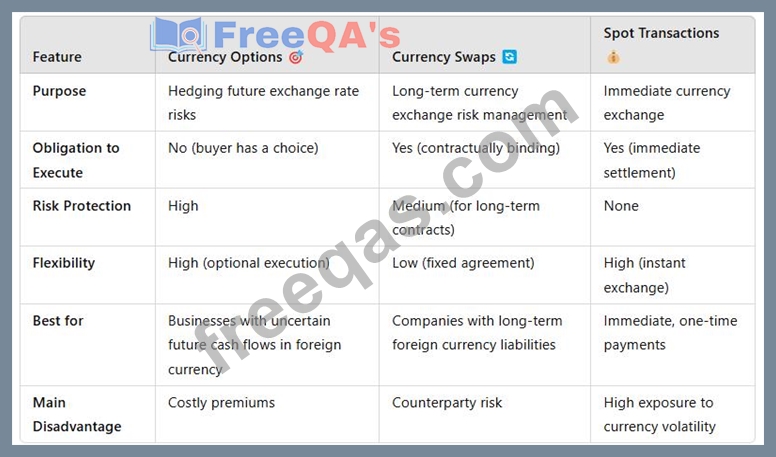
Key Takeaway:
Currency options offer flexibility and protection but come at a cost.
Currency swaps provide long-term stability for large corporations.
Spot transactions are simple but expose businesses to market fluctuations.
5. Conclusion & Best Recommendation
For businesses engaged in international trade, investments, or loans, using currency options and swaps is superior to spot transactions, as they provide:
✅ Protection from exchange rate volatility.
✅ Cost efficiency for large or recurring transactions.
✅ Better financial planning and risk management.
Best Choice Based on Business Needs:
For short-term flexibility → Currency Options
For long-term contracts or loans → Currency Swaps
For one-time currency exchange → Spot Transactions
By selecting the right derivative instrument, businesses can reduce foreign exchange risk and improve financial stability.

Add Comments

Your email address will not be published. Required fields are marked *

insert code
Type the characters from the picture.
Rating:
[×]

Download PDF File

Enter your email address to download CIPS.L6M2.premium Dumps

Email:

FreeQAs

Our website provides the Largest and the most Latest vendors Certification Exam materials around the world.

Using dumps we provide to Pass the Exam, we has the Valid Dumps with passing guranteed just which you need.

  • DMCA
  • About
  • Contact Us
  • Privacy Policy
  • Terms & Conditions
©2026 FreeQAs

www.freeqas.com materials do not contain actual questions and answers from Cisco's certification exams.