When the DHCP client sends the DHCP request packet, it doesn't have an IP address. So it uses the all-zeroes address, 0.0.0.0, as the IP source address. And it doesn't know how to reach the DHCP server, so it uses a general broadcast address, 255.255.255.255, for the destination. So the router must replace the source address with its own IP address, for the interface that received the request. And it replaces the destination address with the address specified in the ip helper-address command. The client device's MAC address is included in the payload of the original DHCP request packet, so the router doesn't need to do anything to ensure that the server receives this information. Topic 6, Network Device Security
Question 52
On a Cisco switch, which protocol determines if an attached VoIP phone is from Cisco or from another vendor?
Correct Answer: C
http://computernetworkingnotes.com/cisco-devices-administration-and-configuration/ciscodiscoveryprotocol.html The Cisco Unified IP Phone uses CDP to communicate information such as auxiliary VLAN ID, per port power management details, and Quality of Service (QoS) configuration information with the Cisco Catalyst switch. Cisco Discovery Protocol (CDP) is a proprietary protocol designed by Cisco to help administrators collect information about both locally attached and remote devices. By using CDP, you can gather hardware and protocol information about neighbor devices, which is useful info for troubleshooting the network. CDP messages are generated every 60 seconds as multicast messages on each of its active interfaces. The information shared in a CDP packet about a Cisco device includes the following: Name of the device configured with the hostname command IOS software version Hardware capabilities, such as routing, switching, and/or bridging Hardware platform, such as 2600, 2950, or 1900 The layer-3 address(es) of the device The interface the CDP update was generated on
Question 53
Refer to the exhibit. A network has been planned as shown. Which three statements accurately describe the areas and devices in the network plan? (Choose three.)
Correct Answer: A,D,E
Switches use a separate collision domain for each port, so device A must be a switch. Hubs, however, place all ports in the same collision domain so device B is a hub. Switches reside in layer 2 while hubs are layer 1 devices.
Question 54
Which IP addresses are valid for hosts belonging to the 10.1.160.0/20 subnet? (Choose three.)
Correct Answer: A,C,D
Explanation All IP address in IP ranges between : 10.1.160.1 and 10.1.175.254 are valid as shown below Address: 10.1.160.0 00001010.00000001.1010 0000.00000000 Netmask:255.255.240.0 = 2011111111.11111111.1111 0000.00000000 Wildcard:0.0.15.25500000000.00000000.0000 1111.11111111 Which implies that Network: 10.1.160.0/20 00001010.00000001.1010 0000.00000000 HostMin:10.1.160.100001010.00000001.1010 0000.00000001 HostMax:10.1.175.25400001010.00000001.1010 1111.11111110 Broadcast:10.1.175.25500001010.00000001.1010 1111.11111111
Question 55
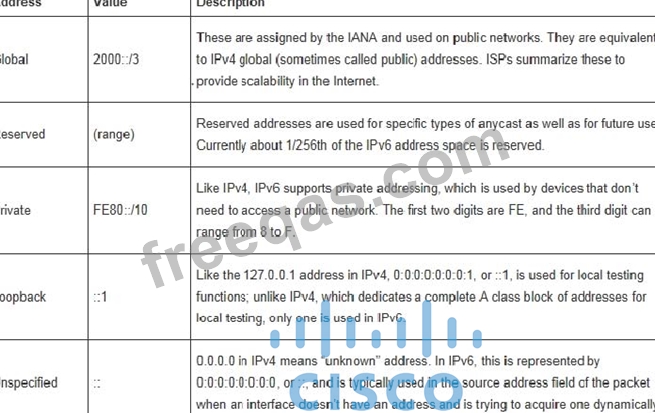
Identify the four valid IPv6 addresses. (Choose four.)