FreeQAs
 Request Exam  Contact
  • Home
  • View All Exams
  • New QA's
  • Upload
PRACTICE EXAMS:
  • Oracle
  • Fortinet
  • Juniper
  • Microsoft
  • Cisco
  • Citrix
  • CompTIA
  • VMware
  • ISC
  • SAP
  • EMC
  • PMI
  • HP
  • Salesforce
  • Other
  • Oracle
    Oracle
  • Fortinet
    Fortinet
  • Juniper
    Juniper
  • Microsoft
    Microsoft
  • Cisco
    Cisco
  • Citrix
    Citrix
  • CompTIA
    CompTIA
  • VMware
    VMware
  • ISC
    ISC
  • SAP
    SAP
  • EMC
    EMC
  • PMI
    PMI
  • HP
    HP
  • Salesforce
    Salesforce
  1. Home
  2. CompTIA Certification
  3. CV0-003 Exam
  4. CompTIA.CV0-003.v2025-12-17.q480 Dumps
  • ««
  • «
  • …
  • 83
  • 84
  • 85
  • 86
  • 87
  • 88
  • 89
  • 90
  • 91
  • 92
  • …
  • »
  • »»
Download Now

Question 431

Which of the following cloud deployment models allows a company to have full control over its IT infrastructure?

Correct Answer: A
https://www.sciencedirect.com/topics/computer-science/private-cloud
insert code

Question 432

A systems administrator is working on the backup schedule for a critical business application that is running in a private cloud. Which of the following would help the administrator schedule the frequency of the backup job?

Correct Answer: A
RPO (Recovery Point Objective) is what would help the administrator schedule the frequency of the backup job for a critical business application that is running in a private cloud. RPO is a metric that measures how much data can be lost or how far back in time a recovery point can be without causing significant impact or damage. RPO can help to schedule the frequency of the backup job by determining how often backups should be performed to minimize data loss in case of a disruption or disaster.
insert code

Question 433

A new service request asks for all members of the finance department to have access to the accounting department's file server VMs on the private cloud environment.
Which of the following is the MOST efficient way to fulfill this service request?

Correct Answer: B
insert code

Question 434

A development team recently completed testing changes to a company's web-based CMS in the sandbox environment. The cloud administrator deployed these CMS application changes to the staging environment as part of the next phase in the release life cycle. The deployment was successful, but after deploying the CMS application, the web page displays an error message stating the application is unavailable. After reviewing the application logs, the administrator sees an error message that the CMS is unable to connect to the database.
Which of the following is the BEST action for the cloud administrator to perform to resolve the issue?

Correct Answer: D
Explanation
Modifying the configuration settings of the CMS (Content Management System) application to connect to the database in the current environment is what the cloud administrator should do to resolve the issue of web page displaying an error message stating the application is unavailable after deploying CMS application changes to the staging environment. A CMS is a software or platform that allows users to create, manage, and publish web content. A CMS may use a database to store and retrieve web content and information. A staging environment is a testing or pre-production environment that simulates the production environment and allows users to verify and validate changes or updates before deploying them to production. Modifying the configuration settings of the CMS application can help to resolve the issue by ensuring that the CMS application can access and communicate with the database in the current environment, rather than using the previous or default settings that may point to a different or non-existent database.
insert code

Question 435

SIMULATION
A company has decided to scale its e-commerce application from its corporate datacenter to a commercial cloud provider to meet an anticipated increase in demand during an upcoming holiday.
The majority of the application load takes place on the application server under normal conditions. For this reason, the company decides to deploy additional application servers into a commercial cloud provider using the on-premises orchestration engine that installs and configures common software and network configurations.
The remote computing environment is connected to the on-premises datacenter via a site-to-site IPSec tunnel. The external DNS provider has been configured to use weighted round-robin routing to load balance connections from the Internet.
During testing, the company discovers that only 20% of connections completed successfully.
INSTRUCTIONS
Review the network architecture and supporting documents and fulfill these requirements:
Part 1:
Part 2:
If at any time you would like to bring back the initial state of the simulation, please click the Reset All button.
Part 1:
Cloud Hybrid Network Diagram


Part 2:
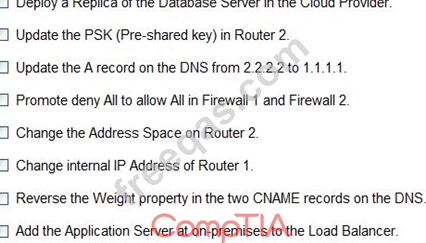
Only select a maximum of TWO options from the multiple choice question
Correct Answer:
See explanation below
Explanation:
Part 1: Router 2
The problematic device is Router 2, which has an incorrect configuration for the IPSec tunnel. The IPSec tunnel is a secure connection between the on-premises datacenter and the cloud provider, which allows the traffic to flow between the two networks. The IPSec tunnel requires both endpoints to have matching parameters, such as the IP addresses, the pre-shared key (PSK), the encryption and authentication algorithms, and the security associations (SAs) .
According to the network diagram and the configuration files, Router 2 has a different PSK and a different address space than Router 1. Router 2 has a PSK of "1234567890", while Router 1 has a PSK of "0987654321". Router 2 has an address space of 10.0.0.0/8, while Router 1 has an address space of 192.168.0.0/16. These mismatches prevent the IPSec tunnel from establishing and encrypting the traffic between the two networks.
The other devices do not have any obvious errors in their configuration. The DNS provider has two CNAME records that point to the application servers in the cloud provider, with different weights to balance the load. The firewall rules allow the traffic from and to the application servers on port 80 and port 443, as well as the traffic from and to the VPN server on port 500 and port 4500. The orchestration server has a script that installs and configures the application servers in the cloud provider, using the DHCP server to assign IP addresses.
Part 2:
The correct options to provide adequate configuration for hybrid cloud architecture are:
Update the PSK in Router 2.
Change the address space on Router 2.
These options will fix the IPSec tunnel configuration and allow the traffic to flow between the on-premises datacenter and the cloud provider. The PSK should match the one on Router 1, which is "0987654321". The address space should also match the one on Router 1, which is 192.168.0.0/16.
B) Update the PSK (Pre-shared key in Router2)
E) Change the Address Space on Router2
insert code
  • ««
  • «
  • …
  • 83
  • 84
  • 85
  • 86
  • 87
  • 88
  • 89
  • 90
  • 91
  • 92
  • …
  • »
  • »»
[×]

Download PDF File

Enter your email address to download CompTIA.CV0-003.v2025-12-17.q480 Dumps

Email:

FreeQAs

Our website provides the Largest and the most Latest vendors Certification Exam materials around the world.

Using dumps we provide to Pass the Exam, we has the Valid Dumps with passing guranteed just which you need.

  • DMCA
  • About
  • Contact Us
  • Privacy Policy
  • Terms & Conditions
©2026 FreeQAs

www.freeqas.com materials do not contain actual questions and answers from Cisco's certification exams.
