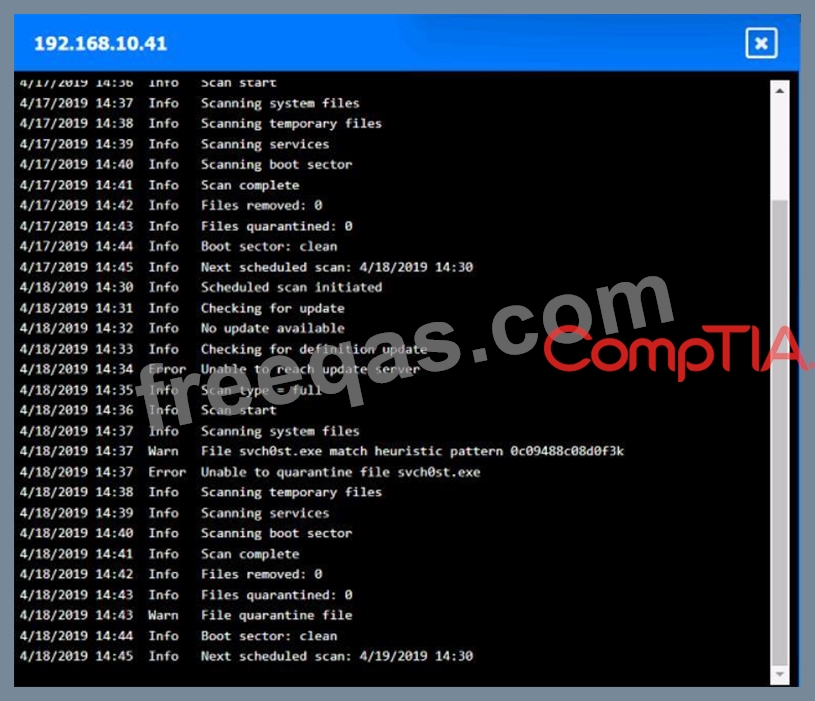
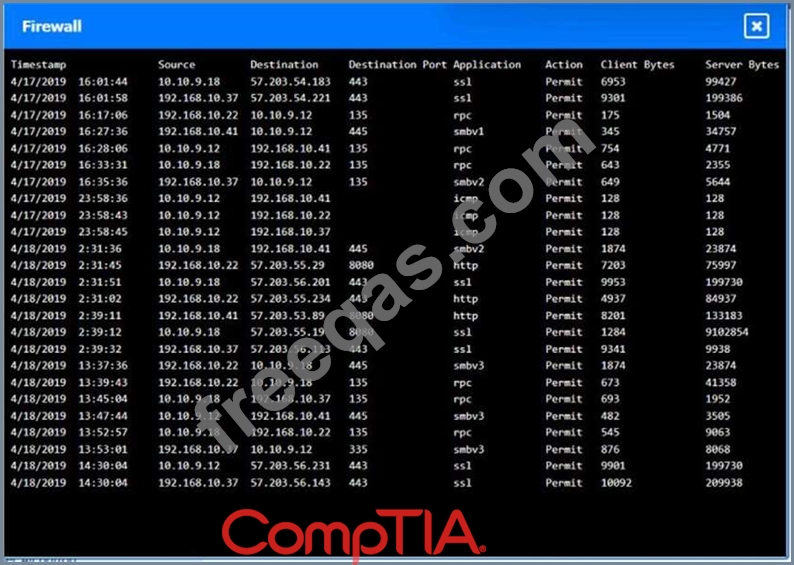
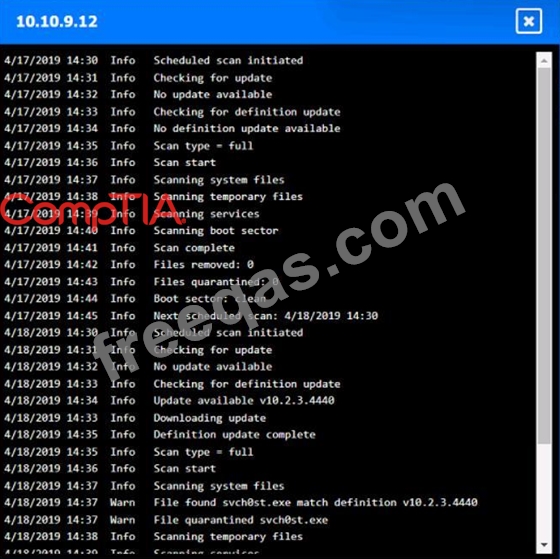
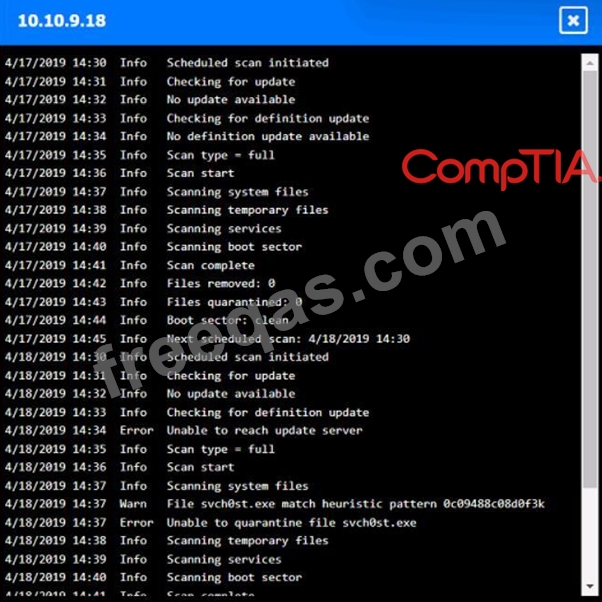
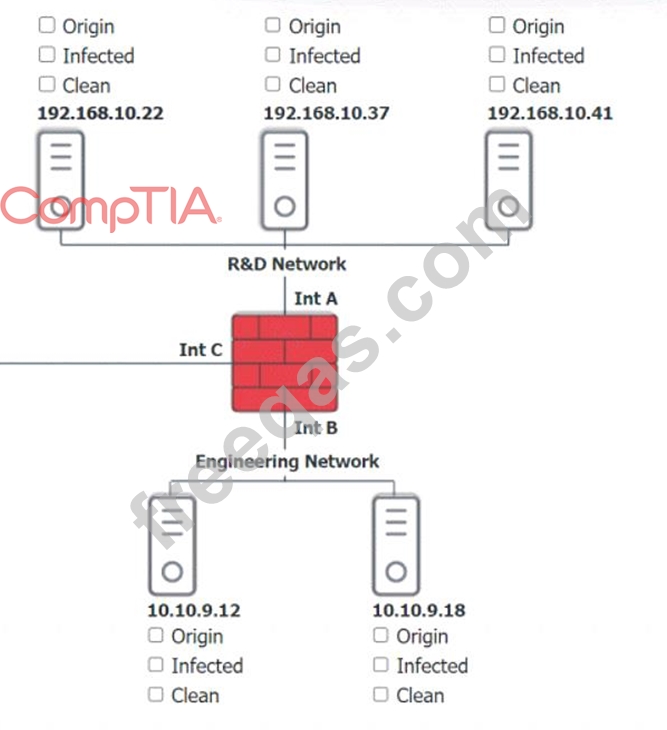
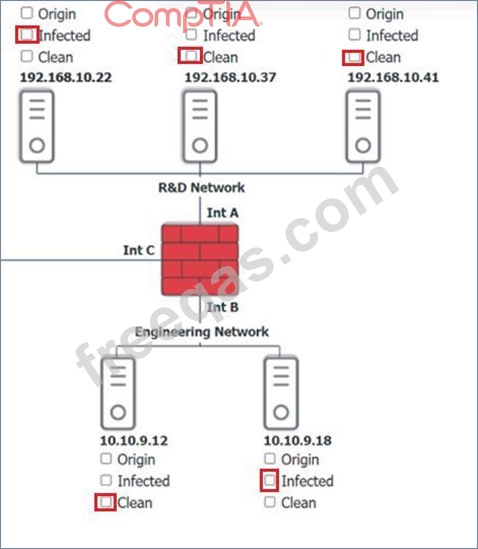
You are security administrator investigating a potential infection on a network. Click on each host and firewall. Review all logs to determine which host originated the Infecton and then deny each remaining hosts clean or infected.
Correct Answer:
Explanation Based on the logs, it seems that the host that originated the infection is 192.168.10.22. This host has a suspicious process named svchost.exe running on port 443, which is unusual for a Windows service. It also has a large number of outbound connections to different IP addresses on port 443, indicating that it is part of a botnet. The firewall log shows that this host has been communicating with 10.10.9.18, which is another infected host on the engineering network. This host also has a suspicious process named svchost.exe running on port 443, and a large number of outbound connections to different IP addresses on port 443. The other hosts on the R&D network (192.168.10.37 and 192.168.10.41) are clean, as they do not have any suspicious processes or connections.
Question 37
A security administrator is deploying a DLP solution to prevent the exfiltration of sensitive customer data. Which of the following should the administrator do first?
Correct Answer: C
Explanation Data classification is the process of assigning labels or tags to data based on its sensitivity, value, and risk. Data classification is the first step in a data loss prevention (DLP) solution, as it helps to identify what data needs to be protected and how. By applying classifications to the data, the security administrator can define appropriate policies and rules for the DLP solution to prevent the exfiltration of sensitive customer data. References: CompTIA Security+ Study Guide: Exam SY0-701, 9th Edition, Chapter 8: Data Protection, page 323. CompTIA Security+ Practice Tests: Exam SY0-701, 3rd Edition, Chapter 8: Data Protection, page 327.
Question 38
Which of the following is used to validate a certificate when it is presented to a user?
Correct Answer: A
Explanation OCSP stands for Online Certificate Status Protocol. It is a protocol that allows applications to check the revocation status of a certificate in real-time. It works by sending a query to an OCSP responder, which is a server that maintains a database of revoked certificates. The OCSP responder returns a response that indicates whether the certificate is valid, revoked, or unknown. OCSP is faster and more efficient than downloading and parsing Certificate Revocation Lists (CRLs), which are large files that contain the serial numbers of all revoked certificates issued by a Certificate Authority (CA). References: CompTIA Security+ Study Guide: Exam SY0-701, 9th Edition, page 337 1
Question 39
A company decided to reduce the cost of its annual cyber insurance policy by removing the coverage for ransomware attacks. Which of the following analysis elements did the company most likely use in making this decision?
Correct Answer: C
Explanation ARO (Annualized Rate of Occurrence) is an analysis element that measures the frequency or likelihood of an event happening in a given year. ARO is often used in risk assessment and management, as it helps to estimate the potential loss or impact of an event. A company can use ARO to calculate the annualized loss expectancy (ALE) of an event, which is the product of ARO and the single loss expectancy (SLE). ALE represents the expected cost of an event per year, and can be used to compare with the cost of implementing a security control or purchasing an insurance policy. The company most likely used ARO in making the decision to remove the coverage for ransomware attacks from its cyber insurance policy. The company may have estimated the ARO of ransomware attacks based on historical data, industry trends, or threat intelligence, and found that the ARO was low or negligible. The company may have also calculated the ALE of ransomware attacks, and found that the ALE was lower than the cost of the insurance policy. Therefore, the company decided to reduce the cost of its annual cyber insurance policy by removing the coverage for ransomware attacks, as it deemed the risk to be acceptable or manageable. IMTTR (Incident Management Team Training and Readiness), RTO (Recovery Time Objective), and MTBF (Mean Time Between Failures) are not analysis elements that the company most likely used in making the decision to remove the coverage for ransomware attacks from its cyber insurance policy. IMTTR is a process of preparing and training the incident management team to respond effectively to security incidents. IMTTR does not measure the frequency or impact of an event, but rather the capability and readiness of the team. RTO is a metric that defines the maximum acceptable time for restoring a system or service after a disruption. RTO does not measure the frequency or impact of an event, but rather the availability and continuity of the system or service. MTBF is a metric that measures the average time between failures of a system or component. MTBF does not measure the frequency or impact of an event, but rather the reliability and performance of the system or component. References = CompTIA Security+ SY0-701 Certification Study Guide, page 97-98; Professor Messer's CompTIA SY0-701 Security+ Training Course, video 5.2 - Risk Management, 0:00 - 3:00.
Question 40
A company's end users are reporting that they are unable to reach external websites. After reviewing the performance data for the DNS severs, the analyst discovers that the CPU, disk, and memory usage are minimal, but the network interface is flooded with inbound traffic. Network logs show only a small number of DNS queries sent to this server. Which of the following best describes what the security analyst is seeing?
Correct Answer: D
A reflected denial of service (RDoS) attack is a type of DDoS attack that uses spoofed source IP addresses to send requests to a third-party server, which then sends responses to the victim server. The attacker exploits the difference in size between the request and the response, which can amplify the amount of traffic sent to the victim server. The attacker also hides their identity by using the victim's IP address as the source. A RDoS attack can target DNS servers by sending forged DNS queries that generate large DNS responses. This can flood the network interface of the DNS server and prevent it from serving legitimate requests from end users. Reference: CompTIA Security+ Study Guide: Exam SY0-701, 9th Edition, page 215-216 1