FreeQAs
 Request Exam  Contact
  • Home
  • View All Exams
  • New QA's
  • Upload
PRACTICE EXAMS:
  • Oracle
  • Fortinet
  • Juniper
  • Microsoft
  • Cisco
  • Citrix
  • CompTIA
  • VMware
  • ISC
  • SAP
  • EMC
  • PMI
  • HP
  • Salesforce
  • Other
  • Oracle
    Oracle
  • Fortinet
    Fortinet
  • Juniper
    Juniper
  • Microsoft
    Microsoft
  • Cisco
    Cisco
  • Citrix
    Citrix
  • CompTIA
    CompTIA
  • VMware
    VMware
  • ISC
    ISC
  • SAP
    SAP
  • EMC
    EMC
  • PMI
    PMI
  • HP
    HP
  • Salesforce
    Salesforce
  1. Home
  2. CompTIA Certification
  3. XK0-005 Exam
  4. CompTIA.XK0-005.v2024-03-22.q272 Dumps
  • ««
  • «
  • …
  • 7
  • 8
  • 9
  • 10
  • 11
  • 12
  • 13
  • 14
  • 15
  • 16
  • …
  • »
  • »»
Download Now

Question 51

A Linux administrator would like to use systemd to schedule a job to run every two hours. The administrator creates timer and service definitions and restarts the server to load these new configurations. After the restart, the administrator checks the log file and notices that the job is only running daily. Which of the following is MOST likely causing the issue?

Correct Answer: D
insert code

Question 52

Due to low disk space, a Linux administrator finding and removing all log files that were modified more than 180 days ago. Which of the following commands will accomplish this task?

Correct Answer: C
The command that will accomplish the task of finding and removing all log files that were modified more than 180 days ago is find /var/log -type f -mtime +180 -exec rm {} ;. This command will use find to search for files (-type f) under /var/log directory that have a modification time (-mtime) older than 180 days (+180). For each matching file, it will execute (-exec) the rm command to delete it, passing the file name as an argument ({}). The command will end with a semicolon (;), which is escaped with a backslash to prevent shell interpretation.
The other options are not correct commands for accomplishing the task. The find /var/log -type d -mtime +180 -print -exec rm {} ; command will search for directories (-type d) instead of files, and print their names (-print) before deleting them. This is not what the task requires. The find /var/log -type f -modified +180 -rm command is invalid because there is no such option as -modified or -rm for find. The correct options are -mtime and -delete, respectively. The find /var/log -type c -atime +180 -remove command is also invalid because there is no such option as -remove for find. Moreover, it will search for character special files (-type c) instead of regular files, and use access time (-atime) instead of modification time. Reference: find(1) - Linux manual page; Find and delete files older than n days in Linux
insert code

Question 53

A Linux systems administrator receives reports from various users that an application hosted on a server has stopped responding at similar times for several days in a row. The administrator logs in to the system and obtains the following output:
Output 1:

Output 2:

Output 3:

Which of the following should the administrator do to provide the BEST solution for the reported issue?

Correct Answer: D
Explanation
Based on the output of the image sent by the user, the system requires more swap space to allow for spikes in usage during peak hours and prevent the Java process from stopping due to a lack of memory. The output shows that there is only 0 MB of swap space available on the system, which means that there is no room for swapping out memory pages when physical memory is full or low. The output also shows that there is only
793 MB of available memory on the system, which may not be enough to handle high-demand applications such as Java. This may cause Java to stop working due to insufficient memory or trigger an OutOfMemoryError exception. Configuring more swap space on the system would help to alleviate this issue by providing more virtual memory for applications and improving performance. Configuring memory allocation policies during business hours will not help to solve this issue, as it will not increase the amount of available memory or swap space on the system. Configuring a different nice value for Java process will not help to solve this issue, as it will only affect its scheduling priority, not its memory consumption or allocation.
Configuring more CPU cores will not help to solve this issue, as it will only increase processing power, not memory capacity or availability. References: CompTIA Linux+ (XK0-005) Certification Study Guide, Chapter
15: Managing Memory and Process Execution, page 468.
insert code

Question 54

A user is asking the systems administrator for assistance with writing a script to verify whether a file exists. Given the following:
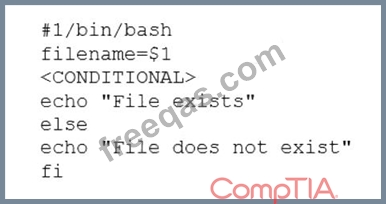
Which of the following commands should replace the <CONDITIONAL> string?

Correct Answer: A
The command if [ -f "$filename" ]; then checks if the variable $filename refers to a regular file that exists. The -f option is used to test for files. If the condition is true, the commands after then are executed. This is the correct way to replace the <CONDITIONAL> string. The other options are incorrect because they either use the wrong option (-d tests for directories), the wrong syntax (missing a semicolon after the condition), or the wrong keyword (while is used for loops, not conditions). Reference: CompTIA Linux+ (XK0-005) Certification Study Guide, Chapter 16: Writing and Executing Bash Shell Scripts, page 493.
insert code

Question 55

A junior administrator is trying to set up a passwordless SSH connection to one of the servers. The administrator follows the instructions and puts the key in the authorized_key file at the server, but the administrator is still asked to provide a password during the connection.
Given the following output:

Which of the following commands would resolve the issue and allow an SSH connection to be established without a password?


Correct Answer: B
Explanation
The command mv .ssh/authorized_key .ssh/authorized_keys will resolve the issue and allow an SSH connection to be established without a password. The issue is caused by the incorrect file name of the authorized key file on the server. The file should be named authorized_keys, not authorized_key.
The mv command will rename the file and fix the issue. The other options are incorrect because they either do not affect the file name (restorecon or chmod) or do not restart the SSH service (systemct1). References: CompTIA Linux+ (XK0-005) Certification Study Guide, Chapter 13: Managing Network Services, page 410.
insert code
  • ««
  • «
  • …
  • 7
  • 8
  • 9
  • 10
  • 11
  • 12
  • 13
  • 14
  • 15
  • 16
  • …
  • »
  • »»
[×]

Download PDF File

Enter your email address to download CompTIA.XK0-005.v2024-03-22.q272 Dumps

Email:

FreeQAs

Our website provides the Largest and the most Latest vendors Certification Exam materials around the world.

Using dumps we provide to Pass the Exam, we has the Valid Dumps with passing guranteed just which you need.

  • DMCA
  • About
  • Contact Us
  • Privacy Policy
  • Terms & Conditions
©2026 FreeQAs

www.freeqas.com materials do not contain actual questions and answers from Cisco's certification exams.