FreeQAs
 Request Exam  Contact
  • Home
  • View All Exams
  • New QA's
  • Upload
PRACTICE EXAMS:
  • Oracle
  • Fortinet
  • Juniper
  • Microsoft
  • Cisco
  • Citrix
  • CompTIA
  • VMware
  • ISC
  • SAP
  • EMC
  • PMI
  • HP
  • Salesforce
  • Other
  • Oracle
    Oracle
  • Fortinet
    Fortinet
  • Juniper
    Juniper
  • Microsoft
    Microsoft
  • Cisco
    Cisco
  • Citrix
    Citrix
  • CompTIA
    CompTIA
  • VMware
    VMware
  • ISC
    ISC
  • SAP
    SAP
  • EMC
    EMC
  • PMI
    PMI
  • HP
    HP
  • Salesforce
    Salesforce
  1. Home
  2. CompTIA Certification
  3. XK0-005 Exam
  4. CompTIA.XK0-005.v2024-03-22.q272 Dumps
  • ««
  • «
  • …
  • 44
  • 45
  • 46
  • 47
  • 48
  • 49
  • 50
  • 51
  • 52
  • 53
  • …
  • »
  • »»
Download Now

Question 236

An administrator attempts to rename a file on a server but receives the following error.

The administrator then runs a few commands and obtains the following output:

Which of the following commands should the administrator run NEXT to allow the file to be renamed by any user?

Correct Answer: D
Explanation
The command that the administrator should run NEXT to allow the file to be renamed by any user is chmod -t files. This command uses the chmod tool, which is used to change file permissions and access modes. The -t option removes (or sets) the sticky bit on a directory, which restricts deletion or renaming of files within that directory to only their owners or root. In this case, since files is a directory with sticky bit set (indicated by t in drwxrwxrwt), removing it will allow any user to rename or delete files within that directory.
The other options are not correct commands for allowing any user to rename files within files directory. The chgrp reet files command will change the group ownership of files directory to reet, but it will not affect its permissions or access modes. The chacl -R 644 files command is invalid, as chacl is used to change file access control lists (ACLs), not permissions or access modes. The chown users files command will change the user ownership of files directory to users, but it will not affect its permissions or access modes. References: CompTIA Linux+ (XK0-005) Certification Study Guide, Chapter 8: Managing Users and Groups; chmod(1) - Linux manual page
insert code

Question 237

A developer has been unable to remove a particular data folder that a team no longer uses. The developer escalated the issue to the systems administrator. The following output was received:
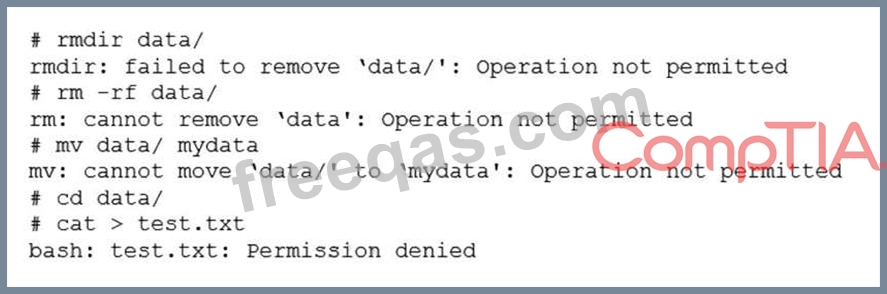
Which of the following commands can be used to resolve this issue?

Correct Answer: C
The command that can be used to resolve the issue of being unable to remove a particular data folder is chattr -R -i data/. This command will use the chattr utility to change file attributes on a Linux file system. The -R option means that chattr will recursively change attributes of directories and their contents. The -i option means that chattr will remove (unset) the immutable attribute from files or directories. When a file or directory has the immutable attribute set, it cannot be modified, deleted, or renamed.
The other options are not correct commands for resolving this issue. The chgrp -R 755 data/ command will change the group ownership of data/ and its contents recursively to 755, which is not a valid group name. The chgrp command is used to change group ownership of files or directories. The chmod -R 777 data/ command will change the file mode bits of data/ and its contents recursively to 777, which means that everyone can read, write, and execute them. However, this will not remove the immutable attribute, which prevents deletion or modification regardless of permissions. The chmod command is used to change file mode bits of files or directories. The chown -R data/ command is incomplete and will produce an error. The chown command is used to change the user and/or group ownership of files or directories, but it requires at least one argument besides the file name. Reference: CompTIA Linux+ (XK0-005) Certification Study Guide, Chapter 7: Managing Disk Storage; chattr(1) - Linux manual page; chgrp(1) - Linux manual page; chmod(1) - Linux manual page; chown(1) - Linux manual page
insert code

Question 238

After listing the properties of a system account, a systems administrator wants to remove the expiration date of a user account. Which of the following commands will accomplish this task?

Correct Answer: D
Explanation
The command chage -E -1 accountname will accomplish the task of removing the expiration date of a user account. The chage command is a tool for changing user password aging information on Linux systems.
The -E option sets the expiration date of the user account, and the -1 value means that the account will never expire. The command chage -E -1 accountname will remove the expiration date of the user account named accountname. This is the correct command to use to accomplish the task. The other options are incorrect because they either do not affect the expiration date (chgrp, passwd, or chmod) or do not exist (chmod
-G). References: CompTIA Linux+ (XK0-005) Certification Study Guide, Chapter 15: Managing Users and Groups, page 467.
insert code

Question 239

A Linux administrator is troubleshooting a systemd mount unit file that is not working correctly. The file contains:
[root@system] # cat mydocs.mount
[Unit]
Description=Mount point for My Documents drive
[Mount]
What=/dev/drv/disk/by-uuid/94afc9b2-ac34-ccff-88ae-297ab3c7ff34
Where=/home/user1/My Documents
Options=defaults
Type=xfs
[Install]
WantedBy=multi-user.target
The administrator verifies the drive UUID correct, and user1 confirms the drive should be mounted as My Documents in the home directory. Which of the following can the administrator do to fix the issues with mounting the drive? (Select two).

Correct Answer: A,E
Explanation
The mount unit file name and the Where entry must be escaped to handle spaces in the path.ReferencesThe mount unit file name must be named after the mount point directory, with spaces replaced by \x20. See How to escape spaces in systemd unit files? and systemd.mount.The Where entry must use \x20 to escape spaces in the path. See systemd.mount and The workaround is to use /usr/bin/env followed by the path in quotes..
insert code

Question 240

A systems administrator received a notification that a system is performing slowly. When running the top command, the systems administrator can see the following values:

Which of the following commands will the administrator most likely run NEXT?

Correct Answer: A
The command vmstat will most likely be run next by the administrator to troubleshoot the system performance. The vmstat command is a tool for reporting virtual memory statistics on Linux systems. The command shows information about processes, memory, paging, block IO, interrupts, and CPU activity. The command can help the administrator identify the source of the performance issue, such as high CPU usage, low free memory, excessive swapping, or disk IO bottlenecks. The command can also be used with an interval and a count to display the statistics repeatedly over time and observe the changes. The command vmstat will provide useful information for diagnosing the system performance and finding the root cause of the issue. This is the most likely command to run next after the top command. The other options are incorrect because they either do not show the virtual memory statistics (strace or lsof) or do not provide more information than the top command (htop). Reference: CompTIA Linux+ (XK0-005) Certification Study Guide, Chapter 14: Managing Processes and Scheduling Tasks, page 425.
insert code
  • ««
  • «
  • …
  • 44
  • 45
  • 46
  • 47
  • 48
  • 49
  • 50
  • 51
  • 52
  • 53
  • …
  • »
  • »»
[×]

Download PDF File

Enter your email address to download CompTIA.XK0-005.v2024-03-22.q272 Dumps

Email:

FreeQAs

Our website provides the Largest and the most Latest vendors Certification Exam materials around the world.

Using dumps we provide to Pass the Exam, we has the Valid Dumps with passing guranteed just which you need.

  • DMCA
  • About
  • Contact Us
  • Privacy Policy
  • Terms & Conditions
©2026 FreeQAs

www.freeqas.com materials do not contain actual questions and answers from Cisco's certification exams.
