FreeQAs
 Request Exam  Contact
  • Home
  • View All Exams
  • New QA's
  • Upload
PRACTICE EXAMS:
  • Oracle
  • Fortinet
  • Juniper
  • Microsoft
  • Cisco
  • Citrix
  • CompTIA
  • VMware
  • ISC
  • SAP
  • EMC
  • PMI
  • HP
  • Salesforce
  • Other
  • Oracle
    Oracle
  • Fortinet
    Fortinet
  • Juniper
    Juniper
  • Microsoft
    Microsoft
  • Cisco
    Cisco
  • Citrix
    Citrix
  • CompTIA
    CompTIA
  • VMware
    VMware
  • ISC
    ISC
  • SAP
    SAP
  • EMC
    EMC
  • PMI
    PMI
  • HP
    HP
  • Salesforce
    Salesforce
  1. Home
  2. Curam Software Certification
  3. CS0-003 Exam
  4. CuramSoftware.CS0-003.v2024-01-19.q203 Dumps
  • ««
  • «
  • …
  • 20
  • 21
  • 22
  • 23
  • 24
  • 25
  • 26
  • 27
  • 28
  • 29
  • …
  • »
  • »»
Download Now

Question 116

Which of the following is described as a method of enforcing a security policy between cloud customers and cloud services?

Correct Answer: A
Explanation
A CASB (Cloud Access Security Broker) is a security solution that acts as an intermediary between cloud users and cloud providers, and monitors and enforces security policies for cloud access and usage. A CASB can help organizations protect their data and applications in the cloud from unauthorized or malicious access, as well as comply with regulatory standards and best practices. A CASB can also provide visibility, control, and analytics for cloud activity, and identify and mitigate potential threats12 The other options are not correct. DMARC (Domain-based Message Authentication, Reporting and Conformance) is an email authentication protocol that helps email domain owners prevent spoofing and phishing attacks by verifying the sender's identity and instructing the receiver how to handle unauthenticated messages34 SIEM (Security Information and Event Management) is a security solution that collects, aggregates, and analyzes log data from various sources across an organization's network, such as applications, devices, servers, and users, and provides real-time alerts, dashboards, reports, and incident response capabilities to help security teams identify and mitigate cyberattacks56 PAM (Privileged Access Management) is a security solution that helps organizations manage and protect the access and permissions of users, accounts, processes, and systems that have elevated or administrative privileges. PAM can help prevent credential theft, data breaches, insider threats, and compliance violations by monitoring, detecting, and preventing unauthorized privileged access to critical resources78
insert code

Question 117

Which of the following best describes the goal of a disaster recovery exercise as preparation for possible incidents?

Correct Answer: A
The correct answer is A. To provide metrics and test continuity controls.
A disaster recovery exercise is a simulation or a test of the disaster recovery plan, which is a set of procedures and resources that are used to restore the normal operations of an organization after a disaster or a major incident. The goal of a disaster recovery exercise is to provide metrics and test continuity controls, which are the measures that ensure the availability and resilience of the critical systems and processes of an organization. A disaster recovery exercise can help evaluate the effectiveness, efficiency, and readiness of the disaster recovery plan, as well as identify and address any gaps or issues .
The other options are not the best descriptions of the goal of a disaster recovery exercise. Verifying the roles of the incident response team (B) is a goal of an incident response exercise, which is a simulation or a test of the incident response plan, which is a set of procedures and roles that are used to detect, contain, analyze, and remediate an incident. Providing recommendations for handling vulnerabilities is a goal of a vulnerability assessment, which is a process of identifying and prioritizing the weaknesses and risks in an organization's systems or network. Performing tests against implemented security controls (D) is a goal of a penetration test, which is an authorized and simulated attack on an organization's systems or network to evaluate their security posture and identify any vulnerabilities or misconfigurations.
insert code

Question 118

Which of the following entities should an incident manager work with to ensure correct processes are adhered to when communicating incident reporting to the general public, as a best practice? (Select two).

Correct Answer: C,E
An incident manager should work with the legal and public relations entities to ensure correct processes are adhered to when communicating incident reporting to the general public, as a best practice. The legal entity can provide guidance on the legal implications and obligations of disclosing the incident, such as compliance with data protection laws, contractual obligations, and liability issues. The public relations entity can help craft the appropriate message and tone for the public communication, as well as manage the reputation and image of the organization in the aftermath of the incident. These two entities can help the incident manager balance the need for transparency and accountability with the need for confidentiality and security12. Reference: Incident Communication Templates, Incident Management: Processes, Best Practices & Tools - Atlassian
insert code

Question 119

A security analyst obtained the following table of results from a recent vulnerability assessment that was conducted against a single web server in the environment:
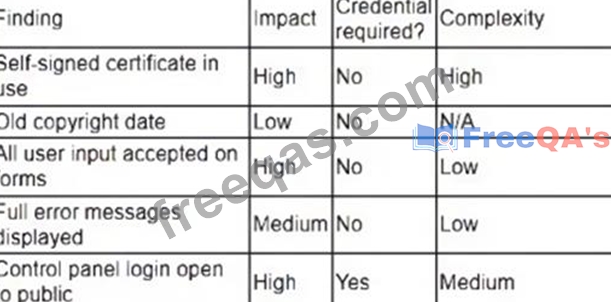
Which of the following should be completed first to remediate the findings?

Correct Answer: D
Explanation
The first action that should be completed to remediate the findings is to perform proper sanitization on all fields. Sanitization is a process that involves validating, filtering, or encoding any user input or data before processing or storing it on a system or application. Sanitization can help prevent various types of attacks, such as cross-site scripting (XSS), SQL injection, or command injection, that exploit unsanitized input or data to execute malicious scripts, commands, or queries on a system or application. Performing proper sanitization on all fields can help address the most critical and common vulnerability found during the vulnerability assessment, which is XSS.
insert code

Question 120

A security analyst noticed the following entry on a web server log:
Warning: fopen (http://127.0.0.1:16) : failed to open stream:
Connection refused in /hj/var/www/showimage.php on line 7
Which of the following malicious activities was most likely attempted?

Correct Answer: C
The malicious activity that was most likely attempted is SSRF (Server-Side Request Forgery). This is a type of attack that exploits a vulnerable web application to make requests to other resources on behalf of the web server. In this case, the attacker tried to use the fopen function to access the local loopback address (127.0.0.1) on port 16, which could be a service that is not intended to be exposed to the public. The connection was refused, indicating that the port was closed or filtered. Reference: CompTIA CySA+ Study Guide: Exam CS0-003, 3rd Edition, Chapter 2: Software and Application Security, page 66.
insert code
  • ««
  • «
  • …
  • 20
  • 21
  • 22
  • 23
  • 24
  • 25
  • 26
  • 27
  • 28
  • 29
  • …
  • »
  • »»
[×]

Download PDF File

Enter your email address to download CuramSoftware.CS0-003.v2024-01-19.q203 Dumps

Email:

FreeQAs

Our website provides the Largest and the most Latest vendors Certification Exam materials around the world.

Using dumps we provide to Pass the Exam, we has the Valid Dumps with passing guranteed just which you need.

  • DMCA
  • About
  • Contact Us
  • Privacy Policy
  • Terms & Conditions
©2026 FreeQAs

www.freeqas.com materials do not contain actual questions and answers from Cisco's certification exams.
