FreeQAs
 Request Exam  Contact
  • Home
  • View All Exams
  • New QA's
  • Upload
PRACTICE EXAMS:
  • Oracle
  • Fortinet
  • Juniper
  • Microsoft
  • Cisco
  • Citrix
  • CompTIA
  • VMware
  • ISC
  • SAP
  • EMC
  • PMI
  • HP
  • Salesforce
  • Other
  • Oracle
    Oracle
  • Fortinet
    Fortinet
  • Juniper
    Juniper
  • Microsoft
    Microsoft
  • Cisco
    Cisco
  • Citrix
    Citrix
  • CompTIA
    CompTIA
  • VMware
    VMware
  • ISC
    ISC
  • SAP
    SAP
  • EMC
    EMC
  • PMI
    PMI
  • HP
    HP
  • Salesforce
    Salesforce
  1. Home
  2. Databricks Certification
  3. Databricks-Certified-Professional-Data-Engineer Exam
  4. Databricks.Databricks-Certified-Professional-Data-Engineer.v2026-02-09.q161 Dumps
  • ««
  • «
  • …
  • 19
  • 20
  • 21
  • 22
  • 23
  • 24
  • 25
  • 26
  • 27
  • 28
  • …
  • »
  • »»
Download Now

Question 111

Which of the following array functions takes input column return unique list of values in an array?

Correct Answer: B
Explanation
Table Description automatically generated
insert code

Question 112

A platform engineer is creating catalogs and schemas for the development team to use.
The engineer has created an initial catalog, catalog_A, and initial schema, schema_A. The engineer has also granted USE CATALOG, USE SCHEMA, and CREATE TABLE to the development team so that the engineer can begin populating the schema with new tables.
Despite being owner of the catalog and schema, the engineer noticed that they do not have access to the underlying tables in Schema_A.
What explains the engineer's lack of access to the underlying tables?

Correct Answer: C
In Databricks, catalogs, schemas (or databases), and tables are managed through the Unity Catalog or Hive Metastore, depending on the environment. Permissions and ownership within these structures are governed by access control lists (ACLs).
* Catalog and Schema Ownership:When a platform engineer creates a catalog (such as catalog_A) and schema (such as schema_A), they automatically become the owner of those entities. This ownership gives them control over granting permissions for those entities (i.e., granting the USE CATALOG and USE SCHEMA privileges to others). However, ownership of the catalog or schema doesnot automaticallyextend to ownership or permission of individual tables within that schema.
* Table Permissions:For tables within a schema, the permission model is more granular. The table creator (i.e., whoever creates the table) is automatically assigned as the owner of that table. In this case, the platform engineer owns the schema but does not automatically inherit permissions to any table created within the schema unless explicitly granted by the table's owner or unless they grant permissions to themselves.
* Why the Engineer Lacks Access:The platform engineer notices that they do not have access to the underlying tables in schema_A despite being the owner of the schema. This occurs because the schema's ownership does not cascade to the tables. The engineer must either:
* Grant permissions to themselves for the tables in schema_A, or
* Be granted permissions by whoever created the tables within the schema.
* Resolution:As the owner of the schema, the platform engineer can easily grant themselves the required permissions (such as SELECT, INSERT, etc.) for the tables in the schema. This explains why the owner of a schema may not automatically have access to the tables and must take explicit steps to acquire those permissions.
References
* Databricks Unity Catalog Documentation: Manage Permissions
* [Databricks Permissions and Ownership](https://docs.databricks.com/security/access-control
/workspace-acl.html#permissions
insert code

Question 113

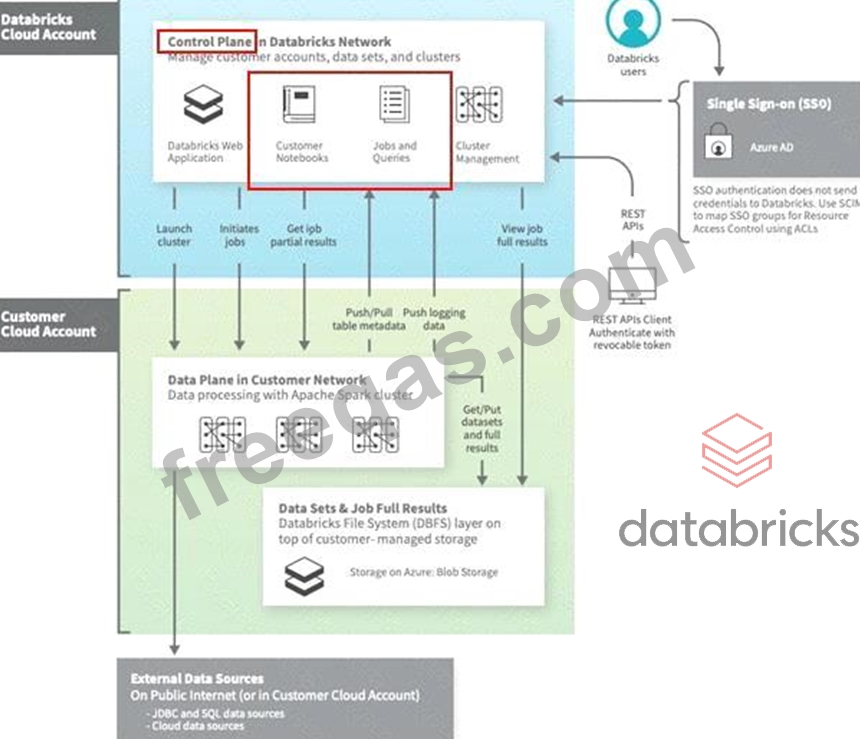
Which of the following locations in Databricks product architecture hosts jobs/pipelines and queries?
Correct Answer: B
Explanation
The answer is Control Plane,
Databricks operates most of its services out of a control plane and a data plane, please note serverless features like SQL Endpoint and DLT compute use shared compute in Control pane.
Control Plane: Stored in Databricks Cloud Account
*The control plane includes the backend services that Databricks manages in its own Azure account. Notebook commands and many other workspace configurations are stored in the control plane and encrypted at rest.
Data Plane: Stored in Customer Cloud Account
*The data plane is managed by your Azure account and is where your data resides. This is also where data is processed. You can use Azure Databricks connectors so that your clusters can connect to external data sources outside of your Azure account to ingest data or for storage.
Here is the product architecture diagram highlighted where
insert code

Question 114

A streaming video analytics team ingests billions of events daily into a Unity Catalog-managed Delta table video_events. Analysts run ad-hoc point-lookup queries on columns like user_id, campaign_id, and region. The team manually runs OPTIMIZE video_events ZORDER BY (user_id, campaign_id, region), but still sees poor performance on recent data and dislikes the operational overhead. The team wants a hands-off way to keep hot columns co-located as query patterns evolve.

Correct Answer: C
Comprehensive and Detailed Explanation From Exact Extract of Databricks Data Engineer Documents:
According to Databricks Delta Lake optimization documentation, Liquid Clustering is a next-generation file organization capability that automatically manages file co-location without requiring explicit partitioning or manual Z-ORDERing. When combined with Predictive Optimization, Databricks automatically maintains clustering across frequently filtered or queried columns, adapting dynamically as query workloads evolve.
This approach eliminates the need for manual maintenance (such as periodic OPTIMIZE or Z-ORDER commands) while improving query performance on large tables-particularly for high-ingest streaming workloads.
Delta caching (B) only improves performance for cached queries and does not address file layout issues, and (D) handles file size optimization but not clustering. Thus, C is the most efficient, modern, and low-maintenance solution recommended by Databricks.
insert code

Question 115

A table named user_ltv is being used to create a view that will be used by data analysis on various teams.
Users in the workspace are configured into groups, which are used for setting up data access using ACLs.
The user_ltv table has the following schema:

An analyze who is not a member of the auditing group executing the following query:

Which result will be returned by this query?

Correct Answer: A
Given the CASE statement in the view definition, the result set for a user not in the auditing group would be constrained by the ELSE condition, which filters out records based on age. Therefore, the view will return all columns normally for records with an age greater than 18, as users who are not in the auditing group will not satisfy the is_member('auditing') condition. Records not meeting the age > 18 condition will not be displayed.
insert code
  • ««
  • «
  • …
  • 19
  • 20
  • 21
  • 22
  • 23
  • 24
  • 25
  • 26
  • 27
  • 28
  • …
  • »
  • »»
[×]

Download PDF File

Enter your email address to download Databricks.Databricks-Certified-Professional-Data-Engineer.v2026-02-09.q161 Dumps


Email:

FreeQAs

Our website provides the Largest and the most Latest vendors Certification Exam materials around the world.

Using dumps we provide to Pass the Exam, we has the Valid Dumps with passing guranteed just which you need.

  • DMCA
  • About
  • Contact Us
  • Privacy Policy
  • Terms & Conditions
©2026 FreeQAs

www.freeqas.com materials do not contain actual questions and answers from Cisco's certification exams.