FreeQAs
 Request Exam  Contact
  • Home
  • View All Exams
  • New QA's
  • Upload
PRACTICE EXAMS:
  • Oracle
  • Fortinet
  • Juniper
  • Microsoft
  • Cisco
  • Citrix
  • CompTIA
  • VMware
  • SAP
  • EMC
  • PMI
  • HP
  • Salesforce
  • Other
  • Oracle
    Oracle
  • Fortinet
    Fortinet
  • Juniper
    Juniper
  • Microsoft
    Microsoft
  • Cisco
    Cisco
  • Citrix
    Citrix
  • CompTIA
    CompTIA
  • VMware
    VMware
  • SAP
    SAP
  • EMC
    EMC
  • PMI
    PMI
  • HP
    HP
  • Salesforce
    Salesforce
  1. Home
  2. Databricks Certification
  3. Databricks-Machine-Learning-Associate Exam
  4. Databricks.Databricks-Machine-Learning-Associate.v2025-12-03.q26 Dumps
  • «
  • 1
  • 2
  • 3
  • 4
  • 5
  • 6
  • 7
  • »
Download Now

Question 1

Which of the following hyperparameter optimization methods automatically makes informed selections of hyperparameter values based on previous trials for each iterative model evaluation?

Correct Answer: C
Tree of Parzen Estimators (TPE) is a sequential model-based optimization algorithm that selects hyperparameter values based on the outcomes of previous trials. It models the probability density of good and bad hyperparameter values and makes informed decisions about which hyperparameters to try next.
This approach contrasts with methods like random search and grid search, which do not use information from previous trials to guide the search process.
Reference:
Hyperopt and TPE
insert code

Question 2

Which of the following statements describes a Spark ML estimator?

Correct Answer: D
In the context of Spark MLlib, an estimator refers to an algorithm which can be "fit" on a DataFrame to produce a model (referred to as a Transformer), which can then be used to transform one DataFrame into another, typically adding predictions or model scores. This is a fundamental concept in machine learning pipelines in Spark, where the workflow includes fitting estimators to data to produce transformers.
Reference
Spark MLlib Documentation: https://spark.apache.org/docs/latest/ml-pipeline.html#estimators
insert code

Question 3

A machine learning engineer has identified the best run from an MLflow Experiment. They have stored the run ID in the run_id variable and identified the logged model name as "model". They now want to register that model in the MLflow Model Registry with the name "best_model".
Which lines of code can they use to register the model associated with run_id to the MLflow Model Registry?

Correct Answer: B
To register a model that has been identified by a specific run_id in the MLflow Model Registry, the appropriate line of code is:
mlflow.register_model(f"runs:/{run_id}/model", "best_model")
This code correctly specifies the path to the model within the run (runs:/{run_id}/model) and registers it under the name "best_model" in the Model Registry. This allows the model to be tracked, managed, and transitioned through different stages (e.g., Staging, Production) within the MLflow ecosystem.
Reference
MLflow documentation on model registry: https://www.mlflow.org/docs/latest/model-registry.html#registering-a-model
insert code

Question 4

A data scientist wants to tune a set of hyperparameters for a machine learning model. They have wrapped a Spark ML model in the objective function objective_function and they have defined the search space search_space.
As a result, they have the following code block:

Which of the following changes do they need to make to the above code block in order to accomplish the task?

Correct Answer: A
The SparkTrials() is used to distribute trials of hyperparameter tuning across a Spark cluster. If the environment does not support Spark or if the user prefers not to use distributed computing for this purpose, switching to Trials() would be appropriate. Trials() is the standard class for managing search trials in Hyperopt but does not distribute the computation. If the user is encountering issues with SparkTrials() possibly due to an unsupported configuration or an error in the cluster setup, using Trials() can be a suitable change for running the optimization locally or in a non-distributed manner.
Reference
Hyperopt documentation: http://hyperopt.github.io/hyperopt/
insert code

Question 5

A data scientist is working with a feature set with the following schema:
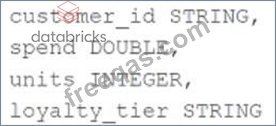
The customer_id column is the primary key in the feature set. Each of the columns in the feature set has missing values. They want to replace the missing values by imputing a common value for each feature.
Which of the following lists all of the columns in the feature set that need to be imputed using the most common value of the column?

Correct Answer: B
For the feature set schema provided, the columns that need to be imputed using the most common value (mode) are typically the categorical columns. In this case, loyalty_tier is the only categorical column that should be imputed using the most common value. customer_id is a unique identifier and should not be imputed, while spend and units are numerical columns that should typically be imputed using the mean or median values, not the mode.
Reference:
Databricks documentation on missing value imputation: Handling Missing Data If you need any further clarification or additional questions answered, please let me know!
insert code
  • «
  • 1
  • 2
  • 3
  • 4
  • 5
  • 6
  • 7
  • »
[×]

Download PDF File

Enter your email address to download Databricks.Databricks-Machine-Learning-Associate.v2025-12-03.q26 Dumps


Email:

FreeQAs

Our website provides the Largest and the most Latest vendors Certification Exam materials around the world.

Using dumps we provide to Pass the Exam, we has the Valid Dumps with passing guranteed just which you need.

  • DMCA
  • About
  • Contact Us
  • Privacy Policy
  • Terms & Conditions
©2025 FreeQAs

www.freeqas.com materials do not contain actual questions and answers from Cisco's certification exams.