Which approach is best for scoring large historical datasets?
A machine learning engineer wants to move their model version model_version for the MLflow Model Registry model model from the Staging stage to the Production stage using MLflow Client client. At the same time, they would like to archive any model versions that are already in the Production stage.
Which of the following code blocks can they use to accomplish the task?
A Machine Learning Engineer needs to digitize millions of historical documents spanning 200+ years with vastly different handwriting styles, fonts, languages, document conditions, and paper types. To do this, the engineer wants to train thousands of specialized OCR models to extract text. The number of documents vary significantly. They need an efficient approach for this parallel model training task. Which approach suits their needs?
A machine learning engineer has developed a model and registered it using the FeatureStoreClient fs. The model has model URI model_uri. The engineer now needs to perform batch inference on customer-level Spark DataFrame spark_df, but it is missing a few of the static features that were used when training the model. The customer_id column is the primary key of spark_df and the training set used when training and logging the model.
Which of the following code blocks can be used to compute predictions for spark_df when the missing feature values can be found in the Feature Store by searching for features by customer_id?
A Data Scientist is building a machine learning pipeline to classify raw text using a Logistic Regression model in Spark using Spark MLlib's Pipelines. This pipeline has three stages: the Tokenizer (to split the raw text in tokens), a HashingTF (to transform tokens into hashes) and the Logistic Regression itself (to perform the classification of texts). The Spark DataFrame with the training data is called trainingDF and the one with the test data is called testDF.
In order to do this, they use the following incomplete piece of code: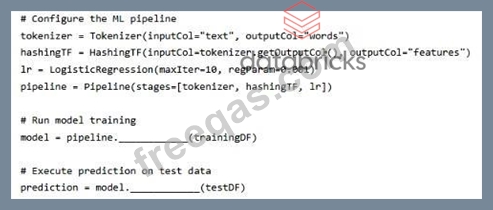
Which option correctly states:
(i) The complete command to run model training;
(ii) The complete command to execute the prediction on test data;
(iii) The object type of the model object returned by the model
training command.
Enter your email address to download Databricks.Databricks-Machine-Learning-Professional.v2026-10-08.q83 Dumps

