FreeQAs
 Request Exam  Contact
  • Home
  • View All Exams
  • New QA's
  • Upload
PRACTICE EXAMS:
  • Oracle
  • Fortinet
  • Juniper
  • Microsoft
  • Cisco
  • Citrix
  • CompTIA
  • VMware
  • ISC
  • SAP
  • EMC
  • PMI
  • HP
  • Salesforce
  • Other
  • Oracle
    Oracle
  • Fortinet
    Fortinet
  • Juniper
    Juniper
  • Microsoft
    Microsoft
  • Cisco
    Cisco
  • Citrix
    Citrix
  • CompTIA
    CompTIA
  • VMware
    VMware
  • ISC
    ISC
  • SAP
    SAP
  • EMC
    EMC
  • PMI
    PMI
  • HP
    HP
  • Salesforce
    Salesforce
  1. Home
  2. ECCouncil Certification
  3. 312-50v12 Exam
  4. ECCouncil.312-50v12.v2024-07-08.q287 Dumps
  • «
  • 1
  • 2
  • 3
  • 4
  • 5
  • 6
  • 7
  • 8
  • 9
  • 10
  • …
  • »
  • »»
Download Now

Question 11

What is the least important information when you analyze a public IP address in a security alert?

Correct Answer: A
insert code

Question 12

Which type of malware spreads from one system to another or from one network to another and causes similar types of damage as viruses do to the infected system?

Correct Answer: B
insert code

Question 13

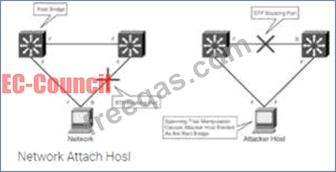
Robin, a professional hacker, targeted an organization's network to sniff all the traffic. During this process.
Robin plugged in a rogue switch to an unused port in the LAN with a priority lower than any other switch in the network so that he could make it a root bridge that will later allow him to sniff all the traffic in the network.
What is the attack performed by Robin in the above scenario?
Correct Answer: D
STP prevents bridging loops in a redundant switched network environment. By avoiding loops, you can ensure that broadcast traffic does not become a traffic storm.
STP is a hierarchical tree-like topology with a "root" switch at the top. A switch is elected as root based on the lowest configured priority of any switch (0 through 65,535). When a switch boots up, it begins a process of identifying other switches and determining the root bridge. After a root bridge is elected, the topology is established from its perspective of the connectivity. The switches determine the path to the root bridge, and all redundant paths are blocked. STP sends configuration and topology change notifications and acknowledgments (TCN/TCA) using bridge protocol data units (BPDU).
An STP attack involves an attacker spoofing the root bridge in the topology. The attacker broadcasts out an STP configuration/topology change BPDU in an attempt to force an STP recalculation. The BPDU sent out announces that the attacker's system has a lower bridge priority. The attacker can then see a variety of frames forwarded from other switches to it. STP recalculation may also cause a denial-of-service (DoS) condition on the network by causing an interruption of 30 to 45 seconds each time the root bridge changes. An attacker using STP network topology changes to force its host to be elected as the root bridge.
insert code

Question 14

Robin, an attacker, is attempting to bypass the firewalls of an organization through the DNS tunneling method in order to exfiltrate dat a. He is using the NSTX tool for bypassing the firewalls. On which of the following ports should Robin run the NSTX tool?

Correct Answer: A
DNS uses Ports 53 which is almost always open on systems, firewalls, and clients to transmit DNS queries. instead of the more familiar Transmission Control Protocol (TCP) these queries use User Datagram Protocol (UDP) due to its low-latency, bandwidth and resource usage compared TCP-equivalent queries. UDP has no error or flow-control capabilities, nor does it have any integrity checking to make sure the info arrived intact. How is internet use (browsing, apps, chat etc) so reliable then? If the UDP DNS query fails (it's a best-effort protocol after all) within the first instance, most systems will retry variety of times and only after multiple failures, potentially switch to TCP before trying again; TCP is additionally used if the DNS query exceeds the restrictions of the UDP datagram size - typically 512 bytes for DNS but can depend upon system settings. Figure 1 below illustrates the essential process of how DNS operates: the client sends a question string (for example, mail.google[.]com during this case) with a particular type - typically A for a number address. I've skipped the part whereby intermediate DNS systems may need to establish where '.com' exists, before checking out where 'google[.]com' are often found, and so on.

Many worms and scanners are created to seek out and exploit systems running telnet. Given these facts, it's really no surprise that telnet is usually seen on the highest Ten Target Ports list. Several of the vulnerabilities of telnet are fixed. They require only an upgrade to the foremost current version of the telnet Daemon or OS upgrade. As is usually the case, this upgrade has not been performed on variety of devices. this might flow from to the very fact that a lot of systems administrators and users don't fully understand the risks involved using telnet. Unfortunately, the sole solution for a few of telnets vulnerabilities is to completely discontinue its use. the well-liked method of mitigating all of telnets vulnerabilities is replacing it with alternate protocols like ssh. Ssh is capable of providing many of an equivalent functions as telnet and a number of other additional services typical handled by other protocols like FTP and Xwindows. Ssh does still have several drawbacks to beat before it can completely replace telnet. it's typically only supported on newer equipment. It requires processor and memory resources to perform the info encryption and decryption. It also requires greater bandwidth than telnet thanks to the encryption of the info . This paper was written to assist clarify how dangerous the utilization of telnet are often and to supply solutions to alleviate the main known threats so as to enhance the general security of the web Once a reputation is resolved to an IP caching also helps: the resolved name-to-IP is usually cached on the local system (and possibly on intermediate DNS servers) for a period of your time . Subsequent queries for an equivalent name from an equivalent client then don't leave the local system until said cache expires. Of course, once the IP address of the remote service is understood , applications can use that information to enable other TCP-based protocols, like HTTP, to try to to their actual work, for instance ensuring internet cat GIFs are often reliably shared together with your colleagues. So, beat all, a couple of dozen extra UDP DNS queries from an organization's network would be fairly inconspicuous and will leave a malicious payload to beacon bent an adversary; commands could even be received to the requesting application for processing with little difficulty.
insert code

Question 15

Techno Security Inc. recently hired John as a penetration tester. He was tasked with identifying open ports in the target network and determining whether the ports are online and any firewall rule sets are encountered.
John decided to perform a TCP SYN ping scan on the target network. Which of the following Nmap commands must John use to perform the TCP SYN ping scan?

Correct Answer: C
https://hub.packtpub.com/discovering-network-hosts-with-tcp-syn-and-tcp-ack-ping-scans-in-nmaptutorial/
insert code
  • «
  • 1
  • 2
  • 3
  • 4
  • 5
  • 6
  • 7
  • 8
  • 9
  • 10
  • …
  • »
  • »»
[×]

Download PDF File

Enter your email address to download ECCouncil.312-50v12.v2024-07-08.q287 Dumps

Email:

FreeQAs

Our website provides the Largest and the most Latest vendors Certification Exam materials around the world.

Using dumps we provide to Pass the Exam, we has the Valid Dumps with passing guranteed just which you need.

  • DMCA
  • About
  • Contact Us
  • Privacy Policy
  • Terms & Conditions
©2026 FreeQAs

www.freeqas.com materials do not contain actual questions and answers from Cisco's certification exams.
