FreeQAs
 Request Exam  Contact
  • Home
  • View All Exams
  • New QA's
  • Upload
PRACTICE EXAMS:
  • Oracle
  • Fortinet
  • Juniper
  • Microsoft
  • Cisco
  • Citrix
  • CompTIA
  • VMware
  • ISC
  • SAP
  • EMC
  • PMI
  • HP
  • Salesforce
  • Other
  • Oracle
    Oracle
  • Fortinet
    Fortinet
  • Juniper
    Juniper
  • Microsoft
    Microsoft
  • Cisco
    Cisco
  • Citrix
    Citrix
  • CompTIA
    CompTIA
  • VMware
    VMware
  • ISC
    ISC
  • SAP
    SAP
  • EMC
    EMC
  • PMI
    PMI
  • HP
    HP
  • Salesforce
    Salesforce
  1. Home
  2. ECCouncil Certification
  3. 312-50v12 Exam
  4. ECCouncil.312-50v12.v2025-07-31.q254 Dumps
  • ««
  • «
  • …
  • 21
  • 22
  • 23
  • 24
  • 25
  • 26
  • 27
  • 28
  • 29
  • 30
  • …
  • »
  • »»
Download Now

Question 121

Session splicing is an IDS evasion technique in which an attacker delivers data in multiple, small sized packets to the target computer, making it very difficult for an IDS to detect the attack signatures. Which tool can be used to perform session splicing attacks?

Correct Answer: D
Many IDS reassemble communication streams; hence, if a packet is not received within a reasonable period, many IDS stop reassembling and handling that stream. If the application under attack keeps a session active for a longer time than that spent by the IDS on reassembling it, the IDS will stop. As a result, any session after the IDS stops reassembling the sessions will be susceptible to malicious data theft by attackers. The IDS will not log any attack attempt after a successful splicing attack. Attackers can use tools such as Nessus for session splicing attacks.
Did you know that the EC-Council exam shows how well you know their official book? So, there is no
"Whisker" in it. In the chapter "Evading IDS" -> "Session Splicing", the recommended tool for performing a session-splicing attack is Nessus. Where Wisker came from is not entirely clear, but I will assume the author of the question found it while copying Wikipedia.
https://en.wikipedia.org/wiki/Intrusion_detection_system_evasion_techniques One basic technique is to split the attack payload into multiple small packets so that the IDS must reassemble the packet stream to detect the attack. A simple way of splitting packets is by fragmenting them, but an adversary can also simply craft packets with small payloads. The 'whisker' evasion tool calls crafting packets with small payloads 'session splicing'.
By itself, small packets will not evade any IDS that reassembles packet streams. However, small packets can be further modified in order to complicate reassembly and detection. One evasion technique is to pause between sending parts of the attack, hoping that the IDS will time out before the target computer does. A second evasion technique is to send the packets out of order, confusing simple packet re-assemblers but not the target computer.
NOTE: Yes, I found scraps of information about the tool that existed in 2012, but I can not give you unverified information. According to the official tutorials, the correct answer is Nessus, but if you know anything about Wisker, please write in the QA section. Maybe this question will be updated soon, but I'm not sure about that.
insert code

Question 122

You have gained physical access to a Windows 2008 R2 server which has an accessible disc drive. When you attempt to boot the server and log in, you are unable to guess the password. In your toolkit, you have an Ubuntu 9.10 Linux LiveCD. Which Linux-based tool can change any user's password or activate disabled Windows accounts?

Correct Answer: A
insert code

Question 123

John is investigating web-application firewall logs and observers that someone is attempting to inject the following:
char buff[10];
buff[>o] - 'a':
What type of attack is this?

Correct Answer: C
Buffer overflow this attack is an anomaly that happens when software writing data to a buffer overflows the buffer's capacity, leading to adjacent memory locations being overwritten. In other words, an excessive amount of information is being passed into a container that doesn't have enough space, which information finishes up replacing data in adjacent containers.Buffer overflows are often exploited by attackers with a goal of modifying a computer's memory so as to undermine or take hold of program execution.

What's a buffer?A buffer, or data buffer, is a neighborhood of physical memory storage wont to temporarily store data while it's being moved from one place to a different . These buffers typically sleep in RAM memory. Computers frequently use buffers to assist improve performance; latest hard drives cash in of buffering to efficiently access data, and lots of online services also use buffers. for instance , buffers are frequently utilized in online video streaming to stop interruption. When a video is streamed, the video player downloads and stores perhaps 20% of the video at a time during a buffer then streams from that buffer. This way, minor drops in connection speed or quick service disruptions won't affect the video stream performance.Buffers are designed to contain specific amounts of knowledge . Unless the program utilizing the buffer has built-in instructions to discard data when an excessive amount of is shipped to the buffer, the program will overwrite data in memory adjacent to the buffer.Buffer overflows are often exploited by attackers to corrupt software. Despite being well-understood, buffer overflow attacks are still a serious security problem that torment cyber-security teams. In 2014 a threat referred to as 'heartbleed' exposed many many users to attack due to a buffer overflow vulnerability in SSL software.
How do attackers exploit buffer overflows?An attacker can deliberately feed a carefully crafted input into a program which will cause the program to undertake and store that input during a buffer that isn't large enough, overwriting portions of memory connected to the buffer space. If the memory layout of the program is well-defined, the attacker can deliberately overwrite areas known to contain executable code. The attacker can then replace this code together with his own executable code, which may drastically change how the program is meant to figure .For example if the overwritten part in memory contains a pointer (an object that points to a different place in memory) the attacker's code could replace that code with another pointer that points to an exploit payload. this will transfer control of the entire program over to theattacker's code.
insert code

Question 124

After an audit, the auditors Inform you that there is a critical finding that you must tackle Immediately. You read the audit report, and the problem is the service running on port 389. Which service Is this and how can you tackle the problem?

Correct Answer: A
https://en.wikipedia.org/wiki/Lightweight_Directory_Access_Protocol
LDAP, the Lightweight Directory Access Protocol, is a mature, flexible, and well supported standards-based mechanism for interacting with directory servers. It's often used for authentication and storing information about users, groups, and applications, but an LDAP directory server is a fairly general-purpose data store and can be used in a wide variety of applications.
The LDAP protocol can deal in quite a bit of sensitive data: Active Directory usernames, login attempts, failed-login notifications, and more. If attackers get ahold of that data in flight, they might be able to compromise data like legitimate AD credentials and use it to poke around your network in search of valuable assets.
Encrypting LDAP traffic in flight across the network can help prevent credential theft and other malicious activity, but it's not a failsafe-and if traffic is encrypted, your own team might miss the signs of an attempted attack in progress.
While LDAP encryption isn't standard, there is a nonstandard version of LDAP called Secure LDAP, also known as "LDAPS" or "LDAP over SSL" (SSL, or Secure Socket Layer, being the now-deprecated ancestor of Transport Layer Security).
LDAPS uses its own distinct network port to connect clients and servers. The default port for LDAP is port 389, but LDAPS uses port 636 and establishes TLS/SSL upon connecting with a client.
insert code

Question 125

Robin, a professional hacker, targeted an organization's network to sniff all the traffic. During this process.
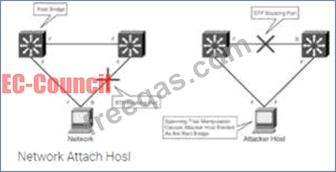
Robin plugged in a rogue switch to an unused port in the LAN with a priority lower than any other switch in the network so that he could make it a root bridge that will later allow him to sniff all the traffic in the network.
What is the attack performed by Robin in the above scenario?
Correct Answer: D
STP prevents bridging loops in a redundant switched network environment. By avoiding loops, you can ensure that broadcast traffic does not become a traffic storm.
STP is a hierarchical tree-like topology with a "root" switch at the top. A switch is elected as root based on the lowest configured priority of any switch (0 through 65,535). When a switch boots up, it begins a process of identifying other switches and determining the root bridge. After a root bridge is elected, the topology is established from its perspective of the connectivity. The switches determine the path to the root bridge, and all redundant paths are blocked. STP sends configuration and topology change notifications and acknowledgments (TCN/TCA) using bridge protocol data units (BPDU).
An STP attack involves an attacker spoofing the root bridge in the topology. The attacker broadcasts out an STP configuration/topology change BPDU in an attempt to force an STP recalculation. The BPDU sent out announces that the attacker's system has a lower bridge priority. The attacker can then see a variety of frames forwarded from other switches to it. STP recalculation may also cause a denial-of-service (DoS) condition on the network by causing an interruption of 30 to 45 seconds each time the root bridge changes. An attacker using STP network topology changes to force its host to be elected as the root bridge.
insert code
  • ««
  • «
  • …
  • 21
  • 22
  • 23
  • 24
  • 25
  • 26
  • 27
  • 28
  • 29
  • 30
  • …
  • »
  • »»
[×]

Download PDF File

Enter your email address to download ECCouncil.312-50v12.v2025-07-31.q254 Dumps

Email:

FreeQAs

Our website provides the Largest and the most Latest vendors Certification Exam materials around the world.

Using dumps we provide to Pass the Exam, we has the Valid Dumps with passing guranteed just which you need.

  • DMCA
  • About
  • Contact Us
  • Privacy Policy
  • Terms & Conditions
©2026 FreeQAs

www.freeqas.com materials do not contain actual questions and answers from Cisco's certification exams.
