Which command will identify the active LTM device currently handling client traffic?
-- Exhibit -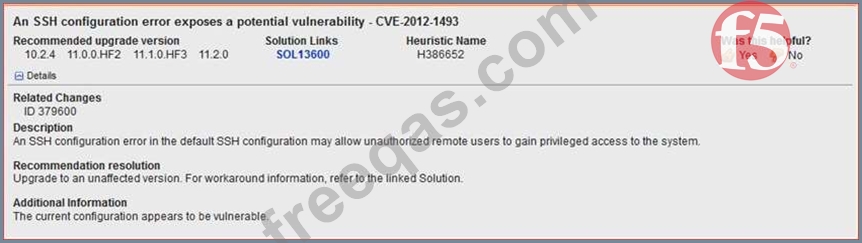
-- Exhibit --
Refer to the exhibit.
An LTM Specialist is working on an LTM 11.0.0 installation and has identified a security vulnerability as shown in the exhibit. The LTM Specialist is tasked with applying the latest available hotfix to resolve the problem.
Which procedure resolves the problem?
An HA pair of LTM devices configured in Active-Standby mode stops responding to traffic and causes an outage. The Active device becomes Standby, but the partner device stays in Standby mode instead of taking over as Active. A reboot and restart of the services brings the LTM device to Active mode for a short time, but then it goes into Standby mode again.
Which two configuration components caused this condition? (Choose two.)
-- Exhibit-
-- Exhibit -
Refer to the exhibit.
An LTM Specialist has created a virtual server to load balance traffic to a pool of HTTPS servers. The servers use client certificates for user authentication. The virtual server has clientssl, serverssl, and http profiles enabled. Clients are unable to connect to the application through the virtual server. Clients are able to connect to the application servers directly.
What is the root cause of the problem?
-- Exhibit -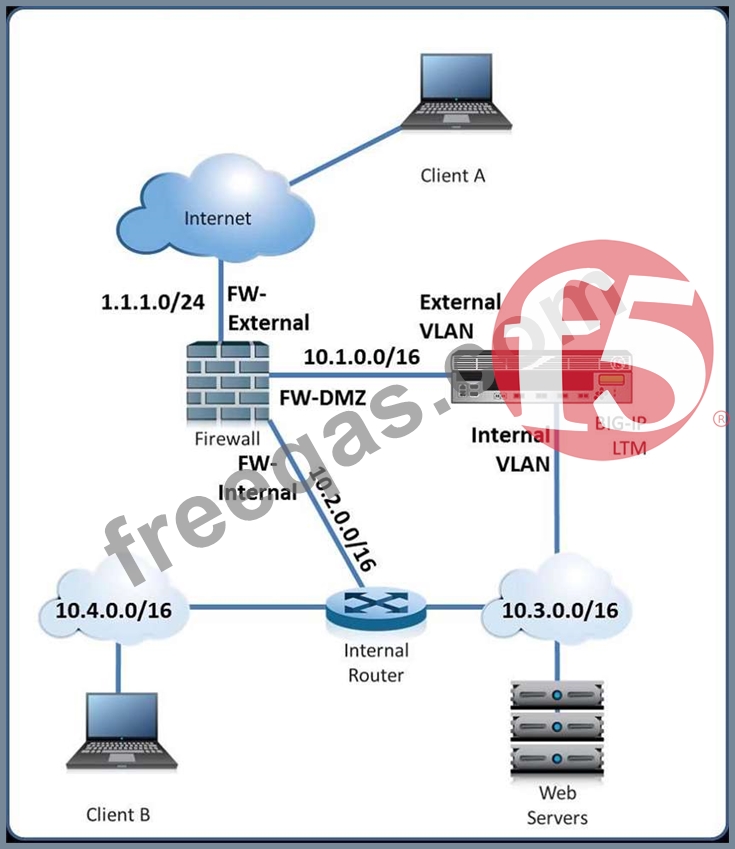
-- Exhibit --
Refer to the exhibit.
A layer 2 nPath routing configuration has been deployed. A packet capture contains a client connection packet with the following properties:
Source IP: <Virtual Server>
Destination IP: <Client A>
At which two locations could the packet capture have been taken? (Choose two.)

