FreeQAs
 Request Exam  Contact
  • Home
  • View All Exams
  • New QA's
  • Upload
PRACTICE EXAMS:
  • Oracle
  • Fortinet
  • IBM
  • Juniper
  • Microsoft
  • Cisco
  • Citrix
  • CompTIA
  • VMware
  • ISC
  • SAP
  • EMC
  • PMI
  • HP
  • Salesforce
  • Other
  • Oracle
    Oracle
  • Fortinet
    Fortinet
  • IBM
    IBM
  • Juniper
    Juniper
  • Microsoft
    Microsoft
  • Cisco
    Cisco
  • Citrix
    Citrix
  • CompTIA
    CompTIA
  • VMware
    VMware
  • ISC
    ISC
  • SAP
    SAP
  • EMC
    EMC
  • PMI
    PMI
  • HP
    HP
  • Salesforce
    Salesforce
  1. Home
  2. Fortinet Certification
  3. FCSS_SOC_AN-7.4 Exam
  4. Fortinet.FCSS_SOC_AN-7.4.v2026-03-14.q42 Dumps
  • «
  • 1
  • 2
  • 3
  • 4
  • 5
  • 6
  • 7
  • 8
  • 9
  • 10
  • »
Download Now

Question 21

Review the following incident report.

Which two MITRE ATT&CK tactics are captured in this report? (Choose two.)

Correct Answer: A,D
insert code

Question 22

How do event handlers improve the efficiency of SOC operations?

Correct Answer: A
insert code

Question 23

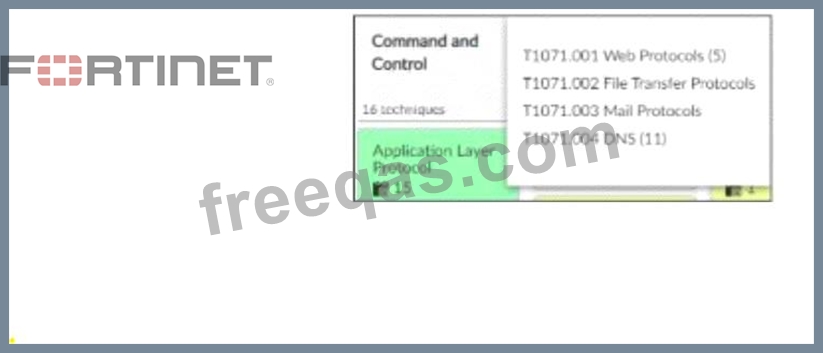
Refer to the exhibit,

which shows the partial output of the MITRE ATT&CK Enterprise matrix on FortiAnalyzer.
Which two statements are true? (Choose two.)

Correct Answer: B,C
* Understanding the MITRE ATT&CK Matrix:
* The MITRE ATT&CK framework is a knowledge base of adversary tactics and techniques based on real-world observations.
* Each tactic in the matrix represents the "why" of an attack technique, while each technique represents "how" an adversary achieves a tactic.
* Analyzing the Provided Exhibit:
* The exhibit shows part of the MITRE ATT&CK Enterprise matrix as displayed on FortiAnalyzer.
* The focus is on technique T1071 (Application Layer Protocol), which has subtechniques labeled T1071.001, T1071.002, T1071.003, and T1071.004.
* Each subtechnique specifies a different type of application layer protocol used for Command and
* Control (C2):
* T1071.001 Web Protocols
* T1071.002 File Transfer Protocols
* T1071.003 Mail Protocols
* T1071.004 DNS
* Identifying Key Points:
* Subtechniques under T1071:There are four subtechniques listed under the primary technique T1071, confirming that statement B is true.
* Event Handlers for T1071:FortiAnalyzer includes event handlers for monitoring various tactics and techniques. The presence of event handlers for tactic T1071 suggests active monitoring and alerting for these specific subtechniques, confirming that statement C is true.
* Misconceptions Clarified:
* Statement A (four techniques under tactic T1071) is incorrect because T1071 is a single technique with four subtechniques.
* Statement D (15 events associated with the tactic) is misleading. The number 15 refers to the techniques under the Application Layer Protocol, not directly related to the number of events.
Conclusion:
* The accurate interpretation of the exhibit confirms that there are four subtechniques under technique T1071 and that there are event handlers covering tactic T1071.
References:
* MITRE ATT&CK Framework documentation.
* FortiAnalyzer Event Handling and MITRE ATT&CK Integration guides.
insert code

Question 24

Review the following incident report:
Attackers leveraged a phishing email campaign targeting your employees.
The email likely impersonated a trusted source, such as the IT department, and requested login credentials.
An unsuspecting employee clicked a malicious link in the email, leading to the download and execution of a Remote Access Trojan (RAT).
The RAT provided the attackers with remote access and a foothold in the compromised system.
Which two MITRE ATT&CK tactics does this incident report capture? (Choose two.)

Correct Answer: A,D
Understanding the MITRE ATT&CK Tactics:
The MITRE ATT&CK framework categorizes various tactics and techniques used by adversaries to achieve their objectives.
Tactics represent the objectives of an attack, while techniques represent how those objectives are achieved.
Analyzing the Incident Report:
Phishing Email Campaign: This tactic is commonly used for gaining initial access to a system. Malicious Link and RAT Download: Clicking a malicious link and downloading a RAT is indicative of establishing initial access.
Remote Access Trojan (RAT): Once installed, the RAT allows attackers to maintain access over an extended period, which is a persistence tactic.
Mapping to MITRE ATT&CK Tactics:
Initial Access:
This tactic covers techniques used to gain an initial foothold within a network.
Techniques include phishing and exploiting external remote services.
The phishing campaign and malicious link click fit this category.
Persistence:
This tactic includes methods that adversaries use to maintain their foothold.
Techniques include installing malware that can survive reboots and persist on the system.
The RAT provides persistent remote access, fitting this tactic.
Exclusions:
Defense Evasion:
This involves techniques to avoid detection and evade defenses.
While potentially relevant in a broader context, the incident report does not specifically describe actions taken to evade defenses.
Lateral Movement:
This involves moving through the network to other systems.
The report does not indicate actions beyond initial access and maintaining that access.
Conclusion:
The incident report captures the tactics of Initial Access and Persistence.
Reference: MITRE ATT&CK Framework documentation on Initial Access and Persistence tactics.
Incident analysis and mapping to MITRE ATT&CK tactics.
insert code

Question 25

Refer to the exhibits.


The Quarantine Endpoint by EMS playbook execution failed.
What can you conclude from reviewing the playbook tasks and raw logs?

Correct Answer: A
insert code
  • «
  • 1
  • 2
  • 3
  • 4
  • 5
  • 6
  • 7
  • 8
  • 9
  • 10
  • »
[×]

Download PDF File

Enter your email address to download Fortinet.FCSS_SOC_AN-7.4.v2026-03-14.q42 Dumps

Email:

FreeQAs

Our website provides the Largest and the most Latest vendors Certification Exam materials around the world.

Using dumps we provide to Pass the Exam, we has the Valid Dumps with passing guranteed just which you need.

  • DMCA
  • About
  • Contact Us
  • Privacy Policy
  • Terms & Conditions
©2026 FreeQAs

www.freeqas.com materials do not contain actual questions and answers from Cisco's certification exams.