FreeQAs
 Request Exam  Contact
  • Home
  • View All Exams
  • New QA's
  • Upload
PRACTICE EXAMS:
  • Oracle
  • Fortinet
  • Juniper
  • Microsoft
  • Cisco
  • Citrix
  • CompTIA
  • VMware
  • SAP
  • EMC
  • PMI
  • HP
  • Salesforce
  • Other
  • Oracle
    Oracle
  • Fortinet
    Fortinet
  • Juniper
    Juniper
  • Microsoft
    Microsoft
  • Cisco
    Cisco
  • Citrix
    Citrix
  • CompTIA
    CompTIA
  • VMware
    VMware
  • SAP
    SAP
  • EMC
    EMC
  • PMI
    PMI
  • HP
    HP
  • Salesforce
    Salesforce
  1. Home
  2. GAQM Certification
  3. Databricks-Certified-Data-Engineer-Associate Exam
  4. GAQM.Databricks-Certified-Data-Engineer-Associate.v2024-09-16.q91 Dumps
  • «
  • 1
  • 2
  • 3
  • 4
  • 5
  • 6
  • 7
  • 8
  • 9
  • 10
  • …
  • »
  • »»
Download Now

Question 6

A data engineer is using the following code block as part of a batch ingestion pipeline to read from a composable table:
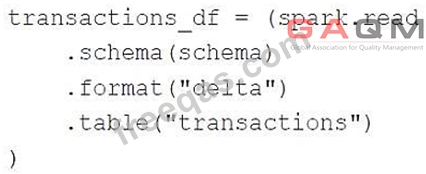
Which of the following changes needs to be made so this code block will work when the transactions table is a stream source?

Correct Answer: E
Explanation
https://docs.databricks.com/en/structured-streaming/delta-lake.html
insert code

Question 7

A data engineer has a Job with multiple tasks that runs nightly. Each of the tasks runs slowly because the clusters take a long time to start.
Which of the following actions can the data engineer perform to improve the start up time for the clusters used for the Job?

Correct Answer: D
The best action that the data engineer can perform to improve the start up time for the clusters used for the Job is to use clusters that are from a cluster pool. A cluster pool is a set of idle clusters that can be used by jobs or interactive sessions. By using a cluster pool, the data engineer can avoid the cluster creation time and reduce the latency of the tasks. Cluster pools also offer cost savings and resource efficiency, as they can be shared by multiple users and jobs.
Option A is not relevant, as endpoints available in Databricks SQL are used for creating and managing SQL analytics workloads, not for improving cluster start up time.
Option B is not correct, as jobs clusters and all-purpose clusters have similar start up times. Jobs clusters are clusters that are dedicated to run a single job and are terminated when the job is completed. All-purpose clusters are clusters that can be used for multiple purposes, such as interactive sessions, notebooks, or multiple jobs. Both types of clusters can benefit from using a cluster pool.
Option C is not advisable, as configuring the clusters to be single-node will reduce the parallelism and performance of the tasks. Single-node clusters are clusters that have only one worker node and are typically used for testing or development purposes. They are not suitable for running production jobs that require high scalability and fault tolerance.
Option E is not helpful, as configuring the clusters to autoscale for larger data sizes will not affect the start up time of the clusters. Autoscaling is a feature that allows clusters to dynamically adjust the number of worker nodes based on the workload. It can help optimize the resource utilization and cost efficiency of the clusters, but it does not speed up the cluster creation process.
References:
* Cluster Pools
* Jobs
* Clusters
* [Databricks Data Engineer Professional Exam Guide]
insert code

Question 8

Which of the following SQL keywords can be used to convert a table from a long format to a wide format?

Correct Answer: A
The SQL keyword that can be used to convert a table from a long format to a wide format is PIVOT. The PIVOT clause is used to rotate the rows of a table into columns of a new table1. The PIVOT clause can aggregate the values of a column based on the distinct values of another column, and use those values as the column names of the new table1. The PIVOT clause can be useful for transforming data from a long format, where each row represents an observation with multiple attributes, to a wide format, where each row represents an observation with a single attribute and multiple values2. For example, the PIVOT clause can be used to convert a table that contains the sales of different products by different regions into a table that contains the sales of each product by each region as separate columns1.
The other options are not suitable for converting a table from a long format to a wide format. CONVERT is a function that can be used to change the data type of an expression3. WHERE is a clause that can be used to filter the rows of a table based on a condition4. TRANSFORM is a keyword that can be used to apply a user-defined function to a group of rows in a table5. SUM is a function that can be used to calculate the total of a numeric column.
References:
* 1: PIVOT | Databricks on AWS
* 2: Reshaping Data - Long vs Wide Format | Databricks on AWS
* 3: CONVERT | Databricks on AWS
* 4: WHERE | Databricks on AWS
* 5: TRANSFORM | Databricks on AWS
* : [SUM | Databricks on AWS]
insert code

Question 9

Which of the following Structured Streaming queries is performing a hop from a Silver table to a Gold table?

Correct Answer: D
insert code

Question 10

An engineering manager wants to monitor the performance of a recent project using a Databricks SQL query.
For the first week following the project's release, the manager wants the query results to be updated every minute. However, the manager is concerned that the compute resources used for the query will be left running and cost the organization a lot of money beyond the first week of the project's release.
Which of the following approaches can the engineering team use to ensure the query does not cost the organization any money beyond the first week of the project's release?

Correct Answer: E
In Databricks SQL, you can use scheduled query executions to update your dashboards or enable routine alerts. By default, your queries do not have a schedule. To set the schedule, you can use the dropdown pickers to specify the frequency, period, starting time, and time zone. You can also choose to end the schedule on a certain date by selecting the End date checkbox and picking a date from the calendar. This way, you can ensure that the query does not run beyond the first week of the project's release and does not incur any additional cost. Option A is incorrect, as setting a limit to the number of DBUs does not stop the query from running. Option B is incorrect, as there is no option to end the schedule after a certain number of refreshes.
Option C is incorrect, as there is a way to ensure the query does not cost the organization money beyond the first week of the project's release. Option D is incorrect, as setting a limit to the number of individuals who can manage the query's refresh schedule does not affect the query's execution or cost. References: Schedule a query, Schedule a query - Azure Databricks - Databricks SQL
insert code
  • «
  • 1
  • 2
  • 3
  • 4
  • 5
  • 6
  • 7
  • 8
  • 9
  • 10
  • …
  • »
  • »»
[×]

Download PDF File

Enter your email address to download GAQM.Databricks-Certified-Data-Engineer-Associate.v2024-09-16.q91 Dumps


Email:

FreeQAs

Our website provides the Largest and the most Latest vendors Certification Exam materials around the world.

Using dumps we provide to Pass the Exam, we has the Valid Dumps with passing guranteed just which you need.

  • DMCA
  • About
  • Contact Us
  • Privacy Policy
  • Terms & Conditions
©2025 FreeQAs

www.freeqas.com materials do not contain actual questions and answers from Cisco's certification exams.