FreeQAs
 Request Exam  Contact
  • Home
  • View All Exams
  • New QA's
  • Upload
PRACTICE EXAMS:
  • Oracle
  • Fortinet
  • Juniper
  • Microsoft
  • Cisco
  • Citrix
  • CompTIA
  • VMware
  • ISC
  • SAP
  • EMC
  • PMI
  • HP
  • Salesforce
  • Other
  • Oracle
    Oracle
  • Fortinet
    Fortinet
  • Juniper
    Juniper
  • Microsoft
    Microsoft
  • Cisco
    Cisco
  • Citrix
    Citrix
  • CompTIA
    CompTIA
  • VMware
    VMware
  • ISC
    ISC
  • SAP
    SAP
  • EMC
    EMC
  • PMI
    PMI
  • HP
    HP
  • Salesforce
    Salesforce
  1. Home
  2. GAQM Certification
  3. Databricks-Certified-Data-Engineer-Associate Exam
  4. GAQM.Databricks-Certified-Data-Engineer-Associate.v2024-11-18.q107 Dumps
  • ««
  • «
  • …
  • 11
  • 12
  • 13
  • 14
  • 15
  • 16
  • 17
  • 18
  • 19
  • 20
  • …
  • »
  • »»
Download Now

Question 71

Which of the following describes when to use the CREATE STREAMING LIVE TABLE (formerly CREATE INCREMENTAL LIVE TABLE) syntax over the CREATE LIVE TABLE syntax when creating Delta Live Tables (DLT) tables using SQL?

Correct Answer: B
A streaming live table or view processes data that has been added only since the last pipeline update.
Streaming tables and views are stateful; if the defining query changes, new data will be processed based on the new query and existing data is not recomputed. This is useful when data needs to be processed incrementally, such as when ingesting streaming data sources or performing incremental loads from batch data sources. A live table or view, on the other hand, may be entirely computed when possible to optimize computation resources and time. This is suitable when data needs to be processed in full, such as when performing complex transformations or aggregations that require scanning all the data. References: Difference between LIVE TABLE and STREAMING LIVE TABLE, CREATE STREAMING TABLE, Load data using streaming tables in Databricks SQL.
insert code

Question 72

In order for Structured Streaming to reliably track the exact progress of the processing so that it can handle any kind of failure by restarting and/or reprocessing, which of the following two approaches is used by Spark to record the offset range of the data being processed in each trigger?

Correct Answer: A
Structured Streaming uses checkpointing and write-ahead logs to record the offset range of the data being processed in each trigger. This ensures that the engine can reliably track the exact progress of the processing and handle any kind of failure by restarting and/or reprocessing. Checkpointing is the mechanism of saving the state of a streaming query to fault-tolerant storage (such as HDFS) so that it can be recovered after a failure.
Write-ahead logs are files that record the offset range of the data being processed in each trigger and are written to the checkpoint location before the processing starts. These logs are used to recover the query state and resume processing from the last processed offset range in case of a failure. References: Structured Streaming Programming Guide, Fault Tolerance Semantics
insert code

Question 73

A Delta Live Table pipeline includes two datasets defined using STREAMING LIVE TABLE. Three datasets are defined against Delta Lake table sources using LIVE TABLE.
The table is configured to run in Production mode using the Continuous Pipeline Mode.
Assuming previously unprocessed data exists and all definitions are valid, what is the expected outcome after clicking Start to update the pipeline?

Correct Answer: C
In Production mode, the pipeline runs continuously and updates the output tables whenever new data is available in the input sources. The compute resources are allocated on demand and released when the pipeline is stopped. This mode is suitable for production workloads that require high availability and reliability. References: Configure pipeline settings for Delta Live Tables, Tutorial: Run your first Delta Live Tables pipeline, Building Reliable Data Pipelines Using DataBricks' Delta Live Tables
insert code

Question 74

A data engineer needs to create a table in Databricks using data from their organization's existing SQLite database.
They run the following command:
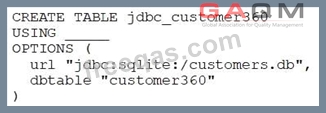
Which of the following lines of code fills in the above blank to successfully complete the task?

Correct Answer: D
In the given command, a data engineer is trying to create a table in Databricks using data from an SQLite database. The correct option to fill in the blank is "sqlite" because it specifies the type of database being connected to in a JDBC connection string. The USING clause should be followed by the format of the data, and since we are connecting to an SQLite database, "sqlite" would be appropriate here. References:
* Create a table using JDBC
* JDBC connection string
* SQLite JDBC driver
insert code

Question 75

A data engineer wants to create a new table containing the names of customers that live in France.
They have written the following command:

A senior data engineer mentions that it is organization policy to include a table property indicating that the new table includes personally identifiable information (PII).
Which of the following lines of code fills in the above blank to successfully complete the task?

Correct Answer: D
Explanation
Ref:https://www.databricks.com/discover/pages/data-quality-management
CREATE TABLE my_table (id INT COMMENT 'Unique Identification Number', name STRING COMMENT 'PII', age INT COMMENT 'PII') TBLPROPERTIES ('contains_pii'=True) COMMENT 'Contains PII';
insert code
  • ««
  • «
  • …
  • 11
  • 12
  • 13
  • 14
  • 15
  • 16
  • 17
  • 18
  • 19
  • 20
  • …
  • »
  • »»
[×]

Download PDF File

Enter your email address to download GAQM.Databricks-Certified-Data-Engineer-Associate.v2024-11-18.q107 Dumps


Email:

FreeQAs

Our website provides the Largest and the most Latest vendors Certification Exam materials around the world.

Using dumps we provide to Pass the Exam, we has the Valid Dumps with passing guranteed just which you need.

  • DMCA
  • About
  • Contact Us
  • Privacy Policy
  • Terms & Conditions
©2026 FreeQAs

www.freeqas.com materials do not contain actual questions and answers from Cisco's certification exams.