FreeQAs
 Request Exam  Contact
  • Home
  • View All Exams
  • New QA's
  • Upload
PRACTICE EXAMS:
  • Oracle
  • Fortinet
  • Juniper
  • Microsoft
  • Cisco
  • Citrix
  • CompTIA
  • VMware
  • ISC
  • SAP
  • EMC
  • PMI
  • HP
  • Salesforce
  • Other
  • Oracle
    Oracle
  • Fortinet
    Fortinet
  • Juniper
    Juniper
  • Microsoft
    Microsoft
  • Cisco
    Cisco
  • Citrix
    Citrix
  • CompTIA
    CompTIA
  • VMware
    VMware
  • ISC
    ISC
  • SAP
    SAP
  • EMC
    EMC
  • PMI
    PMI
  • HP
    HP
  • Salesforce
    Salesforce
  1. Home
  2. GAQM Certification
  3. Databricks-Certified-Data-Engineer-Associate Exam
  4. GAQM.Databricks-Certified-Data-Engineer-Associate.v2026-07-23.q248 Dumps
  • ««
  • «
  • …
  • 13
  • 14
  • 15
  • 16
  • 17
  • 18
  • 19
  • 20
  • 21
  • 22
  • …
  • »
  • »»
Download Now

Question 81

Which query is performing a streaming hop from raw data to a Bronze table?

Correct Answer: D
The query performing a streaming hop from raw data to a Bronze table is identified by using the Spark streaming read capability and then writing to a Bronze table. Let's analyze the options:
Option A: Utilizes .writeStream but performs a complete aggregation which is more characteristic of a roll-up into a summarized table rather than a hop into a Bronze table.
Option B: Also uses .writeStream but calculates an average, which again does not typically represent the raw to Bronze transformation, which usually involves minimal transformations.
Option C: This uses a basic .write with .mode("append") which is not a streaming operation, and hence not suitable for real-time streaming data transformation to a Bronze table.
Option D: It employs spark.readStream.load() to ingest raw data as a stream and then writes it out with .
writeStream, which is a typical pattern for streaming data into a Bronze table where raw data is captured in real-time and minimal transformation is applied. This approach aligns with the concept of a Bronze table in a modern data architecture, where raw data is ingested continuously and stored in a more accessible format.
References:Databricks documentation on Structured Streaming: Structured Streaming in Databricks
insert code

Question 82

A data engineer has a Job with multiple tasks that runs nightly. Each of the tasks runs slowly because the clusters take a long time to start.
Which of the following actions can the data engineer perform to improve the start up time for the clusters used for the Job?

Correct Answer: D
The best action that the data engineer can perform to improve the start up time for the clusters used for the Job is to use clusters that are from a cluster pool. A cluster pool is a set of idle clusters that can be used by jobs or interactive sessions. By using a cluster pool, the data engineer can avoid the cluster creation time and reduce the latency of the tasks. Cluster pools also offer cost savings and resource efficiency, as they can be shared by multiple users and jobs.
Option A is not relevant, as endpoints available in Databricks SQL are used for creating and managing SQL analytics workloads, not for improving cluster start up time.
Option B is not correct, as jobs clusters and all-purpose clusters have similar start up times. Jobs clusters are clusters that are dedicated to run a single job and are terminated when the job is completed. All-purpose clusters are clusters that can be used for multiple purposes, such as interactive sessions, notebooks, or multiple jobs. Both types of clusters can benefit from using a cluster pool.
Option C is not advisable, as configuring the clusters to be single-node will reduce the parallelism and performance of the tasks. Single-node clusters are clusters that have only one worker node and are typically used for testing or development purposes. They are not suitable for running production jobs that require high scalability and fault tolerance.
Option E is not helpful, as configuring the clusters to autoscale for larger data sizes will not affect the start up time of the clusters. Autoscaling is a feature that allows clusters to dynamically adjust the number of worker nodes based on the workload. It can help optimize the resource utilization and cost efficiency of the clusters, but it does not speed up the cluster creation process.
Reference:
Cluster Pools
Jobs
Clusters
[Databricks Data Engineer Professional Exam Guide]
insert code

Question 83

A data engineer needs to create a table in Databricks using data from their organization's existing SQLite database.
They run the following command:
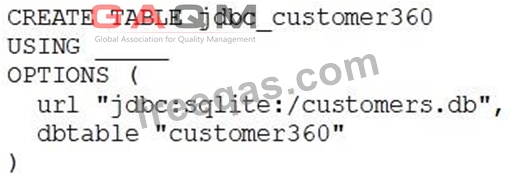
Which of the following lines of code fills in the above blank to successfully complete the task?

Correct Answer: C
insert code

Question 84

A data engineer is attempting to drop a Spark SQL table my_table. The data engineer wants to delete all table metadata and data.
They run the following command:
DROP TABLE IF EXISTS my_table
While the object no longer appears when they run SHOW TABLES, the data files still exist.
Which of the following describes why the data files still exist and the metadata files were deleted?

Correct Answer: C
An external table is a table that is defined in the metastore and points to an existing location in the storage system. When you drop an external table, only the metadata is deleted from the metastore, but the data files are not deleted from the storage system. This is because external tables are meant to be shared by multiple applications and users, and dropping them should not affect the data availability. On the other hand, a managed table is a table that is defined in the metastore and also managed by the metastore. When you drop a managed table, both the metadata and the data files are deleted from the metastore and the storage system, respectively. This is because managed tables are meant to be exclusive to the application or user that created them, and dropping them should free up the storage space. Therefore, the correct answer is C, because the table was external and only the metadata was deleted when the table was dropped. Reference: Databricks Documentation - Managed and External Tables, Databricks Documentation - Drop Table
insert code

Question 85

A new data engineering team team. has been assigned to an ELT project. The new data engineering team will need full privileges on the database customers to fully manage the project.
Which of the following commands can be used to grant full permissions on the database to the new data engineering team?

Correct Answer: E
To grant full permissions on a database to a user, group, or service principal, the GRANT ALL PRIVILEGES ON DATABASE command can be used. This command grants all the applicable privileges on the database, such as CREATE, SELECT, MODIFY, and USAGE. The other options are either incorrect or incomplete, as they do not grant all the privileges or specify the wrong database or principal. References:
* GRANT
* Privileges
insert code
  • ««
  • «
  • …
  • 13
  • 14
  • 15
  • 16
  • 17
  • 18
  • 19
  • 20
  • 21
  • 22
  • …
  • »
  • »»
[×]

Download PDF File

Enter your email address to download GAQM.Databricks-Certified-Data-Engineer-Associate.v2026-07-23.q248 Dumps


Email:

FreeQAs

Our website provides the Largest and the most Latest vendors Certification Exam materials around the world.

Using dumps we provide to Pass the Exam, we has the Valid Dumps with passing guranteed just which you need.

  • DMCA
  • About
  • Contact Us
  • Privacy Policy
  • Terms & Conditions
©2026 FreeQAs

www.freeqas.com materials do not contain actual questions and answers from Cisco's certification exams.