FreeQAs
 Request Exam  Contact
  • Home
  • View All Exams
  • New QA's
  • Upload
PRACTICE EXAMS:
  • Oracle
  • Fortinet
  • Juniper
  • Microsoft
  • Cisco
  • Citrix
  • CompTIA
  • VMware
  • ISC
  • SAP
  • EMC
  • PMI
  • HP
  • Salesforce
  • Other
  • Oracle
    Oracle
  • Fortinet
    Fortinet
  • Juniper
    Juniper
  • Microsoft
    Microsoft
  • Cisco
    Cisco
  • Citrix
    Citrix
  • CompTIA
    CompTIA
  • VMware
    VMware
  • ISC
    ISC
  • SAP
    SAP
  • EMC
    EMC
  • PMI
    PMI
  • HP
    HP
  • Salesforce
    Salesforce
  1. Home
  2. Google Certification
  3. Associate-Cloud-Engineer Exam
  4. Google.Associate-Cloud-Engineer.v2026-09-07.q249 Dumps
  • ««
  • «
  • …
  • 30
  • 31
  • 32
  • 33
  • 34
  • 35
  • 36
  • 37
  • 38
  • 39
  • …
  • »
  • »»
Download Now

Question 166

You have a number of applications that have bursty workloads and are heavily dependent on topics to decouple publishing systems from consuming systems. Your company would like to go serverless to enable developers to focus on writing code without worrying about infrastructure.
Your solution architect has already identified Cloud Pub/Sub as a suitable alternative for decoupling systems. You have been asked to identify a suitable GCP Serverless service that is easy to use with Cloud Pub/Sub. You want the ability to scale down to zero when there is no traffic in order to minimize costs. You want to follow Google recommended practices. What should you suggest?

Correct Answer: D
Cloud Functions is Google Cloud's event-driven serverless compute platform that lets you run your code locally or in the cloud without having to provision servers. Cloud Functions scales up or down, so you pay only for compute resources you use. Cloud Functions have excellent integration with Cloud Pub/Sub, lets you scale down to zero and is recommended by Google as the ideal serverless platform to use when dependent on Cloud Pub/Sub.
"If you're building a simple API (a small set of functions to be accessed via HTTP or Cloud Pub/Sub), we recommend using Cloud Functions."
insert code

Question 167

Your organization is a financial company that needs to store audit log files for 3 years. Your organization has hundreds of Google Cloud projects. You need to implement a cost-effective approach for log file retention.
What should you do?

Correct Answer: A
Explanation
Explanation/Reference: https://cloud.google.com/logging/docs/audit/
insert code

Question 168

You deployed a new application inside your Google Kubernetes Engine cluster using the YAML file specified below.
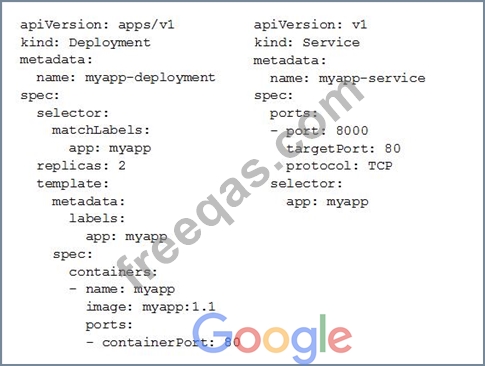
You check the status of the deployed pods and notice that one of them is still in PENDING status:

You want to find out why the pod is stuck in pending status. What should you do?

Correct Answer: C
Reference:
https://cloud.google.com/run/docs/gke/troubleshooting
insert code

Question 169

You have a Compute Engine instance hosting an application used between 9 AM and 6 PM on weekdays. You want to back up this instance daily for disaster recovery purposes. You want to keep the backups for 30 days. You want the Google-recommended solution with the least management overhead and the least number of services. What should you do?

Correct Answer: B
Creating scheduled snapshots for persistent disk This document describes how to create a snapshot schedule to regularly and automatically back up your zonal and regional persistent disks. Use snapshot schedules as a best practice to back up your Compute Engine workloads. After creating a snapshot schedule, you can apply it to one or more persistent disks. https://cloud.google.com/compute/docs/disks/scheduled-snapshots
insert code

Question 170

You have a single binary application that you want to run on Google Cloud Platform. You decided to automatically scale the application based on underlying infrastructure CPU usage. Your organizational policies require you to use virtual machines directly. You need to ensure that the application scaling is operationally efficient and completed as quickly as possible. What should you do?

Correct Answer: B
Managed instance groups offer autoscaling capabilities that let you automatically add or delete instances from a managed instance group based on increases or decreases in load (CPU Utilization in this case). Autoscaling helps your apps gracefully handle increases intraffic and reduce costs when the need for resources is lower.
You define the autoscaling policy and the autoscaler performs automatic scaling based on the measured load (CPU Utilization in this case). Autoscaling works by adding more instances to your instance group when there is more load (upscaling), and deleting instances when the need for instances is lowered (downscaling). Ref:
https://cloud.google.com/compute/docs/autoscaler
insert code
  • ««
  • «
  • …
  • 30
  • 31
  • 32
  • 33
  • 34
  • 35
  • 36
  • 37
  • 38
  • 39
  • …
  • »
  • »»
[×]

Download PDF File

Enter your email address to download Google.Associate-Cloud-Engineer.v2026-09-07.q249 Dumps

Email:

FreeQAs

Our website provides the Largest and the most Latest vendors Certification Exam materials around the world.

Using dumps we provide to Pass the Exam, we has the Valid Dumps with passing guranteed just which you need.

  • DMCA
  • About
  • Contact Us
  • Privacy Policy
  • Terms & Conditions
©2026 FreeQAs

www.freeqas.com materials do not contain actual questions and answers from Cisco's certification exams.
