You are planning to migrate a database and a backend application to a Standard Google Kubernetes Engine (GKE) cluster. You need to prevent data loss and make sure there are enough nodes available for your backend application based on the demands of your workloads. You want to follow Google-recommended practices and minimize the amount of manual work required. What should you do?
Every employee of your company has a Google account. Your operational team needs to manage a large number of instances on Compute Engine. Each member of this team needs only administrative access to the servers. Your security team wants to ensure that the deployment of credentials is operationally efficient and must be able to determine who accessed a given instance. What should you do?
You're about to deploy your team's App Engine application. They're using the Go runtime with a Standard Environment. Which command should you use to deploy the application?
You have a Linux VM that must connect to Cloud SQL. You created a service account with the appropriate access rights. You want to make sure that the VM uses this service account instead of the default Compute Engine service account. What should you do?
Your company has a 3-tier solution running on Compute Engine. The configuration of the current infrastructure is shown below.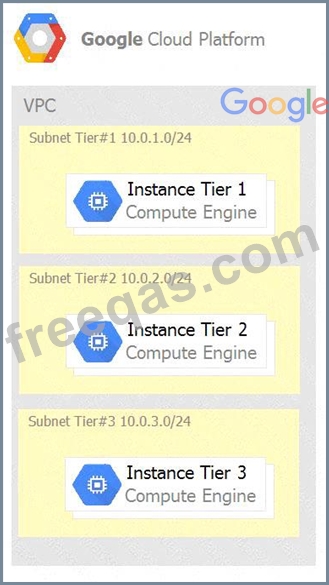
Each tier has a service account that is associated with all instances within it. You need to enable communication on TCP port 8080 between tiers as follows:
* Instances in tier #1 must communicate with tier #2.
* Instances in tier #2 must communicate with tier #3.
What should you do?
Enter your email address to download Google.Associate-Cloud-Engineer.v2026-09-07.q249 Dumps

