You are using Cloud CDN to deliver static HTTP(S) website content hosted on a Compute Engine instance group. You want to improve the cache hit ratio.
What should you do?
Case Study: 3 - JencoMart Case Study
Company Overview
JencoMart is a global retailer with over 10,000 stores in 16 countries. The stores carry a range of goods, such as groceries, tires, and jewelry. One of the company's core values is excellent customer service. In addition, they recently introduced an environmental policy to reduce their carbon output by 50% over the next 5 years.
Company Background
JencoMart started as a general store in 1931, and has grown into one of the world's leading brands known for great value and customer service. Over time, the company transitioned from only physical stores to a stores and online hybrid model, with 25% of sales online. Currently, JencoMart has little presence in Asia, but considers that market key for future growth.
Solution Concept
JencoMart wants to migrate several critical applications to the cloud but has not completed a technical review to determine their suitability for the cloud and the engineering required for migration. They currently host all of these applications on infrastructure that is at its end of life and is no longer supported.
Existing Technical Environment
JencoMart hosts all of its applications in 4 data centers: 3 in North American and 1 in Europe, most applications are dual-homed.
JencoMart understands the dependencies and resource usage metrics of their on-premises architecture.
Application Customer loyalty portal
LAMP (Linux, Apache, MySQL and PHP) application served from the two JencoMart-owned U.S.
data centers.
Database
* Oracle Database stores user profiles



* PostgreSQL database stores user credentials
-homed in US West


Authenticates all users
Compute
* 30 machines in US West Coast, each machine has:


* 20 machines in US East Coast, each machine has:
-core CPU

RAID 1)
Storage
* Access to shared 100 TB SAN in each location
* Tape backup every week
Business Requirements
* Optimize for capacity during peak periods and value during off-peak periods
* Guarantee service availably and support
* Reduce on-premises footprint and associated financial and environmental impact.
* Move to outsourcing model to avoid large upfront costs associated with infrastructure purchase
* Expand services into Asia.
Technical Requirements
* Assess key application for cloud suitability.
* Modify application for the cloud.
* Move applications to a new infrastructure.
* Leverage managed services wherever feasible
* Sunset 20% of capacity in existing data centers
* Decrease latency in Asia
CEO Statement
JencoMart will continue to develop personal relationships with our customers as more people access the web. The future of our retail business is in the global market and the connection between online and in-store experiences. As a large global company, we also have a responsibility to the environment through 'green' initiatives and polices.
CTO Statement
The challenges of operating data centers prevents focus on key technologies critical to our long- term success. Migrating our data services to a public cloud infrastructure will allow us to focus on big data and machine learning to improve our service customers.
CFO Statement
Since its founding JencoMart has invested heavily in our data services infrastructure. However, because of changing market trends, we need to outsource our infrastructure to ensure our long- term success. This model will allow us to respond to increasing customer demand during peak and reduce costs.
For this question, refer to the JencoMart case study.
JencoMart has built a version of their application on Google Cloud Platform that serves traffic to Asia. You want to measure success against their business and technical goals. Which metrics should you track?
Case Study: 2 - TerramEarth Case Study
Company Overview
TerramEarth manufactures heavy equipment for the mining and agricultural industries: About 80% of their business is from mining and 20% from agriculture. They currently have over 500 dealers and service centers in 100 countries. Their mission is to build products that make their customers more productive.
Company Background
TerramEarth formed in 1946, when several small, family owned companies combined to retool after World War II. The company cares about their employees and customers and considers them to be extended members of their family.
TerramEarth is proud of their ability to innovate on their core products and find new markets as their customers' needs change. For the past 20 years trends in the industry have been largely toward increasing productivity by using larger vehicles with a human operator.
Solution Concept
There are 20 million TerramEarth vehicles in operation that collect 120 fields of data per second.
Data is stored locally on the vehicle and can be accessed for analysis when a vehicle is serviced.
The data is downloaded via a maintenance port. This same port can be used to adjust operational parameters, allowing the vehicles to be upgraded in the field with new computing modules.
Approximately 200,000 vehicles are connected to a cellular network, allowing TerramEarth to collect data directly. At a rate of 120 fields of data per second, with 22 hours of operation per day.
TerramEarth collects a total of about 9 TB/day from these connected vehicles.
Existing Technical Environment
TerramEarth's existing architecture is composed of Linux-based systems that reside in a data center. These systems gzip CSV files from the field and upload via FTP, transform and aggregate them, and place the data in their data warehouse. Because this process takes time, aggregated reports are based on data that is 3 weeks old.
With this data, TerramEarth has been able to preemptively stock replacement parts and reduce unplanned downtime of their vehicles by 60%. However, because the data is stale, some customers are without their vehicles for up to 4 weeks while they wait for replacement parts.
Business Requirements
- Decrease unplanned vehicle downtime to less than 1 week, without
increasing the cost of carrying surplus inventory
- Support the dealer network with more data on how their customers use
their equipment IP better position new products and services.
- Have the ability to partner with different companies-especially with
seed and fertilizer suppliers in the fast-growing agricultural
business-to create compelling joint offerings for their customers
CEO Statement
We have been successful in capitalizing on the trend toward larger vehicles to increase the productivity of our customers. Technological change is occurring rapidly and TerramEarth has taken advantage of connected devices technology to provide our customers with better services, such as our intelligent farming equipment. With this technology, we have been able to increase farmers' yields by 25%, by using past trends to adjust how our vehicles operate. These advances have led to the rapid growth of our agricultural product line, which we expect will generate 50% of our revenues by 2020.
CTO Statement
Our competitive advantage has always been in the manufacturing process with our ability to build better vehicles for tower cost than our competitors. However, new products with different approaches are constantly being developed, and I'm concerned that we lack the skills to undergo the next wave of transformations in our industry. Unfortunately, our CEO doesn't take technology obsolescence seriously and he considers the many new companies in our industry to be niche players. My goals are to build our skills while addressing immediate market needs through incremental innovations.
For this question, refer to the TerramEarth case study. TerramEarth has equipped unconnected trucks with servers and sensors to collet telemetry dat
For this question, refer to the TerramEarth case study.
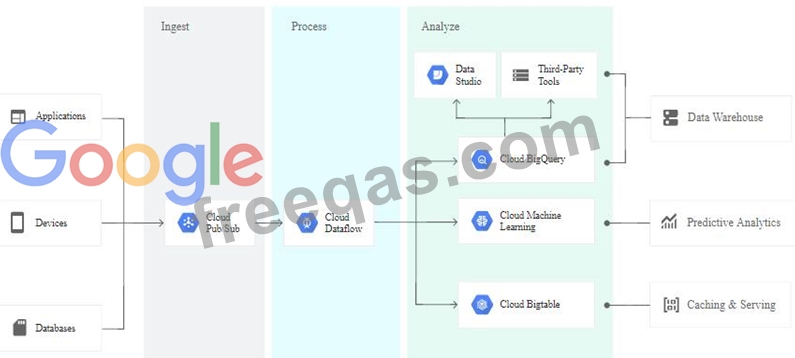
TerramEarth's CTO wants to use the raw data from connected vehicles to help identify approximately when a vehicle in the development team to focus their failure. You want to allow analysts to centrally query the vehicle data. Which architecture should you recommend?
A)
B)
C)
D)
Dress4win has end to end tests covering 100% of their endpoints.
They want to ensure that the move of cloud does not introduce any new bugs.
Which additional testing methods should the developers employ to prevent an outage?
Enter your email address to download Google.Professional-Cloud-Architect.v2026-02-17.q247 Dumps

