FreeQAs
 Request Exam  Contact
  • Home
  • View All Exams
  • New QA's
  • Upload
PRACTICE EXAMS:
  • Oracle
  • Fortinet
  • IBM
  • Juniper
  • Microsoft
  • Cisco
  • Citrix
  • CompTIA
  • VMware
  • ISC
  • SAP
  • EMC
  • PMI
  • HP
  • Salesforce
  • Other
  • Oracle
    Oracle
  • Fortinet
    Fortinet
  • IBM
    IBM
  • Juniper
    Juniper
  • Microsoft
    Microsoft
  • Cisco
    Cisco
  • Citrix
    Citrix
  • CompTIA
    CompTIA
  • VMware
    VMware
  • ISC
    ISC
  • SAP
    SAP
  • EMC
    EMC
  • PMI
    PMI
  • HP
    HP
  • Salesforce
    Salesforce
  1. Home
  2. Google Certification
  3. Professional-Cloud-DevOps-Engineer Exam
  4. Google.Professional-Cloud-DevOps-Engineer.v2024-02-27.q110 Dumps
  • ««
  • «
  • …
  • 9
  • 10
  • 11
  • 12
  • 13
  • 14
  • 15
  • 16
  • 17
  • 18
  • …
  • »
  • »»
Download Now

Question 61

You manage an application that runs in Google Kubernetes Engine (GKE) and uses the blue/green deployment methodology Extracts of the Kubernetes manifests are shown below
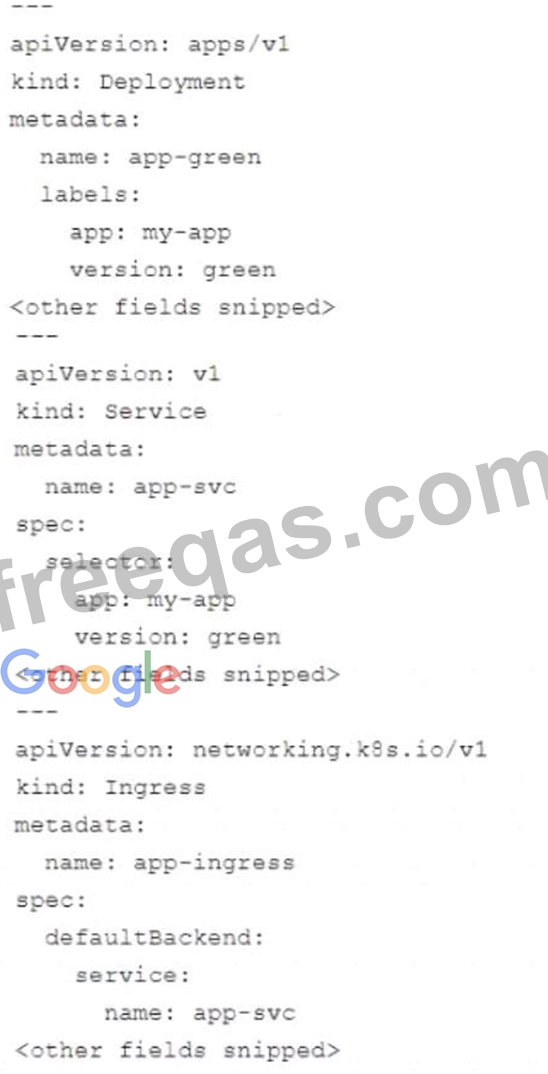
The Deployment app-green was updated to use the new version of the application During post-deployment monitoring you notice that the majority of user requests are failing You did not observe this behavior in the testing environment You need to mitigate the incident impact on users and enable the developers to troubleshoot the issue What should you do?

Correct Answer: D
Explanation
The best option for mitigating the incident impact on users and enabling the developers to troubleshoot the issue is to change the selector on the Service app-svc to app: my-app, version: blue. A Service is a resource that defines how to access a set of Pods. A selector is a field that specifies which Pods are selected by the Service. By changing the selector on the Service app-svc to app: my-app, version: blue, you can ensure that the Service only routes traffic to the Pods that have both labels app: my-app and version: blue. These Pods belong to the Deployment app-blue, which uses the previous version of the application. This way, you can mitigate the incident impact on users by switching back to the working version of the application. You can also enable the developers to troubleshoot the issue with the new version of the application in the Deployment app-green without affecting users.
insert code

Question 62

You use Cloud Build to build and deploy your application. You want to securely incorporate database credentials and other application secrets into the build pipeline. You also want to minimize the development effort. What should you do?

Correct Answer: D
Explanation
https://cloud.google.com/build/docs/securing-builds/use-encrypted-credentials
insert code

Question 63

Your company follows Site Reliability Engineering practices. You are the Incident Commander for a new. customer-impacting incident. You need to immediately assign two incident management roles to assist you in an effective incident response. What roles should you assign?
Choose 2 answers

Correct Answer: A,C
insert code

Question 64

You support a production service that runs on a single Compute Engine instance. You regularly need to spend time on recreating the service by deleting the crashing instance and creating a new instance based on the relevant image. You want to reduce the time spent performing manual operations while following Site Reliability Engineering principles. What should you do?

Correct Answer: D
insert code

Question 65

You recently noticed that one Of your services has exceeded the error budget for the current rolling window period. Your company's product team is about to launch a new feature. You want to follow Site Reliability Engineering (SRE) practices.
What should you do?

Correct Answer: A
Explanation
The correct answer is A. Notify the team that their error budget is used up. Negotiate with the team for a launch freeze or tolerate a slightly worse user experience.
According to the Site Reliability Engineering (SRE) practices, an error budget is the amount of unreliability that a service can tolerate without harming user satisfaction1. An error budget is derived from the service-level objectives (SLOs), which are the measurable goals for the service quality2. When a service exceeds its error budget, it means that it has violated its SLOs and may have negatively impacted the users. In this case, the SRE team should notify the product team that their error budget is used up and negotiate with them for a launch freeze or a lower SLO3. A launch freeze means that no new features are deployed until the service reliability is restored. A lower SLO means that the product team accepts a slightly worse user experience in exchange for launching new features. Both options require a trade-off between reliability and innovation, and should be agreed upon by both teams.
The other options are incorrect because they do not follow the SRE practices. Option B is incorrect because it violates the principle of error budget autonomy, which means that each service should have its own error budget and SLOs, and should not borrow or reallocate them from other services4. Option C is incorrect because it does not address the root cause of the error budget overspend, and may create unrealistic expectations for the service reliability. Option D is incorrect because it does not prevent the possibility of introducing new errors or bugs with the feature launch, which may further degrade the service quality and user satisfaction.
insert code
  • ««
  • «
  • …
  • 9
  • 10
  • 11
  • 12
  • 13
  • 14
  • 15
  • 16
  • 17
  • 18
  • …
  • »
  • »»
[×]

Download PDF File

Enter your email address to download Google.Professional-Cloud-DevOps-Engineer.v2024-02-27.q110 Dumps


Email:

FreeQAs

Our website provides the Largest and the most Latest vendors Certification Exam materials around the world.

Using dumps we provide to Pass the Exam, we has the Valid Dumps with passing guranteed just which you need.

  • DMCA
  • About
  • Contact Us
  • Privacy Policy
  • Terms & Conditions
©2026 FreeQAs

www.freeqas.com materials do not contain actual questions and answers from Cisco's certification exams.