You just finished your company's migration to Google Cloud and configured an architecture with 3 Virtual Private Cloud (VPC) networks: one for Sales, one for Finance, and one for Engineering. Every VPC contains over 100 Compute Engine instances, and now developers using instances in the Sales VPC and the Finance VPC require private connectivity between each other. You need to allow communication between Sales and Finance without compromising performance or security. What should you do?
You have the following routing design. You discover that Compute Engine instances in Subnet-2 in the asia-southeast1 region cannot communicate with compute resources on-premises. What should you do?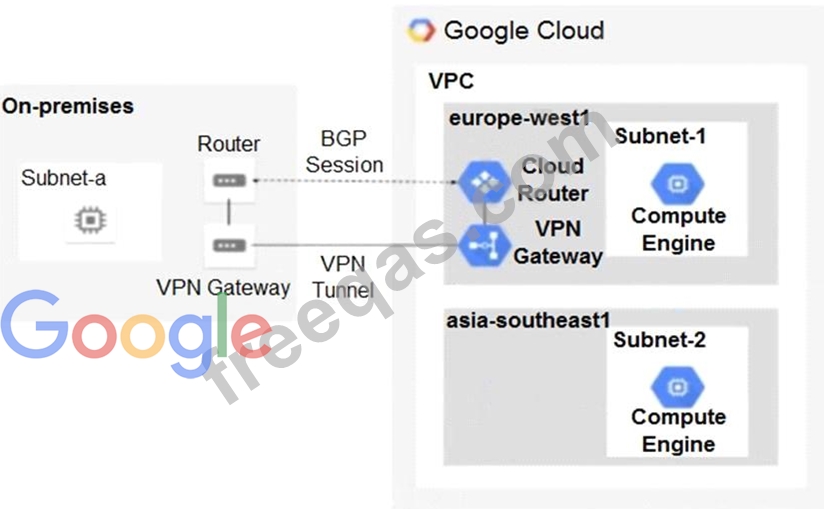
You are configuring the firewall endpoints as part of the Cloud Next Generation Firewall (Cloud NGFW) intrusion prevention service in Google Cloud. You have configured a threat prevention security profile, and you now need to create an endpoint for traffic inspection. What should you do?
You created a new VPC for your development team. You want to allow access to the resources in this VPC via SSH only.
How should you configure your firewall rules?
You are designing a Google Kubernetes Engine (GKE) cluster for your organization. The current cluster size is expected to host 10 nodes, with 20 Pods per node and 150 services. Because of the migration of new services over the next 2 years, there is a planned growth for 100 nodes, 200 Pods per node, and 1500 services.
You want to use VPC-native clusters with alias IP ranges, while minimizing address consumption.
How should you design this topology?
Enter your email address to download Google.Professional-Cloud-Network-Engineer.v2026-11-25.q288 Dumps

