FreeQAs
 Request Exam  Contact
  • Home
  • View All Exams
  • New QA's
  • Upload
PRACTICE EXAMS:
  • Oracle
  • Fortinet
  • Juniper
  • Microsoft
  • Cisco
  • Citrix
  • CompTIA
  • VMware
  • ISC
  • SAP
  • EMC
  • PMI
  • HP
  • Salesforce
  • Other
  • Oracle
    Oracle
  • Fortinet
    Fortinet
  • Juniper
    Juniper
  • Microsoft
    Microsoft
  • Cisco
    Cisco
  • Citrix
    Citrix
  • CompTIA
    CompTIA
  • VMware
    VMware
  • ISC
    ISC
  • SAP
    SAP
  • EMC
    EMC
  • PMI
    PMI
  • HP
    HP
  • Salesforce
    Salesforce
  1. Home
  2. Google Certification
  3. Professional-Cloud-Network-Engineer Exam
  4. Google.Professional-Cloud-Network-Engineer.v2026-11-25.q288 Dumps
  • ««
  • «
  • …
  • 46
  • 47
  • 48
  • 49
  • 50
  • 51
  • 52
  • 53
  • 54
  • 55
  • …
  • »
  • »»
Download Now

Question 246

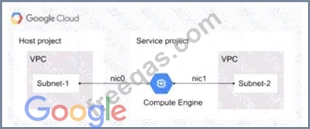
You have the following Shared VPC design VPC Flow Logs is configured for Subnet-1 In the host VPC. You also want to monitor flow logs for Subnet-2. What should you do?
Correct Answer: D
* Understanding VPC Flow Logs:
* VPC Flow Logs is a feature that captures information about the IP traffic going to and from network interfaces in a VPC. It helps in monitoring and analyzing network traffic, ensuring security, and optimizing network performance.
* Current Configuration:
* According to the diagram, VPC Flow Logs is already configured for Subnet-1 in the host VPC.
This means that traffic information for Subnet-1 is being captured and logged.
* Requirement for Subnet-2:
* The goal is to monitor flow logs for Subnet-2, which is in the service project VPC.
* Correct Configuration for Subnet-2:
* To monitor the flow logs for Subnet-2, you need to configure VPC Flow Logs within the service project VPC where Subnet-2 resides. This is because VPC Flow Logs must be configured in the same project and VPC where the subnet is located.
* Implementation Steps:
* Go to the Google Cloud Console.
* Navigate to the service project where Subnet-2 is located.
* Select the VPC network containing Subnet-2.
* Enable VPC Flow Logs for Subnet-2 by editing the subnet settings and enabling the flow logs option.
* Cost and Performance Considerations:
* Enabling VPC Flow Logs may incur additional costs based on the volume of data logged. Ensure to review and understand the pricing implications.
* Analyze and manage the data collected to avoid unnecessary logging and costs.
insert code

Question 247

(You need to migrate multiple PostgreSQL databases from your on-premises data center to Google Cloud.
You want to significantly improve the performance of your databases while minimizing changes to your data schema and application code. You expect to exceed 150 TB of data per geographical region. You want to follow Google-recommended practices and minimize your operational costs. What should you do?)

Correct Answer: A
Comprehensive and Detailed In Depth Explanation:
Let's analyze each option based on the requirements: PostgreSQL compatibility, significant performance improvement, minimal schema/code changes, handling large data volumes, Google-recommended practices, and cost minimization:
A). Migrate your data to AlloyDB: AlloyDB for PostgreSQL is a fully managed, PostgreSQL-compatible database service that offers significant performance improvements over standard PostgreSQL due to its architectural optimizations. It is designed to handle large data volumes and minimizes the need for schema and application code changes as it's wire-compatible with PostgreSQL. This aligns well with the requirements for performance improvement, minimal changes, large data, and being a Google-recommended option for PostgreSQL workloads.
B). Migrate your data to Spanner: Spanner is a globally distributed, horizontally scalable database with strong consistency. While it offers excellent scalability and performance, it's not directly PostgreSQL-compatible.
Migrating to Spanner would likely require significant schema and application code changes due to differences in data modeling and SQL dialect.
C). Migrate your data to Firebase: Firebase is a suite of mobile and web development tools, with its primary database offering being Firestore (a NoSQL document database) and Realtime Database. These are not PostgreSQL-compatible and would require substantial changes to the data model and application code.
D). Migrate your data to Bigtable: Bigtable is a highly scalable NoSQL wide-column store. It's not compatible with PostgreSQL and requires a completely different data model and application logic.
Therefore, AlloyDB is the most suitable option as it provides PostgreSQL compatibility for minimal migration effort, significant performance improvements, scalability for large data volumes, and is a recommended Google Cloud database service for PostgreSQL workloads.
Google Cloud Documentation References:
AlloyDB for PostgreSQL Overview: https://cloud.google.com/alloydb/docs/overview - This document highlights AlloyDB's PostgreSQL compatibility, performance benefits, scalability, and suitability for migrating existing PostgreSQL workloads.
Spanner Overview: https://cloud.google.com/spanner/docs/overview - This emphasizes Spanner's unique features and differences from traditional relational databases like PostgreSQL.
Firebase Documentation: https://firebase.google.com/docs - This outlines the features of Firebase, including Firestore and Realtime Database, highlighting their NoSQL nature and incompatibility with PostgreSQL.
Cloud Bigtable Overview: https://cloud.google.com/bigtable/docs/overview - This describes Bigtable as a NoSQL database, emphasizing its differences from relational databases like PostgreSQL.
insert code

Question 248

You are designing a shared VPC architecture. Your network and security team has strict controls over which routes are exposed between departments. Your Production and Staging departments can communicate with each other, but only via specific networks. You want to follow Google-recommended practices.
How should you design this topology?

Correct Answer: D
Explanation/Reference: https://cloud.google.com/vpc/docs/shared-vpc
insert code

Question 249

You are responsible for configuring firewall policies for your company in Google Cloud. Your security team has a strict set of requirements that must be met to configure firewall rules.
- Always allow Secure Shell (SSH) from your corporate IP address.
- Restrict SSH access from all other IP addresses.
There are multiple projects and VPCs in your Google Cloud organization.
You need to ensure that other VPC firewall rules cannot bypass the security team's requirements.
What should you do?

Correct Answer: B
insert code

Question 250

Your organization wants to deploy HA VPN over Cloud Interconnect to ensure encryption in transit over the Cloud Interconnect connections. You have created a Cloud Router and two encrypted VLAN attachments that have a 5 Gbps capacity and a BGP configuration. The BGP sessions are operational. You need to complete the deployment of the HA VPN over Cloud Interconnect. What should you do?

Correct Answer: B
For secure traffic over Cloud Interconnect, you configure an HA VPN gateway to work with existing VLAN attachments and use the same Cloud Router. This setup integrates seamlessly, leveraging the established BGP sessions for VPN tunnel configurations.
insert code
  • ««
  • «
  • …
  • 46
  • 47
  • 48
  • 49
  • 50
  • 51
  • 52
  • 53
  • 54
  • 55
  • …
  • »
  • »»
[×]

Download PDF File

Enter your email address to download Google.Professional-Cloud-Network-Engineer.v2026-11-25.q288 Dumps


Email:

FreeQAs

Our website provides the Largest and the most Latest vendors Certification Exam materials around the world.

Using dumps we provide to Pass the Exam, we has the Valid Dumps with passing guranteed just which you need.

  • DMCA
  • About
  • Contact Us
  • Privacy Policy
  • Terms & Conditions
©2026 FreeQAs

www.freeqas.com materials do not contain actual questions and answers from Cisco's certification exams.