FreeQAs
 Request Exam  Contact
  • Home
  • View All Exams
  • New QA's
  • Upload
PRACTICE EXAMS:
  • Oracle
  • Fortinet
  • Juniper
  • Microsoft
  • Cisco
  • Citrix
  • CompTIA
  • VMware
  • ISC
  • SAP
  • EMC
  • PMI
  • HP
  • Salesforce
  • Other
  • Oracle
    Oracle
  • Fortinet
    Fortinet
  • Juniper
    Juniper
  • Microsoft
    Microsoft
  • Cisco
    Cisco
  • Citrix
    Citrix
  • CompTIA
    CompTIA
  • VMware
    VMware
  • ISC
    ISC
  • SAP
    SAP
  • EMC
    EMC
  • PMI
    PMI
  • HP
    HP
  • Salesforce
    Salesforce
  1. Home
  2. Google Certification
  3. Professional-Machine-Learning-Engineer Exam
  4. Google.Professional-Machine-Learning-Engineer.v2024-01-19.q113 Dumps
  • ««
  • «
  • …
  • 15
  • 16
  • 17
  • 18
  • 19
  • 20
  • 21
  • 22
  • 23
  • 24
  • »
Download Now

Question 106

You are an ML engineer at a global shoe store. You manage the ML models for the company's website. You are asked to build a model that will recommend new products to the user based on their purchase behavior and similarity with other users. What should you do?

Correct Answer: D
insert code

Question 107

You need to train a regression model based on a dataset containing 50,000 records that is stored in BigQuery. The data includes a total of 20 categorical and numerical features with a target variable that can include negative values. You need to minimize effort and training time while maximizing model performance. What approach should you take to train this regression model?

Correct Answer: B
https://cloud.google.com/bigquery-ml/docs/introduction
insert code

Question 108

You are creating a deep neural network classification model using a dataset with categorical input values.
Certain columns have a cardinality greater than 10,000 unique values. How should you encode these categorical values as input into the model?

Correct Answer: B
* Option A is incorrect because converting each categorical value into an integer value is not a good way to encode categorical values with high cardinality. This method implies an ordinal relationship between the categories, which may not be true. For example, assigning the values 1, 2, and 3 to the categories
"red", "green", and "blue" does not make sense, as there is no inherent order among these colors1.
* Option B is correct because converting the categorical string data to one-hot hash buckets is a suitable way to encode categorical values with high cardinality. This method uses a hash function to map each category to a fixed-length vector of binary values, where only one element is 1 and the rest are 0. This method preserves the sparsity and independence of the categories, and reduces the dimensionality of the input space2.
* Option C is incorrect because mapping the categorical variables into a vector of boolean values is not a valid way to encode categorical values with high cardinality. This method implies that each category can be represented by a combination of true/false values, which may not be possible for a large number of categories. For example, if there are 10,000 categories, then there are 2^10,000 possible combinations of boolean values, which is impractical to store and process3.
* Option D is incorrect because converting each categorical value into a run-length encoded string is not a useful way to encode categorical values with high cardinality. This method compresses a string by replacing consecutive repeated characters with the character and the number of repetitions. For example,
"AAAABBBCC" becomes "A4B3C2". This method does not reduce the dimensionality of the input space, and does not preserve the semantic meaning of the categories4.
References:
* Encoding categorical features
* One-hot hash buckets
* Boolean vector
* Run-length encoding
insert code

Question 109

You are designing an architecture with a serveress ML system to enrich customer support tickets with informative metadata before they are routed to a support agent. You need a set of models to predict ticket priority, predict ticket resolution time, and perform sentiment analysis to help agents make strategic decisions when they process support requests. Tickets are not expected to have any domain-specific terms or jargon.
The proposed architecture has the following flow:
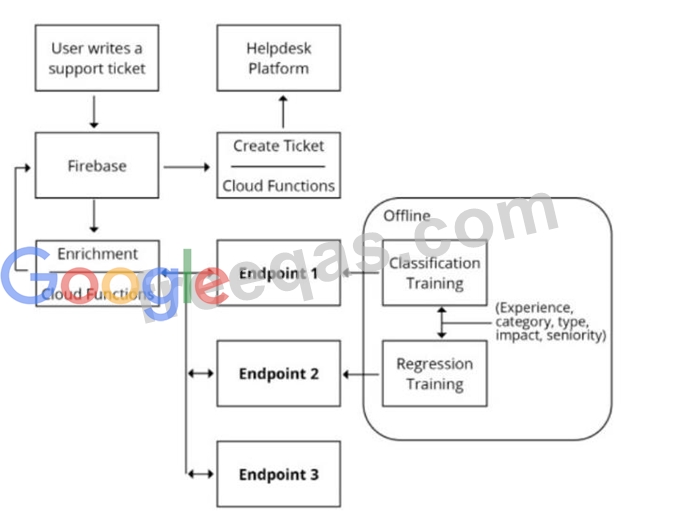
Which endpoints should the Enrichment Cloud Functions call?

Correct Answer: C
https://cloud.google.com/architecture/architecture-of-a-serverless-ml-model#architecture The architecture has the following flow:
A user writes a ticket to Firebase, which triggers a Cloud Function.
-The Cloud Function calls 3 different endpoints to enrich the ticket:
-An AI Platform endpoint, where the function can predict the priority.
-An AI Platform endpoint, where the function can predict the resolution time.
-The Natural Language API to do sentiment analysis and word salience.
-For each reply, the Cloud Function updates the Firebase real-time database.
-The Cloud Function then creates a ticket into the helpdesk platform using the RESTful API.
insert code

Question 110

You manage a team of data scientists who use a cloud-based backend system to submit training jobs. This system has become very difficult to administer, and you want to use a managed service instead. The data scientists you work with use many different frameworks, including Keras, PyTorch, theano, scikit-learn, and custom libraries. What should you do?

Correct Answer: A
The best option for using a managed service to submit training jobs with different frameworks is to use Vertex AI Training. Vertex AI Training is a fully managed service that allows you to train custom models on Google Cloud using any framework, such as TensorFlow, PyTorch, scikit-learn, XGBoost, etc. You can also use custom containers to run your own libraries and dependencies. Vertex AI Training handles the infrastructure provisioning, scaling, and monitoring for you, so you can focus on your model development and optimization.
Vertex AI Training also integrates with other Vertex AI services, such as Vertex AI Pipelines, Vertex AI Experiments, and Vertex AI Prediction. The other options are not as suitable for using a managed service to submit training jobs with different frameworks, because:
* Configuring Kubeflow to run on Google Kubernetes Engine and submit training jobs through TFJob would require more infrastructure maintenance, as Kubeflow is not a fully managed service, and you would have to provision and manage your own Kubernetes cluster. This would also incur more costs, as you would have to pay for the cluster resources, regardless of the training job usage. TFJob is also mainly designed for TensorFlow models, and might not support other frameworks as well as Vertex AI Training.
* Creating a library of VM images on Compute Engine, and publishing these images on a centralized repository would require more development time and effort, as you would have to create and maintain different VM images for different frameworks and libraries. You would also have to manually configure and launch the VMs for each training job, and handle the scaling and monitoring yourself. This would not leverage the benefits of a managed service, such as Vertex AI Training.
* Setting up Slurm workload manager to receive jobs that can be scheduled to run on your cloud infrastructure would require more configuration and administration, as Slurm is not a native Google Cloud service, and you would have to install and manage it on your own VMs or clusters. Slurm is also a general-purpose workload manager, and might not have the same level of integration and optimization for ML frameworks and libraries as Vertex AI Training. References:
* Vertex AI Training | Google Cloud
* Kubeflow on Google Cloud | Google Cloud
* TFJob for training TensorFlow models with Kubernetes | Kubeflow
* Compute Engine | Google Cloud
* Slurm Workload Manager
insert code
  • ««
  • «
  • …
  • 15
  • 16
  • 17
  • 18
  • 19
  • 20
  • 21
  • 22
  • 23
  • 24
  • »
[×]

Download PDF File

Enter your email address to download Google.Professional-Machine-Learning-Engineer.v2024-01-19.q113 Dumps


Email:

FreeQAs

Our website provides the Largest and the most Latest vendors Certification Exam materials around the world.

Using dumps we provide to Pass the Exam, we has the Valid Dumps with passing guranteed just which you need.

  • DMCA
  • About
  • Contact Us
  • Privacy Policy
  • Terms & Conditions
©2026 FreeQAs

www.freeqas.com materials do not contain actual questions and answers from Cisco's certification exams.