FreeQAs
 Request Exam  Contact
  • Home
  • View All Exams
  • New QA's
  • Upload
PRACTICE EXAMS:
  • Oracle
  • Fortinet
  • Juniper
  • Microsoft
  • Cisco
  • Citrix
  • CompTIA
  • VMware
  • ISC
  • SAP
  • EMC
  • PMI
  • HP
  • Salesforce
  • Other
  • Oracle
    Oracle
  • Fortinet
    Fortinet
  • Juniper
    Juniper
  • Microsoft
    Microsoft
  • Cisco
    Cisco
  • Citrix
    Citrix
  • CompTIA
    CompTIA
  • VMware
    VMware
  • ISC
    ISC
  • SAP
    SAP
  • EMC
    EMC
  • PMI
    PMI
  • HP
    HP
  • Salesforce
    Salesforce
  1. Home
  2. HP Certification
  3. HPE6-A85 Exam
  4. HP.HPE6-A85.v2023-10-28.q23 Dumps
  • «
  • 1
  • 2
  • 3
  • 4
  • 5
  • 6
  • »
Download Now

Question 16

When using an Aruba standalone AP you select "Native VLAN" for the Client VLAN Assignment In which subnet will the client IPs reside?

Correct Answer: D
Explanation
When using an Aruba standalone AP, selecting "Native VLAN" for the Client VLAN Assignment means that the clients will get their IP addresses from the same subnet as the access point's IP address. This is because the access point acts as a DHCP server for the clients in this mode.
References:https://www.arubanetworks.com/techdocs/Instant_86_WebHelp/Content/instant-ug/iap-dhcp/iap-dhc
insert code

Question 17

What does WPA3-Personal use as the source to generate a different Pairwise Master Key (PMK) each time a station connects to the wireless network?

Correct Answer: A
Explanation
The source that WPA3-Personal uses to generate a different Pairwise Master Key (PMK) each time a station connects to the wireless network is session-specific information (MACs and nonces). WPA3-Personal uses Simultaneous Authentication of Equals (SAE) to replace PSK authentication in WPA2-Personal. SAE is a secure key establishment protocol that uses a Diffie-Hellman key exchange to derive a shared secret between two parties without revealing it to an eavesdropper. SAE involves the following steps:
The station and the access point exchange Commit messages that contain their MAC addresses and random numbers called nonces.
The station and the access point use their own passwords and the received MAC addresses and nonces to calculate a shared secret called SAE Password Element (PE).
The station and the access point use their own PE and the received MAC addresses and nonces to calculate a shared secret called SAE Key Seed (KS).
The station and the access point use their own KS and the received MAC addresses and nonces to calculate a shared secret called SAE Key Confirmation Key (KCK).
The station and the access point use their own KCK and the received MAC addresses and nonces to calculate a confirmation value called SAE Confirm.
The station and the access point exchange Confirm messages that contain their SAE Confirm values.
The station and the access point verify that the received SAE Confirm values match their own calculated values. If they match, the authentication is successful and the station and the access point have established a shared secret called SAE PMK.
The SAE PMK is different for each session because it depends on the MAC addresses and nonces that are exchanged in each authentication process. The SAE PMK is used as an input for the 4-way handshake that generates the Pairwise Temporal Key (PTK) for encrypting data frames.
The other options are not sources that WPA3-Personal uses to generate a different PMK each time a station connects to the wireless network because:
Opportunistic Wireless Encryption (OWE): OWE is a feature that provides encryption for open networks without requiring authentication or passwords. OWE uses a similar key establishment protocol as SAE, but it does not generate a PMK. Instead, it generates a Pairwise Secret (PS) that is used as an input for the 4-way handshake that generates the PTK.
Simultaneous Authentication of Equals (SAE): SAE is not a source, but a protocol that uses session-specific information as a source to generate a different PMK each time a station connects to the wireless network.
Key Encryption Key (KEK): KEK is not a source, but an output of the 4-way handshake that generates the PTK. KEK is used to encrypt group keys that are distributed by the access point.
References: https://www.wi-fi.org/discover-wi-fi/wi-fi-certified-6e
https://www.wi-fi.org/file/wi-fi-alliance-unlicensed-spectrum-in-the-us
https://www.cisco.com/c/en/us/products/collateral/wireless/catalyst-9100ax-access-points/wpa3-dep-guide-og.ht
https://info.support.huawei.com/info-finder/encyclopedia/en/WPA3.html
https://rp.os3.nl/2019-2020/p99/presentation.pdf
insert code

Question 18

Which commands are used to set a default route to 10.4.5.1 on an Aruba CX switch when ln-band management using an SVl is being used?

Correct Answer: C
Explanation
The command that is used to set a default route to 10.4.5.1 on an Aruba CX switch when in-band management using an SVI is being used is ip route 0.0 0 0/0 10.4.5.1 . This command specifies the destination network address (0.0 0 0) and prefix length (/0) and the next-hop address (10.4.5.1) for reaching any network that is not directly connected to the switch. The default route applies to the default VRF Virtual Routing and Forwarding.
VRF is a technology that allows multiple instances of a routing table to co-exist within the same router at the same time. VRFs are typically used to segment network traffic for security, privacy, or administrative purposes. , which is used for in-band management traffic that goes through an SVI Switch Virtual Interface.
SVI is a virtual interface on a switch that allows the switch to route packets between different VLANs on the same switch or different switches that are connected by a trunk link. An SVI is associated with a VLAN and has an IP address and subnet mask assigned to it
https://www.arubanetworks.com/techdocs/AOS-CX/10_08/HTML/ip_route_4100i-6000-6100-6200/Content/Ch
2
https://www.arubanetworks.com/techdocs/AOS-CX/10_08/HTML/ip_route_4100i-6000-6100-6200/Content/Ch
insert code

Question 19

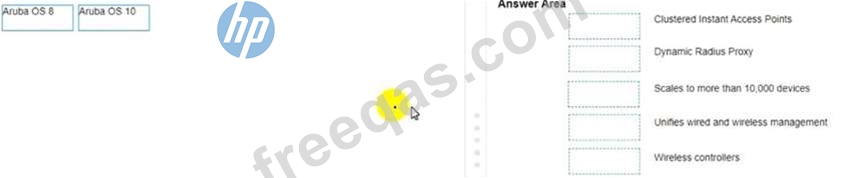
Match the feature to the Aruba OS version (Matches may be used more than once.)

Correct Answer:

Explanation
Features: 1) Clustered Instant Access Points Aruba OS version: a) Aruba OS 8 Features: 2) Dynamic Radius Proxy Aruba OS version: a) Aruba OS 8 Features: 3) Scales to more than 10,000 devices Aruba OS version: b) Aruba OS 10 Features: 4) Unifies wired and wireless management Aruba OS version: a) Aruba OS 8 Features: 5) Wireless controllers Aruba OS version: a) Aruba OS 8 ArubaOS is the operating system for all Aruba Mobility Controllers (MCs) and controller-managed wireless access points (APs). ArubaOS 8 delivers unified wired and wireless access, seamless roaming, enterprise grade security, and a highly available network with the required reliability to support high density environments1.
Some of the features of ArubaOS 8 are:
Clustered Instant Access Points: This feature allows multiple Instant APs to form a cluster and share configuration and state information. This enables seamless roaming, load balancing, and fast failover for clients2.
Dynamic Radius Proxy: This feature allows an MC to act as a proxy for RADIUS authentication requests from clients or APs. This simplifies the configuration and management of RADIUS servers and reduces the network traffic between MCs and RADIUS servers3.
Wireless controllers: Aruba wireless controllers are devices that centrally manage and control the wireless network. They provide functions such as AP provisioning, configuration, security, policy enforcement, and network optimization.
ArubaOS 10 is the next-generation operating system that works with Aruba Central, a cloud-based network management platform. ArubaOS 10 delivers greater scalability, security, and AI-powered optimization across large campuses, branches, and remote work environments. Some of the features of ArubaOS 10 are:
Scales to more than 10,000 devices: ArubaOS 10 can support up to 10,000 devices per cluster, which is ten times more than ArubaOS 8. This enables customers to scale their networks without compromising performance or reliability.
Unifies wired and wireless management: ArubaOS 10 provides a single platform for managing both wired and wireless devices across the network. Customers can use Aruba Central to configure, monitor, troubleshoot, and update their devices from anywhere.
Both ArubaOS 8 and ArubaOS 10 share some common features, such as:
Unifies wired and wireless management: Both operating systems provide unified wired and wireless access for customers who use Aruba switches and APs. Customers can use a single interface to manage their entire network infrastructure
https://www.arubanetworks.com/resource/arubaos-8-fundamental-guide/ 2
https://www.arubanetworks.com/techdocs/Instant_86_WebHelp/Content/instant-ug/iap-maintenance/clust
3
https://www.arubanetworks.com/techdocs/ArubaOS_86_Web_Help/Content/arubaos-solutions/1-overview
https://www.arubanetworks.com/products/networking/controllers/
https://www.arubanetworks.com/products/network-management-operations/arubaos/
https://blogs.arubanetworks.com/solutions/making-the-switch/
https://www.arubanetworks.com/products/network-management-operations/aruba-central/
insert code

Question 20

The customer has a requirement to create authorization policies for their users with Windows 10 clients, with a requirement Tor authorizing both device and user credentials within one Radius session.
What would be the correct solution for the requirement?

Correct Answer: D
Explanation
EAP-TEAP is a tunnel-based authentication method that supports both device and user authentication within a single RADIUS session. ClearPass 6.9 supports EAP-TEAP as anauthentication method for Windows 10 clients. References:
https://www.arubanetworks.com/techdocs/ClearPass/6.9/Guest/Content/CPPM_UserGuide/EAP-TEAP/EAP-TE
insert code
  • «
  • 1
  • 2
  • 3
  • 4
  • 5
  • 6
  • »
[×]

Download PDF File

Enter your email address to download HP.HPE6-A85.v2023-10-28.q23 Dumps

Email:

FreeQAs

Our website provides the Largest and the most Latest vendors Certification Exam materials around the world.

Using dumps we provide to Pass the Exam, we has the Valid Dumps with passing guranteed just which you need.

  • DMCA
  • About
  • Contact Us
  • Privacy Policy
  • Terms & Conditions
©2026 FreeQAs

www.freeqas.com materials do not contain actual questions and answers from Cisco's certification exams.
