A hospital uses a lot of mobile equipment for the diagnosis and documentation of patient data. What Is the ideal access switch for this large hospital with distribution racks of over 400 ports in a single VSF stack?
Correct Answer: A
The ideal access switch for a large hospital with distribution racks of over 400 ports in a single VSF stack is the CX 6300. This switch provides the following benefits: - The CX 6300 supports up to 48 ports per switch and up to 10 switches per VSF stack, allowing for a total of 480 ports in a single stack. This meets the requirement of having over 400 ports in a single VSF stack. - The CX 6300 supports high-performance switching with up to 960 Gbps of switching capacity and up to 714 Mpps of forwarding rate. This meets the requirement of having high throughput and low latency for mobile equipment and patient data. - The CX 6300 supports advanced features such as dynamic segmentation, policy-based routing, and role-based access control. These features enhance the security and flexibility of the network by applying different policies and roles to different types of devices and users. - The CX 6300 supports Aruba NetEdit, a network configuration and orchestration tool that simplifies the management and automation of the network. This reduces the complexity and human errors involved in network configuration and maintenance. The other options are not ideal because: - OCX 6400: This switch is designed for data center applications and does not support VSF stacking. It also does not support dynamic segmentation or policy-based routing, which are useful for network security and flexibility. - OCX 6200: This switch is designed for small to medium-sized businesses and does not support VSF stacking. It also has lower switching capacity and forwarding rate than the CX 6300, which may affect the performance of the network. - OCX 6100: This switch is designed for edge applications and does not support VSF stacking. It also has lower switching capacity and forwarding rate than the CX 6300, which may affect the performance of the network. References: https://www.arubanetworks.com/assets/ds/DS_CX6300Series.pdf https://www.arubanetworks.com/assets/ds/DS_OC6400Series.pdf https://www.arubanetworks.com/assets/ds/DS_OC6200Series.pdf https://www.arubanetworks.com/assets/ds/DS_OC6100Series.pdf
Question 47
You need to troubleshoot an Aruba CX 6200 4-node VSF stack switch that fails to boot correctly Select the option that allows you to access the switch and see the boot options available for OS images and ServiceOS.
Correct Answer: C
Explanation The option that allows you to access the switch and see the boot options available for OS images and ServiceOS is Conductor USB-C console port. This option provides direct access to ServiceOS, which is an operating system that runs on Aruba CX switches independently of AOS-CX Aruba Operating System CX (AOS-CX) is an operating system that runs on Aruba CX switches . ServiceOS provides low-level functions such as booting, firmware upgrades, password recovery, hardware diagnostics, switch stacking, and system recovery. ServiceOS can be accessed through one of two methods: Conductor USB-C console port: This method allows you to connect your PC or laptop to the USB-C console port on any member switch in a VSF stack using a USB-C cable. This method provides direct access to ServiceOS without requiring any configuration or authentication on AOS-CX. AOS-CX CLI: This method allows you to access ServiceOS through AOS-CX CLI using SSH or Telnet protocols. This method requires you to configure an IP address on AOS-CX and authenticate with your username and password. To see the boot options available for OS images and ServiceOS, you need to access ServiceOS through Conductor USB-C console port and enter boot menu command at ServiceOS prompt. The other options do not allow you to access the switch and see the boot options available for OS images and ServiceOS because: Member 2 RJ-45 console port: This option allows you to connect your PC or laptop to the RJ-45 console port on any member switch in a VSF stack using an RJ-45 cable. This option provides direct access to AOS-CX CLI, not ServiceOS. Member 2 switch mgmt port: This option allows you to connect your PC or laptop to the switch mgmt port on any member switch in a VSF stack using an Ethernet cable. This option provides indirect access to AOS-CX CLI through SSH or Telnet protocols, not ServiceOS. Conductor mgmt port using SSH: This option allows you to connect your PC or laptop to the mgmt port on any member switch in a VSF stack using an Ethernet cable. This option provides indirect access to AOS-CX CLI through SSH protocol, not ServiceOS. References: https://www.arubanetworks.com/techdocs/AOS-CX_10_08/NOSCG/Content/cx-noscg/serviceos/serviceos-overv https://www.arubanetworks.com/techdocs/AOS-CX_10_08/NOSCG/Content/cx-noscg/serviceos/access-serviceo https://www.arubanetworks.com/techdocs/AOS-CX_10_08/NOSCG/Content/cx-noscg/serviceos/boot-menu.htm
Question 48
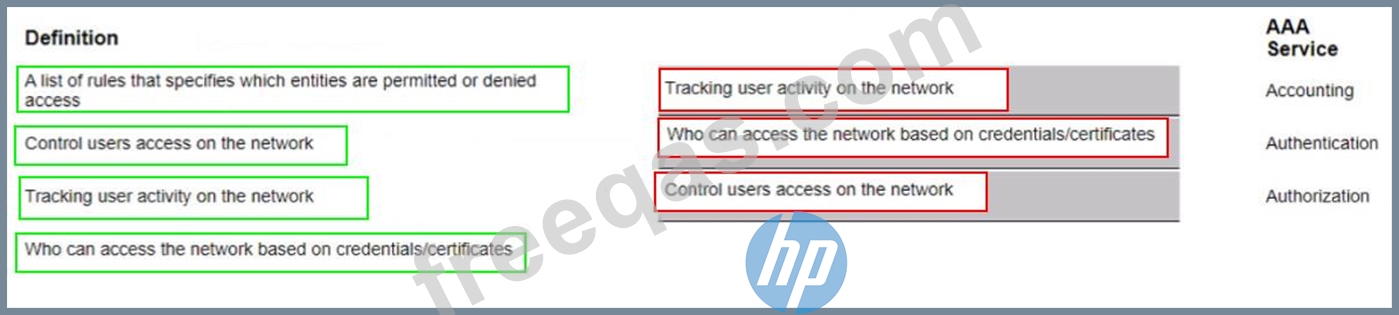
Match each AAA service with its correct definition (Matches may be used more than once or not at all)
Correct Answer:
Question 49
Match the phase of message processing with the Open Systems interconnection (OSl) layer.
Correct Answer:
Explanation: In the OSI model, data is handled differently at each layer. Here is the correct matching of the phase of message processing with the OSI layer: Physical Layer: Organizes the data into bits. Data Link Layer: Organizes the data into frames. Network Layer: Organizes the data into packets. Transport Layer: Organizes the data into segments. The Physical Layer is responsible for the transmission of raw bits over a physical medium. The Data Link Layer encapsulates packets into frames with MAC addresses for node-to-node communication. The Network Layer is responsible for packet forwarding including routing through intermediate routers. The Transport Layer provides reliable data transfer services to the upper layers and handles the segmentation and reassembly of data.
Question 50
Describe the functionality of ARP.
Correct Answer: C
The Address Resolution Protocol (ARP) is used to map layer-3 IP addresses to layer-2 MAC addresses. When a device on a network wants to communicate with another device, it uses ARP to find the MAC address that corresponds to the IP address it wishes to communicate with, allowing it to construct a frame for the local network.