FreeQAs
 Request Exam  Contact
  • Home
  • View All Exams
  • New QA's
  • Upload
PRACTICE EXAMS:
  • Oracle
  • Fortinet
  • IBM
  • Juniper
  • Microsoft
  • Cisco
  • Citrix
  • CompTIA
  • VMware
  • ISC
  • SAP
  • EMC
  • PMI
  • HP
  • Salesforce
  • Other
  • Oracle
    Oracle
  • Fortinet
    Fortinet
  • IBM
    IBM
  • Juniper
    Juniper
  • Microsoft
    Microsoft
  • Cisco
    Cisco
  • Citrix
    Citrix
  • CompTIA
    CompTIA
  • VMware
    VMware
  • ISC
    ISC
  • SAP
    SAP
  • EMC
    EMC
  • PMI
    PMI
  • HP
    HP
  • Salesforce
    Salesforce
  1. Home
  2. HP Certification
  3. HPE7-A01 Exam
  4. HP.HPE7-A01.v2025-07-22.q100 Dumps
  • ««
  • «
  • …
  • 3
  • 4
  • 5
  • 6
  • 7
  • 8
  • 9
  • 10
  • 11
  • 12
  • …
  • »
  • »»
Download Now

Question 31

A new network design is being considered to minimize client latency in a high-density environment. The design needs to do this by eliminating contention overhead by dedicating subcarriers to clients.
Which technology is the best match for this use case?

Correct Answer: A
OFDMA (Orthogonal Frequency Division Multiple Access) is a technology that can minimize client latency in a high-density environment by eliminating contention overhead by dedicating subcarriers to clients. OFDMA allows multiple clients to transmit simultaneously on different subcarriers within the same channel, reducing contention and increasing efficiency. MU-MIMO (Multi-User Multiple Input Multiple Output) is a technology that allows multiple clients totransmit simultaneously on different spatial streams within the same channel, but it does not eliminate contention overhead. QWMM (Quality of Service Wireless Multimedia) is a technology that prioritizes traffic based on four access categories, but it does not eliminate contention overhead. Channel Bonding is a technology that combines two adjacent channels into one wider channel, increasing bandwidth but not eliminating contention overhead.References:
https://www.arubanetworks.com/assets/ds/DS_AP510Series.pdfhttps://www.arubanetworks.com/assets/wp/WP_
insert code

Question 32

A customer is looking Tor a wireless authentication solution for all of their loT devices that meet the following requirements
- The wireless traffic between the IoT devices and the Access Points must be encrypted
- Unique passphrase per device
- Use fingerprint information to perform role-based access
Which solutions will address the customer's requirements? (Select two.)

Correct Answer: A,C
MPSK is a feature that allows device-specific or group-specific passphrases for WPA2 PSK-based deployments. The passphrases are generated by a RADIUS server such as ClearPass Policy Manager and sent to the APs. The wireless traffic between the IoT devices and the APs is encrypted using the passphrases. The passphrases can also be used to perform role-based access by mapping them to different VLANs and user roles 12. ClearPass Policy Manager is a network access control solution that can provide device fingerprinting and profiling for IoT devices based on various attributes such as MAC address, DHCP options, HTTP user agents, etc3. ClearPass Policy Manager can also integrate with other IoT platforms and services to enhance the visibility and security of IoT devices.
References:
1 https://www.arubanetworks.com/techdocs/central/latest/content/aos10x/cfg/aps/wpa2_mpsk.htm
https://docs.fortinet.com/document/fortigate/7.0.0/new-features/139640/wireless-client-mac- authentication-and-
3 https://www.arubanetworks.com/assets/ds/DS_ClearPass.pdf
https://www.arubanetworks.com/assets/tg/TB_ClearPass_IoT.pdf
insert code

Question 33

What is one advantage of using OCSP vs CRLs for certificate validation?

Correct Answer: A
OCSP is a protocol that allows clients to query the CA or a trusted responder for the status of a specific certificate. OCSP requests and responses are smaller and faster than CRLs, and they can provide real- time information about the revocation status of a certificate12. CRLs are lists of all revoked certificates that are downloaded from the CA. CRLs can present issues, as they can become outdated and have to be downloaded frequently13. Therefore, OCSP reduces latency between the time a certificate is revoked and validation reflects this status.
References:
1 https://sectigostore.com/blog/ocsp-vs-crl-whats-the-difference/
2 https://www.keyfactor.com/blog/what-is-a-certificate-revocation-list-crl-vs-ocsp/
3 https://www.fortinet.com/resources/cyberglossary/ocsp
insert code

Question 34

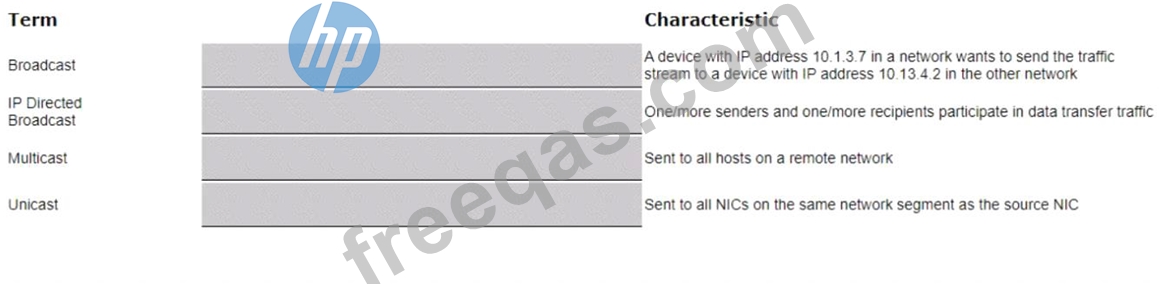
Match the terms below to their characteristics (Options may be used more than once or not at all.)
Correct Answer:

Explanation:
a) A device with IP address 10.1.3.7 in a network wants to send the traffic stream to a device with IP address
10.13.4.2 in the other network -> Unicast
b) One/more senders and one/more recipients participate in data transfer traffic -> Multicast c) Sent to all hosts on a remote network -> IP Directed Broadcast d) Sent to all NICs on the same network segment as the source NIC -> Broadcast References: 1 https://www.thestudygenius.com/unicast-broadcast-multicast/ The terms broadcast, IP directed broadcast, multicast, and unicast are different types of communication or data transmission over a network. They differ in how many devices are involved in the communication and how they address the messages. The following table summarizes the characteristics of each term1:
A screenshot of a computer Description automatically generated with medium confidence
insert code

Question 35

Which statements regarding 0SPFv2 route redistribution are true for Aruba OS CX switches? (Select two.)


Correct Answer: A,E
These are two correct statements regarding OSPFv2 route redistribution for Aruba OS CX switches. Route redistribution is a process that allows routes from one routing protocol or source to be injected into another routing protocol or destination. OSPFv2 is a link-state routing protocol that supports route redistribution from various sources, such as connected, static, BGP, etc. The "redistribute connected" command will redistribute all connected routes for the switch, including local loopback addresses, into OSPFv2. The "redistribute static route-map connected-routes" command will redistribute all static routes that have a matching permit statement in the route map named "connected-routes" into OSPFv2. The other statements are incorrect because they either do not reflect the correct behavior of route redistribution commands or do not exist as valid commands. Reference: https://www.arubanetworks.com/techdocs/AOS-CX/10.04/HTML/5200-6728/bk01-ch02.html https://www.arubanetworks.com/techdocs/AOS-CX/10.04/HTML/5200-6728/bk01-ch03.html
insert code
  • ««
  • «
  • …
  • 3
  • 4
  • 5
  • 6
  • 7
  • 8
  • 9
  • 10
  • 11
  • 12
  • …
  • »
  • »»
[×]

Download PDF File

Enter your email address to download HP.HPE7-A01.v2025-07-22.q100 Dumps

Email:

FreeQAs

Our website provides the Largest and the most Latest vendors Certification Exam materials around the world.

Using dumps we provide to Pass the Exam, we has the Valid Dumps with passing guranteed just which you need.

  • DMCA
  • About
  • Contact Us
  • Privacy Policy
  • Terms & Conditions
©2026 FreeQAs

www.freeqas.com materials do not contain actual questions and answers from Cisco's certification exams.