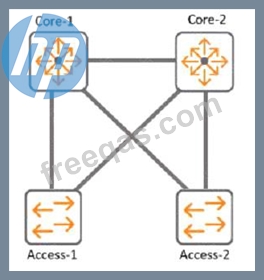
Refer to Exhibit: With Access-1, What needs to be identically configured With MSTP to load-balance VLANS?
Correct Answer: B
Explanation The correct answer is B. Spanning-tree instance VLAN mapping. To load-balance VLANs with MSTP, you need to configure the same VLAN-to-instance mapping on all switches in the same MST region. This means that you need to assign different VLANs to different MST instances, and then adjust the spanning tree parameters (such as priority, cost, or port role) for each instance to achieve the desired load balancing. For example, you can make one switch the root for instance 1 and another switch the root for instance 2, and then map half of the VLANs to instance 1 and the other half to instance 2. According to the Cisco document Understand the Multiple Spanning Tree Protocol (802.1s), one of the steps to configure MST is: Split your set of VLANs into more instances and configure different MST settings for each of these instances. In order to easily achieve this, elect Bridge D1 to be the root for VLANs 501 through 1000, and Bridge D2 to be the root for VLANs 1 through 500. These statements are true for this configuration: Switch D1(config)#spanning-tree mst configuration Switch D1(config-mst)#instance 1 vlan 501-1000 Switch D1(config-mst)#exit Switch D1(config)#spanning-tree mst 1 priority 0 Switch D2(config)#spanning-tree mst configuration Switch D2(config-mst)#instance 2 vlan 1-500 Switch D2(config-mst)#exit Switch D2(config)#spanning-tree mst 2 priority 0 The above commands create two MST instances, 1 and 2, and map VLANs 501-1000 to instance 1 and VLANs 1-500 to instance 2. Then, they make switch D1 the root for instance 1 and switch D2 the root for instance 2. The other options are incorrect because: A: Spanning-tree bpdu-guard setting is a security feature that disables a port if it receives a BPDU from an unauthorized device. It does not affect load balancing with MSTP. C: Spanning-tree CIST mapping is not a valid command. CIST stands for Common and Internal Spanning Tree, which is the spanning tree instance that runs within an MST region and interacts with other regions or non-MST switches. D: Spanning-tree root-guard setting is another security feature that prevents a port from becoming a root port if it receives superior BPDUs from another switch. It does not affect load balancing with MSTP.
Question 57
In AOS 10. which session-based ACL below will only allow ping from any wired station to wireless clients but will not allow ping from wireless clients to wired stations"? The wired host ingress traffic arrives on a trusted port.
Correct Answer: D
A session-based ACL is applied to traffic entering or leaving a port or VLAN based on the direction of the session initiation. To allow ping from any wired station to wireless clients but not vice versa, a session-based ACL should be used to deny icmp echo traffic from any source to any destination, and then permit icmp echo- reply traffic from any source to user destination. The user role represents wireless clients in AOS 10. References: https://techhub.hpe.com/eginfolib/Aruba/OS-CX_10.04/5200-6692/GUID-BD3E0A5F-FE4C-4B9B-BE1D-FE7D2B9F8C3A.html https://techhub.hpe.com/eginfolib/networking/docs/arubaos-switch/security/GUID-EA0A5B3C-FE4C-4B9B-BE1D-FE7D2B9F8C3A.html
Question 58
Which feature supported by SNMPv3 provides an advantage over SNMPv2c?
Correct Answer: D
Explanation Encryption is a feature supported by SNMPv3 that provides an advantage over SNMPv2c. Encryption protects the confidentiality and integrity of SNMP messages by encrypting them with a secret key. SNMPv2c does not support encryption and relies on community strings for authentication and authorization, which are transmitted in clear text and can be easily intercepted or spoofed. Transport mapping, community strings, and GetBulk are features that are common to both SNMPv2c and SNMPv3. References: https://www.arubanetworks.com/techdocs/ArubaOS_86_Web_Help/Content/arubaos-solutions/snmp/snmp.htm https://www.arubanetworks.com/techdocs/ArubaOS_86_Web_Help/Content/arubaos-solutions/snmp/snmpv3.htm
Question 59
Your customer is interested in hearing more about how roles can help keep consistent policy enforcement in a distributed overlay fabric How would you explain this concept to them''
Correct Answer: C
This is the correct explanation of how roles can help keep consistent policy enforcement in a distributed overlay fabric. Roles are used to assign group based policy IDs (GBPs) to devices after they authenticate with ClearPass or a local database. GBPs are then used to tag the traffic from the devices and send them to the ingress VTEP, which applies the GBP on the VXLAN header. The egress VTEP then enforces the policy based on the GBP and the destination device. The other options are incorrect because they either do not describe the correct sequence of events or do not use the correct terms. Reference: https://www.arubanetworks.com/techdocs/AOS-CX/10.04/HTML/5200-6728/bk01-ch03.html https://www.arubanetworks.com/techdocs/AOS-CX/10.04/HTML/5200-6728/bk01-ch05.html
Question 60
You need to configure an ACL on an Aruba switch to block HTTP traffic but allow HTTPS. Which of the following ACL rules accomplishes this?