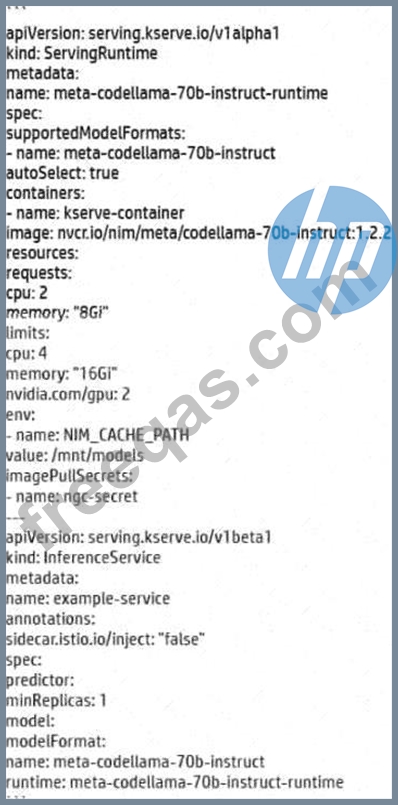
You are planning to demonstrate how you can use KServe to run NIMs on HPE Private Cloud AI. You have downloaded the CodeLlama-70B-Instruct model to a volume in your namespace named demo-model. The objects that you are planning to deploy are shown below: What change should you make to the objects?
Correct Answer: D
D is correct after correcting the YAML location to spec.predictor.model.storageUri. The ServingRuntime describes the runtime container capable of serving the model; the InferenceService describes the particular model instance to deploy. Because the CodeLlama model files already reside on a persistent volume claim named demo-model, the InferenceService must tell KServe where those model artifacts are stored. A PVC URI is therefore supplied through the model's storageUri field, for example pvc://demo-model. Option A is structurally wrong because modelFormat.name identifies the model format understood by the ServingRuntime; it is not a storage location. Option B incorrectly assigns model storage to the ServingRuntime specification. Option C changes the NIM cache directory inside the container but does not tell KServe to mount and initialize the requested model from the PVC. KServe's v1beta1 schema places storageUri alongside modelFormat and runtime under the predictor's model block. This distinction is fundamental to reusable KServe design: a runtime can serve multiple compatible models, while each InferenceService supplies the model-specific location and deployment parameters. References/topics: Advanced HPE Compute Solutions, Rev. 26.21, Module 5 "Other options for serving models on HPE Private Cloud AI"; HPE AI Essentials KServe documentation; KServe InferenceService v1beta1 schema.
Question 7
Which correctly describes an aspect of the AI software stack for HPE Cray XD systems?
Correct Answer: D
D is correct. HPE Cray XD systems use a conventional layered management model: platform firmware is managed through standards-based interfaces such as Redfish, while the host operating environment is Linux- based. This separation is appropriate for HPC because firmware lifecycle, hardware telemetry, node provisioning, and operating-system management are distinct administrative functions even when they are coordinated by cluster-management tooling. Option A overstates the role of HPE GreenLake. HPE Cray XD environments are not fundamentally managed as a multi-system HPC control plane through GreenLake. Option B misnames and mischaracterizes HPE Performance Cluster Manager (HPCM); HPCM is cluster provisioning and management software, not the AI development environment itself. Option C is false because HPE does not provide a single combined firmware- and-OS image that replaces the normal platform firmware and Linux software stack. An integrator should understand both layers: Redfish/BMC interfaces expose node hardware management and telemetry, while Linux and HPC software provide the runtime environment for schedulers, MPI, accelerators, storage clients, and applications. References/topics: Advanced HPE Compute Solutions, Rev. 26.21, Module 9 "HPE Cray management" and "HPE Cray firmware and software"; HPE Cray XD management documentation.
Question 8
What is one benefit of HPE Slingshot for HPC workloads?
Correct Answer: B
B is correct. HPE Slingshot uses fine-grained adaptive routing to make efficient use of available fabric paths. For traffic that can tolerate reordering, the network can make routing decisions at packet granularity, steering packets away from congested links and distributing high-bandwidth MPI or storage traffic across the fabric. This is particularly useful in HPC environments where compute collectives and Lustre I/O can create dynamic hotspots that are difficult to predict with static routing. Option A is false because Slingshot is an Ethernet-based HPC interconnect, not InfiniBand NDR. Option C incorrectly characterizes its congestion management as primarily DiffServ-based; Slingshot uses specialized congestion-control and telemetry mechanisms designed for HPC traffic behavior. Option D overstates a topology requirement. HPC applications do not require every fabric to be constructed as a mathematically non- blocking network, and Slingshot's value includes maintaining performance through adaptive routing and congestion management even under variable traffic. The design goal is sustained application throughput, not merely peak link speed. Efficient path use keeps compute nodes from idling behind network congestion. References/topics: Advanced HPE Compute Solutions, Rev. 26.21, Module 10 "HPE HPC networking solutions"; HPE Slingshot QuickSpecs and adaptive-routing documentation.
Question 9
What is one role played by the retriever reranking NIM in the NVIDIA NeMo Retriever pipeline?
Correct Answer: C
C is correct. In a retrieval-augmented generation pipeline, initial retrieval can return a set of candidate passages or vectors that are approximately relevant to the user's query. The retriever reranking NIM evaluates those candidates more precisely and reorders them so that the items with the strongest semantic relevance are placed first. The highest-quality context can then be supplied to the generative model, improving answer relevance and reducing the amount of weak context passed into the prompt. Option A describes ingestion and preprocessing, which occurs before the content is indexed in a RAG datastore. Option B describes retrieval or database-query activity, not reranking itself. Option D is the role of the LLM or generation NIM that produces the final natural-language response. Reranking sits between retrieval and generation. The distinction is important because RAG quality is not determined only by the embedding search. A reranker can use a stronger relevance model on a limited candidate set, trading a small amount of additional computation for substantially better context selection. References/topics: Advanced HPE Compute Solutions, Rev. 26.21, Module 5, NVIDIA NeMo deep dive; NVIDIA NeMo Retriever documentation, retrieval and reranking services.
Question 10
What is one innovation in NVIDIA Blackwell GPUs?
Correct Answer: A
A is correct, with the terminology corrected to "second-generation Transformer Engine." NVIDIA Blackwell introduces a second-generation Transformer Engine that expands support for lower-precision numerical formats used in AI workloads. By dynamically selecting suitable precision while preserving model quality, the architecture can increase throughput and reduce memory and compute requirements for training and inference. Blackwell also introduces newer Tensor Core capabilities specifically designed for generative-AI workloads. The other choices do not accurately describe Blackwell. The architecture is not characterized by an "L4 memory cache." High-speed GPU-to-GPU communication in HGX-class systems relies on NVIDIA NVLink /NVSwitch technology rather than simply routing peer traffic over ordinary PCIe lanes. Blackwell uses fifth- generation Tensor Cores; therefore an answer referring to a mixture of fourth-generation Tensor and RT cores is not correct. For the HPE7-S02 objective, the important point is workload fit. HPE AI-optimized systems use current accelerator architectures because LLM training and inference depend heavily on tensor throughput, efficient low-precision arithmetic, high memory bandwidth, and fast GPU interconnects. References/topics: Advanced HPE Compute Solutions, Rev. 26.21, Module 1 "HPE ProLiant Gen12 for AI"; HPE and NVIDIA Blackwell platform materials; NVIDIA Blackwell architecture documentation.