FreeQAs
 Request Exam  Contact
  • Home
  • View All Exams
  • New QA's
  • Upload
PRACTICE EXAMS:
  • Oracle
  • Fortinet
  • Juniper
  • Microsoft
  • Cisco
  • Citrix
  • CompTIA
  • VMware
  • ISC
  • SAP
  • EMC
  • PMI
  • HP
  • Salesforce
  • Other
  • Oracle
    Oracle
  • Fortinet
    Fortinet
  • Juniper
    Juniper
  • Microsoft
    Microsoft
  • Cisco
    Cisco
  • Citrix
    Citrix
  • CompTIA
    CompTIA
  • VMware
    VMware
  • ISC
    ISC
  • SAP
    SAP
  • EMC
    EMC
  • PMI
    PMI
  • HP
    HP
  • Salesforce
    Salesforce
  1. Home
  2. HashiCorp Certification
  3. HCVA0-003 Exam
  4. HashiCorp.HCVA0-003.v2025-07-18.q98 Dumps
  • «
  • 1
  • 2
  • 3
  • 4
  • 5
  • 6
  • 7
  • 8
  • 9
  • 10
  • …
  • »
  • »»
Download Now

Question 16

By default, what TCP port does Vault replication use?

Correct Answer: C
Comprehensive and Detailed in Depth Explanation:
Vault replication ensures data consistency across clusters, using a specific port:
* A: 8200- Default HTTP API port, not replication.
* B: 8300- Raft protocol port, not replication.
* C: 8201- Default replication port. Correct.
* D: 8301- Serf protocol port, not replication.
Overall Explanation from Vault Docs:
"Replication occurs on TCP port 8201 by default... distinct from the API (8200) and Raft (8300) ports." Reference: https://developer.hashicorp.com/vault/tutorials/day-one-raft/raft-reference-architecture#network-connectivity
insert code

Question 17

A new Vault administrator is writing a CURL command (shown below) to retrieve a secret stored in a KV v2 secrets engine at secret/audio/soundbooth but is receiving an error. What could be the cause of the error?
$ curl \
--header "X-Vault-Token: hvs.rffHw0iXqkRo19b2cjf93DM39WjpbN3J" \
https://vault.unlimited.com:8200/v1/secret/audio/soundbooth

Correct Answer: B
Comprehensive and Detailed in Depth Explanation:
The error occurs because the CURL command uses the wrong endpoint for a KV v2 secrets engine. The HashiCorp Vault documentation states: "The KVv2 store uses a prefixed API, which is different from the version 1 API. Writing and reading versions are prefixed with the data/ path." For KV v2, the correct endpoint to retrieve a secret is /v1/secret/data/audio/soundbooth, not /v1/secret/audio/soundbooth, which applies to KV v1.
The docs explain: "In KV v2, the data/ prefix is required when accessing secrets via the API to distinguish data operations from metadata or versioning tasks." Option A (VAULT_ADDR) is irrelevant for API calls, as it's CLI-specific. Option C (token UI restriction) is incorrect-tokens apply universally. Option D misinterprets v1 as the API version, not the engine version. Thus, B is correct.
Reference:
HashiCorp Vault Documentation - KV v2: ACL Rules
insert code

Question 18

You have multiple Vault clusters in your environment, one for test and one for production. You have the CLI installed on your local machine and need to target the production cluster to make configuration changes. What environment variable can you set to target the production cluster?

Correct Answer: C
Comprehensive and Detailed In-Depth Explanation:
The VAULT_ADDR variable specifies the target Vault server. The Vault documentation states:
"VAULT_ADDR is the environment variable that is used to specify the address of the Vault server expressed as a URL and port, for example: https://vault.bryankrausen.com:8200/. You can easily modify the value of the environment variable whenever you want to target a different Vault node/cluster."
-Vault Environment Variables
* C: Correct. Sets the production cluster address:
"Setting the VAULT_ADDR environment variable allows you to specify the address of the Vault server you want to target."
-Vault Environment Variables
* A,B,D: Incorrect; unrelated to CLI targeting.
References:
Vault Environment Variables
insert code

Question 19

Which statement describes the results of this command: $ vault secrets enable transit

Correct Answer: A
The command vault secrets enable transit enables the transit secrets engine at the transit path. The transit secrets engine is a secrets engine that handles cryptographic functions on data in-transit, such as encryption, decryption, signing, verification, hashing, and random bytes generation. The transit secrets engine does not store the data sent to it, but only performs the requested operations and returns the results. The transit secrets engine can also be viewed as "cryptography as a service" or "encryption as a service". The command vault secrets enable transit uses the default path of transit for the secrets engine, but this can be changed by using the -path option. For example, vault secrets enable -path=my-transit transit would enable the transit secrets engine at the my-transit path. References: Transit - Secrets Engines | Vault | HashiCorp Developer, vault secrets enable - Command | Vault | HashiCorp Developer
insert code

Question 20

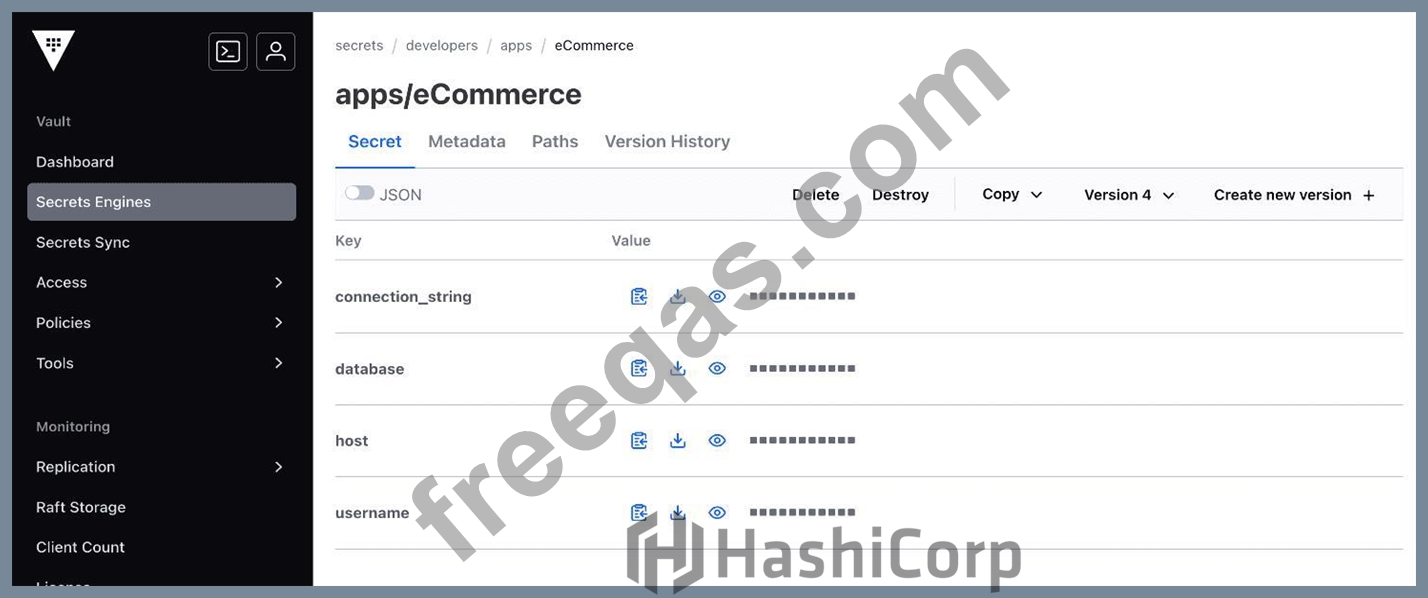
You are working on a new project and need to retrieve a secret from Vault. You log into the Vault UI and browse to the path where the secret is stored. Based on the screenshot below, what is true about the secrets stored in this path? (Select four)
Correct Answer: C,D,E,F
Comprehensive and Detailed In-Depth Explanation:
Assuming the screenshot shows a KV secrets engine at developers/ with version 5 of a secret and options for delete/create:
* C: KV v2 is indicated by versioning (version 5 and four previous versions). KV v1 doesn't support versioning, per the KV v2 documentation.
* D: The path developers/ is the mount point, as secrets are accessed under this path, consistent with Vault's mount structure.
* E: Four previous versions (v1-v4) exist if v5 is current, a feature of KV v2's versioning.
* F: Delete and create options in the UI imply permissions beyond list and read, such as delete and create or update, per Vault's UI behavior reflecting policy capabilities.
* A: KV v1 lacks versioning, so this is incorrect.
* B: The delete option's presence suggests permission exists, though UI visibility isn't a definitive policy check-still, it's typically indicative.
References:
KV Secrets Engine v2 Docs
Vault UI Tutorial
insert code
  • «
  • 1
  • 2
  • 3
  • 4
  • 5
  • 6
  • 7
  • 8
  • 9
  • 10
  • …
  • »
  • »»
[×]

Download PDF File

Enter your email address to download HashiCorp.HCVA0-003.v2025-07-18.q98 Dumps

Email:

FreeQAs

Our website provides the Largest and the most Latest vendors Certification Exam materials around the world.

Using dumps we provide to Pass the Exam, we has the Valid Dumps with passing guranteed just which you need.

  • DMCA
  • About
  • Contact Us
  • Privacy Policy
  • Terms & Conditions
©2026 FreeQAs

www.freeqas.com materials do not contain actual questions and answers from Cisco's certification exams.
