FreeQAs
 Request Exam  Contact
  • Home
  • View All Exams
  • New QA's
  • Upload
PRACTICE EXAMS:
  • Oracle
  • Fortinet
  • Juniper
  • Microsoft
  • Cisco
  • Citrix
  • CompTIA
  • VMware
  • ISC
  • SAP
  • EMC
  • PMI
  • HP
  • Salesforce
  • Other
  • Oracle
    Oracle
  • Fortinet
    Fortinet
  • Juniper
    Juniper
  • Microsoft
    Microsoft
  • Cisco
    Cisco
  • Citrix
    Citrix
  • CompTIA
    CompTIA
  • VMware
    VMware
  • ISC
    ISC
  • SAP
    SAP
  • EMC
    EMC
  • PMI
    PMI
  • HP
    HP
  • Salesforce
    Salesforce
  1. Home
  2. HashiCorp Certification
  3. HCVA0-003 Exam
  4. HashiCorp.HCVA0-003.v2025-10-21.q101 Dumps
  • ««
  • «
  • …
  • 13
  • 14
  • 15
  • 16
  • 17
  • 18
  • 19
  • 20
  • 21
  • 22
  • »
Download Now

Question 81

You need to create a limited-privileged token that isn't impacted by the TTL of its parent. What type of token should you create?

Correct Answer: B
Comprehensive and Detailed In-Depth Explanation:
For independence from parent TTL:
* B. Orphan token: "Orphan tokens are not children of their parent; therefore, orphan tokensdo not expire when their parent does."
* Incorrect Options:
* A: Use limit doesn't affect TTL linkage.
* C: Periodic tokens renew but follow parent TTL.
* D: Root tokens are unrestricted.
Reference:https://developer.hashicorp.com/vault/tutorials/tokens/tokens#orphan-tokens
insert code

Question 82

Jarrad is an AWS engineer and has provisioned a new EC2 instance running MySQL since his application requires a specific MySQL version. He wants to integrate Vault into his workflow but is new to Vault. What secrets engine should Jarrad use to integrate this new database running in AWS?

Correct Answer: B
Comprehensive and Detailed In-Depth Explanation:
For integrating a MySQL database on an EC2 instance with Vault, thedatabase secrets engineis the appropriate choice:
* B. database: "The 'database' secrets engine in Vault is specifically designed for integrating with databases like MySQL." It generates dynamic credentials, manages rotations, and supports MySQL plugins, ideal for Jarrad's use case. "To manage the database resource, the database secrets engine should be used, specifically with the MySQL plugin."
* Incorrect Options:
* A. azure: For Azure-specific credential management, not databases. "Used for generating Azure service principal credentials."
* C. kv: Stores static secrets, not dynamic database credentials. "Used for storing arbitrary secrets in a key-value pair format."
* D. aws: Manages AWS credentials, not database integration. "Used for generating AWS access keys." The database engine's MySQL support is agnostic to the hosting platform (EC2 vs. RDS), focusing on the database itself.
Reference:https://developer.hashicorp.com/vault/docs/secrets/databases/mysql-maria
insert code

Question 83

The key/value v2 secrets engine is enabled at secret/ See the following policy:
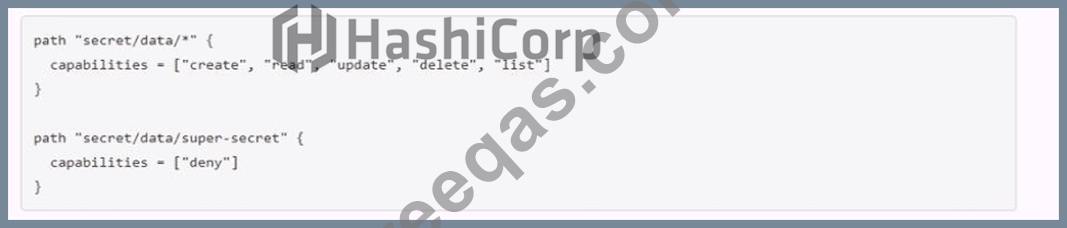
Which of the following operations are permitted by this policy? Choose two correct answers.

Correct Answer: A,C
The policy shown in the image is:
path "secret/data/webapp1" { capabilities = ["create", "read", "update", "delete", "list"] } path "secret/data/super-secret" { capabilities = ["deny"] } This policy grants or denies access to the key/value v2 secrets engine mounted at secret/ according to the following rules:
* The path "secret/data/webapp1" has the capabilities of "create", "read", "update", "delete", and "list".
This means that the policy allows performing any of these operations on the secrets stored under this path. The data/ prefix is used to access the actual secret data in the key/value v2 secrets engine5. Therefore, the policy permits the operation of vault kv get secret/webapp1, which reads the secret data at secret/data/webapp16.
* The path "secret/data/super-secret" has the capability of "deny". This means that the policy denies performing any operation on the secrets stored under this path. The policy overrides any other policy that might grant access to this path. Therefore, the policy does not permit the operations of vault kv delete secret/super-secret and vault kv list secret/super-secret, which delete and list the secret data at secret/data/super-secret respectively6.
* The policy does not explicitly define any rules for the path "secret/metadata". The metadata/ prefix is used to access the metadata of the secrets in the key/value v2 secrets engine, such as the number of versions, the deletion status, the creation time, etc5. By default, if the policy grants any of the capabilities of "create", "read", "update", or "delete" on the data/ path, it also grants the same capabilities on the corresponding metadata/ path7. Therefore, the policy permits the operation of vault kv metadata get secret/webapp1, which reads the metadata of the secret at secret/metadata/webapp18.
5 (https://developer.hashicorp.com/vault/docs/secrets/kv/kv-v2), [6]6, 7 (https://developer.hashicorp.com/vault/docs/secrets/kv/kv-v2), [8]8
insert code

Question 84

Select the two paths below that would be permitted for read access based on the following Vault policy:
path "secret/+/training/*" {
capabilities = ["create", "read"]
}

Correct Answer: B,D
Comprehensive and Detailed In-Depth Explanation:
Vault policies use path-based syntax with wildcards (+ for one segment, * for zero or more) to define permissions. The policy path "secret/+/training/*" { capabilities = ["create", "read"] } grants "create" and
"read" access to paths matching this pattern.
* Path Analysis:
* The + wildcard matches exactly one segment after "secret/".
* "training/" must follow that segment.
* The * wildcard allows any number of subsequent segments (including none).
* Correct Paths:
* B. secret/cloud/training/test/exam: Matches as "cloud" fits +, followed by "training/", and "test
/exam" fits *. "Permitted since + allows for cloud and * allows for test/exam."
* D. secret/departments/training/vault: Matches with "departments" as +, "training/", and "vault" as *. "Permitted since + allows for departments and vault is in place of *."
* Incorrect Paths:
* A. secret/business/training: Fails because there's no trailing segment after "training/" to match
*. "Not permitted since the wildcard is AFTER training."
* C. secret/departments/certification/api: Fails because "certification" replaces "training/", which is required. "Not permitted since certification does not equal training." This policy targets paths with a specific structure, ensuring precise access control.
Reference:https://developer.hashicorp.com/vault/docs/concepts/policies#policy-syntax
insert code

Question 85

Based on the following output, what command can Steve use to determine if the KV store is configured for versioning?
text
CollapseWrapCopy
$ vault secrets list
Path Type Accessor Description
---- ---- -------- -----------
automation/ kv kv_56f991b9 Automation team for CI/CD
cloud/ kv kv_4426c541 Cloud team for static secrets
cubbyhole/ cubbyhole cubbyhole_9bd538e per-token priv secret storage
data_team/ kv kv_96d57692 Data warehouse KV for certs
identity/ identity identity_0042595e identity store
network/ kv kv_3e53aaab Network team secret storage
secret/ kv kv_d66e2adc key/value secret storage
sys/ system system_d6f218a9 system endpoints

Correct Answer: C
Comprehensive and Detailed in Depth Explanation:
To determine if a KV store is configured for versioning (i.e., KV v1 or v2), Steve needs detailed information about the secrets engines. The HashiCorp Vault documentation states: "To list all enabled secrets engines with detailed output, use the command vault secrets list -detailed. This will provide additional information about each secrets engine, including the version of the KV secrets engines." The -detailed flag reveals configuration details, such as the options field indicating version=2 for KV v2, which supports versioning.
vault secrets list -allis not a valid command.vault kv get automationretrieves a specific secret, not engine configuration.vault kv listlists keys in a path, not engine details. Thus, C is correct.
Reference:
HashiCorp Vault Documentation - Secrets Engines(Note: Specific command details are from CLI help and tutorials)
insert code
  • ««
  • «
  • …
  • 13
  • 14
  • 15
  • 16
  • 17
  • 18
  • 19
  • 20
  • 21
  • 22
  • »
[×]

Download PDF File

Enter your email address to download HashiCorp.HCVA0-003.v2025-10-21.q101 Dumps

Email:

FreeQAs

Our website provides the Largest and the most Latest vendors Certification Exam materials around the world.

Using dumps we provide to Pass the Exam, we has the Valid Dumps with passing guranteed just which you need.

  • DMCA
  • About
  • Contact Us
  • Privacy Policy
  • Terms & Conditions
©2026 FreeQAs

www.freeqas.com materials do not contain actual questions and answers from Cisco's certification exams.
