FreeQAs
 Request Exam  Contact
  • Home
  • View All Exams
  • New QA's
  • Upload
PRACTICE EXAMS:
  • Oracle
  • Fortinet
  • Juniper
  • Microsoft
  • Cisco
  • Citrix
  • CompTIA
  • VMware
  • ISC
  • SAP
  • EMC
  • PMI
  • HP
  • Salesforce
  • Other
  • Oracle
    Oracle
  • Fortinet
    Fortinet
  • Juniper
    Juniper
  • Microsoft
    Microsoft
  • Cisco
    Cisco
  • Citrix
    Citrix
  • CompTIA
    CompTIA
  • VMware
    VMware
  • ISC
    ISC
  • SAP
    SAP
  • EMC
    EMC
  • PMI
    PMI
  • HP
    HP
  • Salesforce
    Salesforce
  1. Home
  2. HashiCorp Certification
  3. HCVA0-003 Exam
  4. HashiCorp.HCVA0-003.v2025-10-21.q101 Dumps
  • «
  • 1
  • 2
  • 3
  • 4
  • 5
  • 6
  • 7
  • 8
  • 9
  • 10
  • …
  • »
  • »»
Download Now

Question 6

Given the following screenshot, how many secrets engines have been enabled by a Vault user?

Correct Answer: B
Comprehensive and Detailed in Depth Explanation:
* cubbyhole is default; kv and transit are user-enabled. Total: 3.
Overall Explanation from Vault Docs:
"cubbyhole is enabled by default... User-enabled engines add to this."
Reference:https://developer.hashicorp.com/vault/docs/secrets/cubbyhole
insert code

Question 7

You are using an orchestrator to deploy a new application. Even though the orchestrator creates anew AppRole secret ID, security requires that only the new application has the combination of the role ID and secret ID. What feature can you use to meet these requirements?

Correct Answer: B
Comprehensive and Detailed in Depth Explanation:
* A:Exposes the secret ID, violating the requirement. Incorrect.
* B:Response wrapping delivers the secret ID in a single-use token, ensuring only the application unwraps it. Correct.
* C:Batch tokens don't address secret ID delivery security. Incorrect.
* D:TLS secures communication but doesn't restrict access to the secret ID. Incorrect.
Overall Explanation from Vault Docs:
"Response wrapping... wraps the secret in a single-use token, ensuring only the intended recipient unwraps it." Reference:https://developer.hashicorp.com/vault/tutorials/auth-methods/approle
insert code

Question 8

Where do you define the Namespace to log into using the Vault Ul?
To answer this question
Use your mouse to click on the screenshot in the location described above. An arrow indicator will mark where you have clicked. Click the "Answer" button once you have positioned the arrow to answer the question. You may need to scroll down to see the entire screenshot.
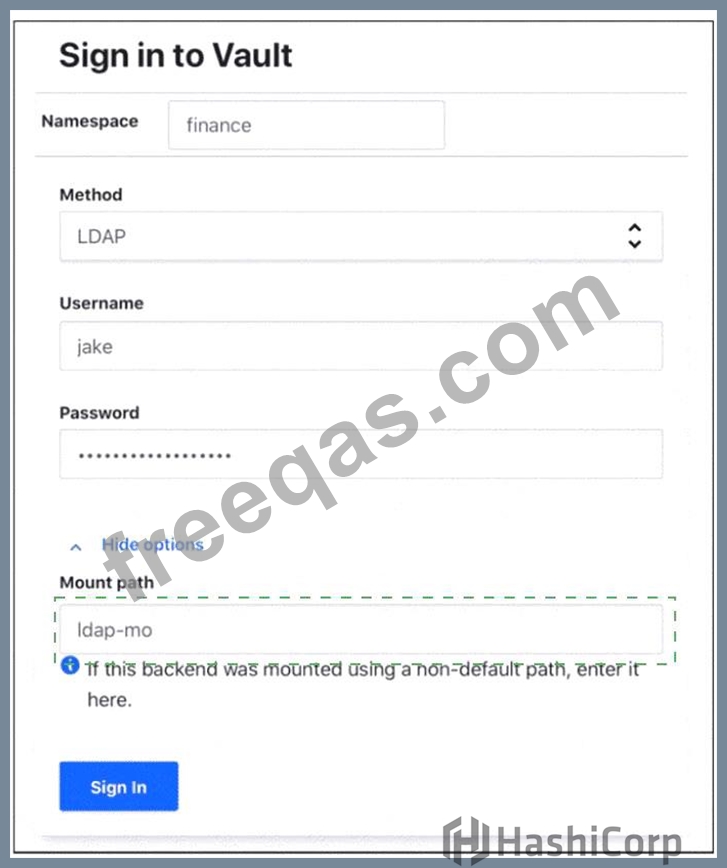
Correct Answer:

Explanation:
The namespace can be defined in the "Mount path" field in the "Advanced options" section of the login screen. The mount path is the path where the auth method is enabled, and it can include a namespace prefix.
For example, if the LDAP auth method is enabled at the path ns1/auth/ldap, where ns1 is the namespace, then the mount path field should be set to ns1/auth/ldap. This way, the Vault UI will log in to the correct namespace and auth method. Alternatively, the namespace can also be specified in the URL of the Vault UI, such as https://vault.example.com/ui/vault/auth/ns1/auth/ldap/login.
insert code

Question 9

You've hit the URL for the Vault UI, but you're presented with this screen. Why doesn't Vault present you with a way to log in?

Correct Answer: B
Comprehensive and Detailed in Depth Explanation:
The initialization page means Vault is new or reset. Let's evaluate:
* A:Storage issues don't trigger this screen; they'd cause errors post-init. Incorrect.
* B:Vault requires initialization (vault operator init) to set up keys and enable login. Correct.
* C:Policies apply post-login, not pre-init. Incorrect.
* D:Config errors would prevent Vault from starting, not show this screen. Incorrect.
Overall Explanation from Vault Docs:
"Before Vault can be used, it must be initialized and unsealed... This screen indicates Vault has not been initialized yet." Reference:https://developer.hashicorp.com/vault/docs/commands/operator/init
insert code

Question 10

Your company's security policies require that all encryption keys must be rotated at least once per year. After using the Transit secrets engine for a year, the Vault admin issues the proper command to rotate the key named ecommerce that was used to encrypt your data. What command can be used to easily re-encrypt the original data with the new version of the key?

Correct Answer: D
Comprehensive and Detailed in Depth Explanation:
The Transit secrets engine in Vault manages encryption keys and supports key rotation. After rotating the ecommerce key, existing ciphertext (encrypted with the old key version) must be re-encrypted (rewrapped) with the new key version without exposing plaintext. Let's evaluate:
* A: vault write -f transit/keys/ecommerce/rotate <old data>This command rotates the key, creating a new version, but does not re-encrypt existing data. It's for key management, not data rewrapping.
Incorrect.
* B: vault write -f transit/keys/ecommerce/update <old data>There's no update endpoint in Transit for re-encrypting data. This is invalid and incorrect.
* C: vault write transit/encrypt/ecommerce v1:v2 <old data>The transit/encrypt endpoint encrypts new plaintext, not existing ciphertext. The v1:v2 syntax is invalid. Incorrect.
* D: vault write transit/rewrap/ecommerce ciphertext=<old data>The transit/rewrap endpoint takes existing ciphertext, decrypts it with the old key version, and re-encrypts it with the latest key version (post-rotation). This is the correct command. For example, if <old data> is vault:v1:cZNHVx+..., the output might be vault:v2:kChHZ9w4....
Overall Explanation from Vault Docs:
"Vault's Transit secrets engine supports key rotation... The rewrap endpoint allows ciphertext encrypted with an older key version to be re-encrypted with the latest key version without exposing the plaintext." This operation is secure and efficient, using the keyring internally.
Reference:https://developer.hashicorp.com/vault/tutorials/encryption-as-a-service/eaas-transit-rewrap
insert code
  • «
  • 1
  • 2
  • 3
  • 4
  • 5
  • 6
  • 7
  • 8
  • 9
  • 10
  • …
  • »
  • »»
[×]

Download PDF File

Enter your email address to download HashiCorp.HCVA0-003.v2025-10-21.q101 Dumps

Email:

FreeQAs

Our website provides the Largest and the most Latest vendors Certification Exam materials around the world.

Using dumps we provide to Pass the Exam, we has the Valid Dumps with passing guranteed just which you need.

  • DMCA
  • About
  • Contact Us
  • Privacy Policy
  • Terms & Conditions
©2026 FreeQAs

www.freeqas.com materials do not contain actual questions and answers from Cisco's certification exams.
