A major manufacturer of popular beverages has appointed a local distributor to serve a specific territory. The demand for the beverages has a pronounced seasonal pattern. The distributor performs well overall, but is repeatedly unable to keep up with fulfilling many customer orders during peak demand periods. The distributor's current delivery capability is stretched to deliver 60 tons of merchandise per day whereas the season's peak demand periods need a daily delivery capability of up to 100 tons.
The distributor is under pressure to fully meet the year-round market demand in order to stay in business. The distributor's management wants to identify and consider more cost-effective options as resorting to adding more trucks and drivers would not be economically feasible.
A business analyst (BA) has spent several days observing and measuring the warehouse activities to understand the situation and to gain insights into possible solutions. The delivery workflow is a four-step process: (1) picking the orders and assembling them on trays, (2) bringing the trays to the loading bay, (3) loading the orders into trucks, and (4) delivering the orders to customers. As the following table illustrates, overall performance depends is dependent on five major resources: (1) the workers who pick the orders and load them into trucks, (2) the tallyers who check the orders, (3) the drivers, (4) the trucks, and (5) eight loading bays (LBs).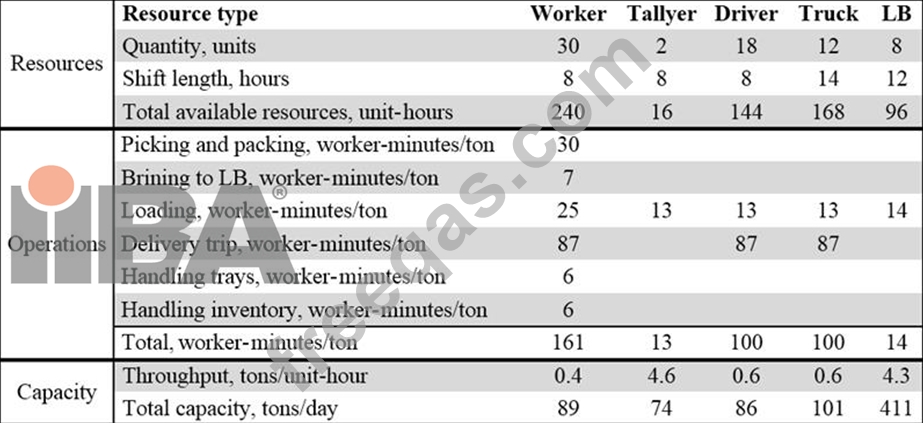
Preparing a customer order for loading takes about one hour. Upon the BA's observation, only 30% of trips have their orders available for loading when a truck arrives. This causes a waste of both the truck's and the driver's time.
What should the BA recommend to eliminate such waste?
Donna is leading a brainstorming session for her organization. She has asked the participants in this group to come up with at least ten ideas for possible solutions to an identified problem.
What is the problem with setting the goal as ten ideas for possible solutions in this session?
A large insurance company wants to buy a new claims processing system or upgrade one of its two existing systems. Each year the claims department is given a $3,5 million budget to spend. Time is of the essence since there are some regulatory changes that will be coming the following year that will require several features that currently neither one of the two claims systems currently support.
There are eight stakeholders involved in this initiative. There are local to where the claim systems are managed, while five are located across the country. The business analyst (BA) struggled to get all stakeholders to agree on the desired features but ultimately got agreement on ten identified key features for the new claims systems. The BA was able to build a current state and future state process model which included all ten key features.
System A processes 75% of the company's claims. It is 5 years old and the claim processors love it because it is easy to use. However it must go offline for two hours each day. The code is very modular so it does have flexibility to be modified. To upgrade system A to have all ten features it would cost %5 million. System A would be at capacity if it were to process all of the company's claims.
System B processes 25% of the company's claims. It is an older mainframe system, but rarely goes offline. It could easily handle double the number of claims that system A processes. However, it has a lot of legacy code and would cost $6 million to upgrade.
Both systems have some of the ten desired key features. But neither system has all ten. The cost to buy a new system would be $7 million.
Below is the estimated cost for each feature in priority order.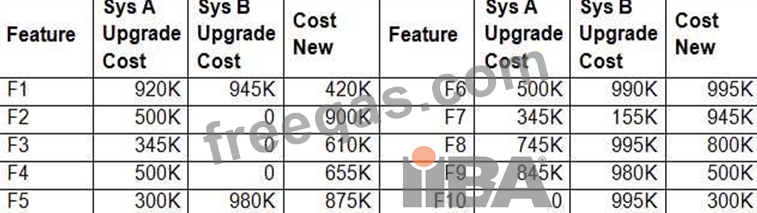
What kind of analysis must the BA do to determine if one of the systems is better suited to be modified and upgraded?
You are the business analyst for the YGT Organization. You have just completed a capabilities gap assessment and have determined that your organization does not have the necessary resources and technology to seize a business opportunity. What is the most likely course of action for the organization?
A business unit of a transnational manufacturer wants to implement a robust process for addressing integrity- critical equipment deterioration incidents. Timely and complete resolution of such incidents is vital for the business unit's continuous safe and profitable operation. Treating each incident involves many employees from different departments extensively collaborating and exchanging information. That information is spread across multiple systems having their access limited to particular user groups. With the current manual process, some incidents get forgotten and remain unresolved for years.
The project's Sponsor is an Equipment Integrity and Reliability Advisor, who moved into this position from another business unit. That business unit implemented a proprietary application to integrate the information and to assist in tracking and managing the incidents. Having a positive experience with the application, the Sponsor is suggesting to customize it and reuse in the new business unit.
The business unit's Enterprise Architect (EA), who is responsible for assessing solution options and presenting them to executive decision makers, has a few concerns with adopting the existing application. The application uses point-to-point interfaces with other data sources whereas the business unit's target architecture relies on a data warehouse-based integration. Moreover, the two business units use different legacy systems, as well as different front-end implementation technologies. Additionally, the existing application is monolingual, while the business unit needs user interfaces and some data to be presented in two languages. With all of this, it may be easier to build a new application from scratch than to customize the existing one. To understand which option is better, the EA asks a business analyst (BA) to define business requirements.
Through the elicitation process, the BA identifies the following requirement: "Particular incident-related activities require approval by authorized personnel before beginning them, as well as confirmation of acceptance of their completion." What kind of asset should the BA provide to fully specify the approval requirement?

