The NIS2 Directive, an update to the European Union's cybersecurity directive, introduces several new requirements, including the establishment of a cyber crisis management framework at both national and EU levels. This is designed to coordinate effective responses to major cybersecurity incidents and crises. NIS2 goes beyond mandating compliance or focusing only on physical security and emphasizes collaboration between the public and private sectors. Reference: NIS2 Directive (Directive (EU) 2022/2555), Articles 9-11, and official ENISA documentation.
Question 52
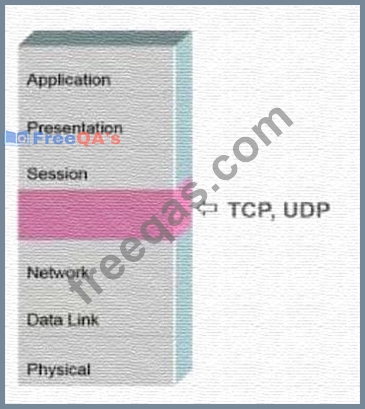
What is the name of the missing layer in the Open Systems Interconnection (OSI) model shown below?
Correct Answer: C
The Open Systems Interconnection (OSI) model is a framework that describes the functions of a networking system. The OSI model categorizes the computing functions of the different network components, outlining the rules and requirement needed to support the interoperability of the software and hardware that make up the network1. The OSI model consists of seven abstraction layers arranged in a top-down order: Physical, Data Link, Network, Transport, Session, Presentation, and Application. The Transport layer is the fourth layer in the OSI model, and it is responsible for ensuring reliable and efficient data transfer between the Network layer and the Session layer2. The Transport layer uses protocols such as Transmission Control Protocol (TCP) and User Datagram Protocol (UDP) to provide end-to-end communication services, such as error detection and correction, flow control, congestion control, and segmentation2. The image that you sent shows a 3D representation of the OSI model, with the layers stacked on top of each other. The missing layer is the Transport layer, which isrepresented by a pink box with a white arrow pointing to it. The arrow is labeled "TCP, UDP". 1: What is the OSI Model? 7 Network Layers Explained | Fortinet 2: What is OSI Model | 7 Layers Explained - GeeksforGeeks
Question 53
What should the identification analysis of discovered vulnerabilities determine?
Correct Answer: A
In the context of vulnerability management within industrial systems, the identification analysis aims to determine the root cause of the vulnerability in order to understand its origin and impact, and to plan appropriate mitigation actions. This is a crucial step in the Secure Product Development Lifecycle (SDL) described in ISA/IEC 62443-4-1. "The supplier shall perform vulnerability root cause analysis as part of the identification phase to determine the underlying cause of the vulnerability. This helps to guide the correction and prevention process." - ISA/IEC 62443-4-1:2018, SR 6.2.1 - Vulnerability Identification and Handling This process not only addresses the specific issue but also improves the product development lifecycle by preventing similar future flaws. References: ISA/IEC 62443-4-1:2018 - SR 6.2.1 ISA/IEC 62443-3-3 - System-level requirements for vulnerability mitigation
Question 54
Which analysis method is MOST frequently used as an input to a security risk assessment? Available Choices (select all choices that are correct)
Correct Answer: C
A Process Hazard Analysis (PHA) is a systematic and structured method of identifying and evaluating the potential hazards and risks associated with an industrial process. A PHA can help to identify the possible causes and consequences of undesired events, such as equipment failures, human errors, cyberattacks, natural disasters, etc. A PHA can also provide recommendations for reducing the likelihood and severity of such events, as well as improving the safety and security of the process. A PHA is one of the most frequently used analysis methods as an input to a security risk assessment, as it can help to identify the assets, threats, vulnerabilities, and impacts related to the process, and provide a basis for determining the security risk level and the appropriate security countermeasures. A PHA is also a requirement of the ISA/IEC 62443 standard, as part of the security program development and implementation phase12. References: 1: ISA/IEC 62443-2-1: Security for industrial automation and control systems: Establishing an industrial automation and control systems security program 2: ISA/IEC 62443-3-2: Security for industrial automation and control systems: Security risk assessment for system design
Question 55
How can defense in depth be achieved via security zones?
Correct Answer: A
Defense in depth is a core concept of ISA/IEC 62443, and security zones are a structural method to implement it. According to ISA/IEC 62443-3-2 and 62443-1-1, layering can be achieved by nesting zones - creating zones within zones (i.e., subzones) - to enhance protection through multiple barriers. "Defense in depth is realized through segmentation into zones and conduits. A zone may contain subzones to establish additional layers of security, providing multiple barriers to intrusion." - ISA/IEC 62443-3-2:2020, Clause 5.3.2 - Zone and Conduit Model This layered zoning approach enables tiered security controls, reducing the impact of breaches and limiting lateral movement within a network. References: ISA/IEC 62443-3-2:2020 - Clause 5.3.2 ISA/IEC 62443-1-1:2007 - Security Zones and Conduits