FreeQAs
 Request Exam  Contact
  • Home
  • View All Exams
  • New QA's
  • Upload
PRACTICE EXAMS:
  • Oracle
  • Fortinet
  • Juniper
  • Microsoft
  • Cisco
  • Citrix
  • CompTIA
  • VMware
  • SAP
  • EMC
  • PMI
  • HP
  • Salesforce
  • Other
  • Oracle
    Oracle
  • Fortinet
    Fortinet
  • Juniper
    Juniper
  • Microsoft
    Microsoft
  • Cisco
    Cisco
  • Citrix
    Citrix
  • CompTIA
    CompTIA
  • VMware
    VMware
  • SAP
    SAP
  • EMC
    EMC
  • PMI
    PMI
  • HP
    HP
  • Salesforce
    Salesforce
  1. Home
  2. ISACA Certification
  3. CISA Exam
  4. ISACA.CISA.v2022-02-26.q471 Dumps
  • ««
  • «
  • …
  • 24
  • 25
  • 26
  • 27
  • 28
  • 29
  • 30
  • 31
  • 32
  • 33
  • …
  • »
  • »»
Download Now

Question 136

Which of the following term in business continuity defines the total amount of time that a business process can be disrupted without causing any unacceptable consequences?

Correct Answer: D
Explanation/Reference:
The sum of RTO and WRT is defined as the Maximum Tolerable Downtime (MTD) which defines the total amount of time that a business process can be disrupted without causing any unacceptable consequences. This value should be defined by the business management team or someone like CTO, CIO or IT manager.
For your exam you should know below information about RPO, RTO, WRT and MTD:
Stage 1: Business as usual
Business as usual
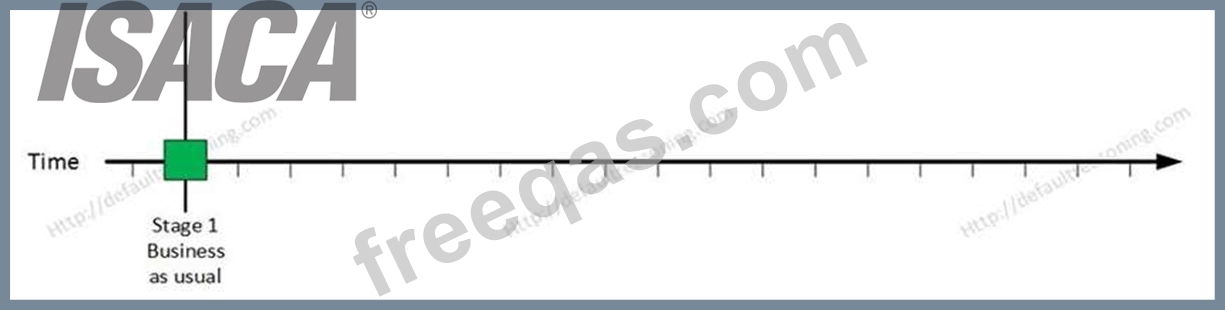
Image Reference - http://defaultreasoning.files.wordpress.com/2013/12/bcdr-01.png At this stage all systems are running production and working correctly.
Stage 2: Disaster occurs
Disaster Occurs
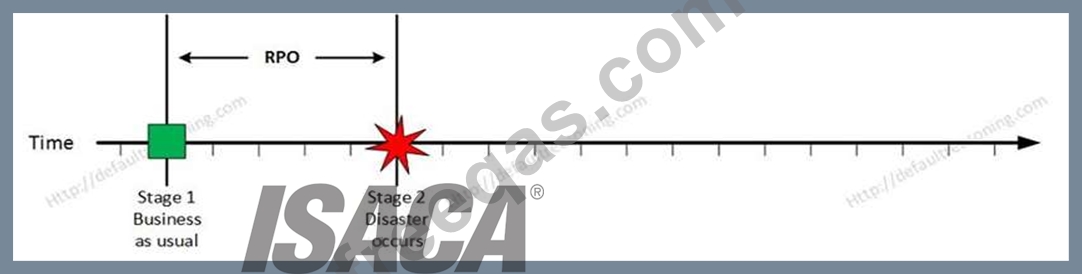
Image Reference - http://defaultreasoning.files.wordpress.com/2013/12/bcdr-02.png On a given point in time, disaster occurs and systems needs to be recovered. At this point the Recovery Point Objective (RPO) determines the maximum acceptable amount of data loss measured in time. For example, the maximum tolerable data loss is 15 minutes.
Stage 3: Recovery
Recovery
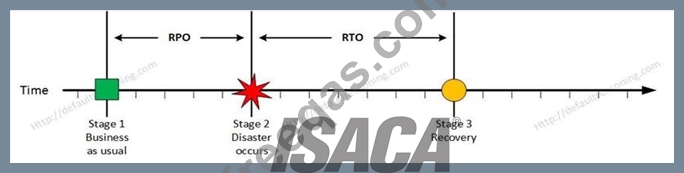
Image Reference - http://defaultreasoning.files.wordpress.com/2013/12/bcdr-03.png At this stage the system are recovered and back online but not ready for production yet. The Recovery Time Objective (RTO) determines the maximum tolerable amount of time needed to bring all critical systems back online. This covers, for example, restore data from back-up or fix of a failure. In most cases this part is carried out by system administrator, network administrator, storage administrator etc.
Stage 4: Resume Production
Resume Production
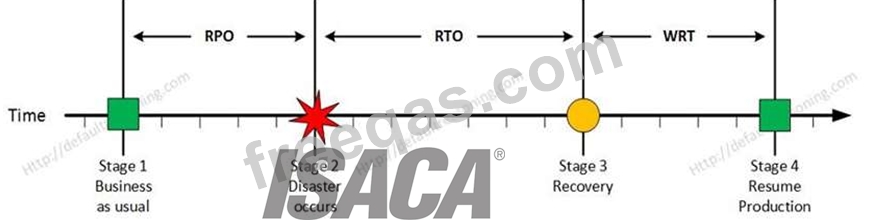
Image Reference - http://defaultreasoning.files.wordpress.com/2013/12/bcdr-04.png At this stage all systems are recovered, integrity of the system or data is verified and all critical systems can resume normal operations. The Work Recovery Time (WRT) determines the maximum tolerable amount of time that is needed to verify the system and/or data integrity. This could be, for example, checking the databases and logs, making sure the applications or services are running and are available.
In most cases those tasks are performed by application administrator, database administrator etc. When all systems affected by the disaster are verified and/or recovered, the environment is ready to resume the production again.
MTD
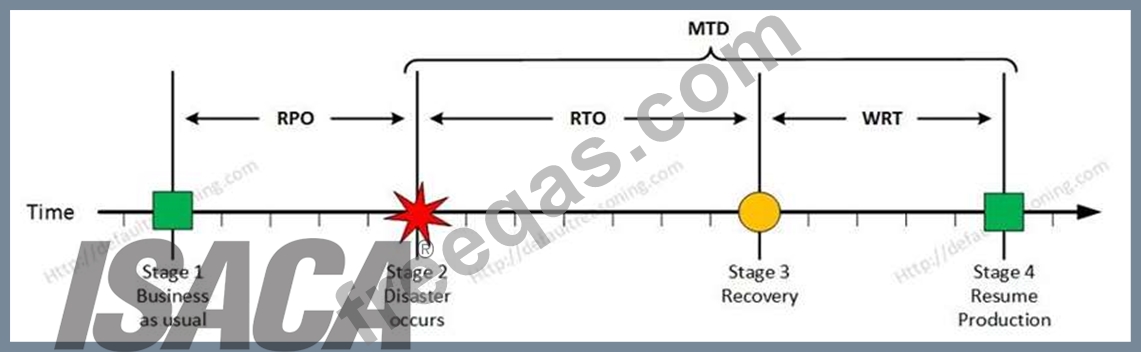
Image Reference - http://defaultreasoning.files.wordpress.com/2013/12/bcdr-05.png The sum of RTO and WRT is defined as the Maximum Tolerable Downtime (MTD) which defines the total amount of time that a business process can be disrupted without causing any unacceptable consequences. This value should be defined by the business management team or someone like CTO, CIO or IT manager.
The following answers are incorrect:
RPO - Recovery Point Objective (RPO) determines the maximum acceptable amount of data loss measured in time. For example, the maximum tolerable data loss is 15 minutes.
RTO - The Recovery Time Objective (RTO) determines the maximum tolerable amount of time needed to bring all critical systems back online. This covers, for example, restore data from back-up or fix of a failure.
In most cases this part is carried out by system administrator, network administrator, storage administrator etc.
WRT - The Work Recovery Time (WRT) determines the maximum tolerable amount of time that is needed to verify the system and/or data integrity. This could be, for example, checking the databases and logs, making sure the applications or services are running and are available. In most cases those tasks are performed by application administrator, database administrator etc. When all systems affected by the disaster are verified and/or recovered, the environment is ready to resume the production again.
The following reference(s) were/was used to create this question:
CISA review manual 2014 page number 284
http://defaultreasoning.com/2013/12/10/rpo-rto-wrt-mtdwth/
insert code

Question 137

When creating a new risk management program, it is CRITICAL to consider:

Correct Answer: B
Section: Governance and Management of IT
insert code

Question 138

Which of the following backup schemes is the BEST option when storage media is limited?

Correct Answer: B
insert code

Question 139

Which of the following layer of an enterprise data flow architecture represents subsets of information from the core data warehouse?

Correct Answer: C
Explanation/Reference:
Data Mart layer - Data mart represents subset of information from the core DW selected and organized to meet the needs of a particular business unit or business line. Data mart can be relational databases or some form on-line analytical processing (OLAP) data structure.
For CISA exam you should know below information about business intelligence:
Business intelligence(BI) is a broad field of IT encompasses the collection and analysis of information to assist decision making and assess organizational performance. To deliver effective BI, organizations need to design and implement a data architecture. The complete data architecture consists of two components The enterprise data flow architecture (EDFA) A logical data architecture
Various layers/components of this data flow architecture are as follows:
Presentation/desktop access layer - This is where end users directly deal with information. This layer includes familiar desktop tools such as spreadsheets, direct querying tools, reporting and analysis suits offered by vendors such as Congas and business objects, and purpose built application such as balanced source cards and digital dashboards.
Data Source Layer - Enterprise information derives from number of sources:
Operational data - Data captured and maintained by an organization's existing systems, and usually held in system-specific database or flat files.
External Data - Data provided to an organization by external sources. This could include data such as customer demographic and market share information.
Nonoperational data - Information needed by end user that is not currently maintained in a computer accessible format.
Core data warehouse -This is where all the data of interest to an organization is captured and organized to assist reporting and analysis. DWs are normally instituted as large relational databases. A property constituted DW should support three basic form of an inquiry.
Drilling up and drilling down - Using dimension of interest to the business, it should be possible to aggregate data as well as drill down. Attributes available at the more granular levels of the warehouse can also be used to refine the analysis.
Drill across - Use common attributes to access a cross section of information in the warehouse such as sum sales across all product lines by customer and group of customers according to length of association with the company.
Historical Analysis - The warehouse should support this by holding historical, time variant data. An example of historical analysis would be to report monthly store sales and then repeat the analysis using only customer who were preexisting at the start of the year in order to separate the effective new customer from the ability to generate repeat business with existing customers.
Data Mart Layer- Data mart represents subset of information from the core DW selected and organized to meet the needs of a particular business unit or business line. Data mart can be relational databases or some form on-line analytical processing (OLAP) data structure.
Data Staging and quality layer -This layer is responsible for data copying, transformation into DW format and quality control. It is particularly important that only reliable data into core DW. This layer needs to be able to deal with problems periodically thrown by operational systems such as change to account number format and reuse of old accounts and customer numbers.
Data Access Layer -This layer operates to connect the data storage and quality layer with data stores in the data source layer and, in the process, avoiding the need to know to know exactly how these data stores are organized. Technology now permits SQL access to data even if it is not stored in a relational database.
Data Preparation layer -This layer is concerned with the assembly and preparation of data for loading into data marts. The usual practice is to per-calculate the values that are loaded into OLAP data repositories to increase access speed. Data mining is concern with exploring large volume of data to determine patterns and trends of information. Data mining often identifies patterns that are counterintuitive due to number and complexity of data relationships. Data quality needs to be very high to not corrupt the result.
Metadata repository layer - Metadata are data about data. The information held in metadata layer needs to extend beyond data structure names and formats to provide detail on business purpose and context. The metadata layer should be comprehensive in scope, covering data as they flow between the various layers, including documenting transformation and validation rules.
Warehouse Management Layer -The function of this layer is the scheduling of the tasks necessary to build and maintain the DW and populate data marts. This layer is also involved in administration of security.
Application messaging layer -This layer is concerned with transporting information between the various layers. In addition to business data, this layer encompasses generation, storage and targeted communication of control messages.
Internet/Intranet layer - This layer is concerned with basic data communication. Included here are browser based user interface and TCP/IP networking.
Various analysis models used by data architects/ analysis follows:
Activity or swim-lane diagram - De-construct business processes.
Entity relationship diagram -Depict data entities and how they relate. These data analysis methods obviously play an important part in developing an enterprise data model. However, it is also crucial that knowledgeable business operative are involved in the process. This way proper understanding can be obtained of the business purpose and context of the data. This also mitigates the risk of replication of suboptimal data configuration from existing systems and database into DW.
The following were incorrect answers:
Desktop access layer or presentation layer is where end users directly deal with information. This layer includes familiar desktop tools such as spreadsheets, direct querying tools, reporting and analysis suits offered by vendors such as Congas and business objects, and purpose built application such as balanced source cards and digital dashboards.
Data access layer - his layer operates to connect the data storage and quality layer with data stores in the data source layer and, in the process, avoiding the need to know to know exactly how these data stores are organized. Technology now permits SQL access to data even if it is not stored in a relational database.
The following reference(s) were/was used to create this question:
CISA review manual 2014 Page number 188
insert code

Question 140

After discovering a security vulnerability in a third-party application that interfaces with several external systems, a patch is applied to a significant number of modules. Which of the following tests should an IS auditor recommend?

Correct Answer: D
Section: Protection of Information Assets
Explanation:
Given the extensiveness of the patch and its interfaces to external systems, system testing is most appropriate. Interface testing is not enough, and stress or black box testing are inadequate in these circumstances.
insert code
  • ««
  • «
  • …
  • 24
  • 25
  • 26
  • 27
  • 28
  • 29
  • 30
  • 31
  • 32
  • 33
  • …
  • »
  • »»
[×]

Download PDF File

Enter your email address to download ISACA.CISA.v2022-02-26.q471 Dumps

Email:

FreeQAs

Our website provides the Largest and the most Latest vendors Certification Exam materials around the world.

Using dumps we provide to Pass the Exam, we has the Valid Dumps with passing guranteed just which you need.

  • DMCA
  • About
  • Contact Us
  • Privacy Policy
  • Terms & Conditions
©2026 FreeQAs

www.freeqas.com materials do not contain actual questions and answers from Cisco's certification exams.
