Section: Information System Operations, Maintenance and Support
Explanation/Reference:
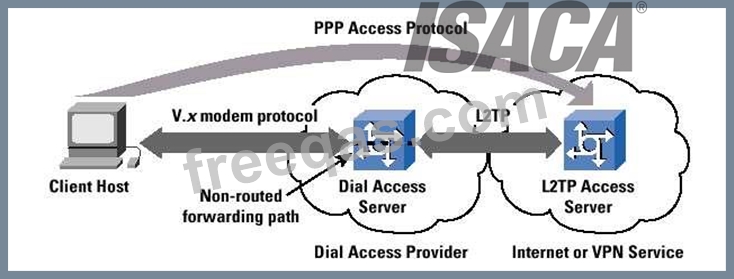
PPP (Point-to-Point Protocol) is a protocol for communication between two computers using a serial
interface, typically a personal computer using a MODEM connected by phone line to a server.
For your exam you should know below information about WAN Technologies:
Point-to-point protocol
PPP (Point-to-Point Protocol) is a protocol for communication between two computers using a serial
interface, typically a personal computer connected by phone line to a server. For example, your Internet
server provider may provide you with a PPP connection so that the provider's server can respond to your
requests, pass them on to the Internet, and forward your requested Internet responses back to you. PPP
uses the Internet protocol (IP) (and is designed to handle others). It is sometimes considered a member of
the TCP/IP suite of protocols. Relative to the Open Systems Interconnection (OSI) reference model, PPP
provides layer 2 (data-link layer) service. Essentially, it packages your computer's TCP/IP packets and
forwards them to the server where they can actually be put on the Internet.
PPP is a full-duplex protocol that can be used on various physical media, including twisted pair or fiber
optic lines or satellite transmission. It uses a variation of High Speed Data Link Control (HDLC) for packet
encapsulation.
PPP is usually preferred over the earlier de facto standard Serial Line Internet Protocol (SLIP) because it
can handle synchronous as well as asynchronous communication. PPP can share a line with other users
and it has error detection that SLIP lacks. Where a choice is possible, PPP is preferred.
Point-to-point protocol
X.25
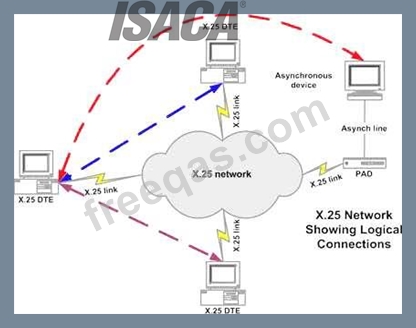
X.25 is an ITU-T standard protocol suite for packet switched wide area network (WAN) communication.
X.25 is a packet switching technology which uses carrier switch to provide connectivity for many different
networks.
Subscribers are charged based on amount of bandwidth they use. Data are divided into 128 bytes and
encapsulated in High Level Data Link Control (HDLC).
X.25 works at network and data link layer of an OSI model.
X.25
Frame Relay
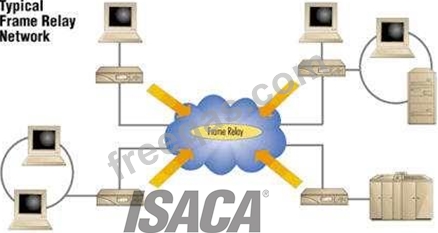
Works on a packet switching
Operates at data link layer of an OSI model
Companies that pay more to ensure that a higher level of bandwidth will always be available, pay a
committed information rate or CIR
Two main types of equipment's are used in Frame Relay
1. Data Terminal Equipment (DTE) - Usually a customer owned device that provides a connectivity
between company's own network and the frame relay's network.
2. Data Circuit Terminal Equipment (DCE) - Service provider device that does the actual data transmission
and switching in the frame relay cloud.
The Frame relay cloud is the collection of DCE that provides that provides switching and data
communication functionality. Frame relay is any to any service.
Frame Relay
Integrated Service Digital Network
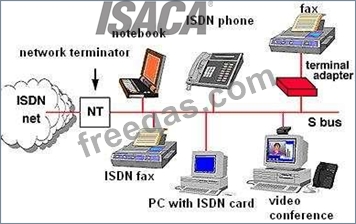
Enables data, voice and other types of traffic to travel over a medium in a digital manner previously used
only for analog voice transmission.
Same copper telephone wire is used.
Provide digital point-to-point circuit switching medium.
ISDN
Asynchronous Transfer Mode (ATM)
Uses Cell switching method
High speed network technology used for LAN, MAN and WAN
Like a frame relay it is connection oriented technology which creates and uses fixed channel
Data are segmented into fixed size cell of 53 bytes
Some companies have replaced FDDI back-end with ATM
Asynchronous Transfer Mode
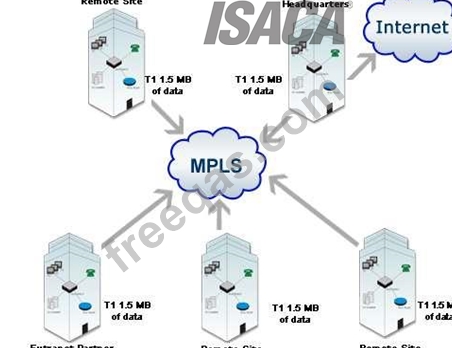
Multiprotocol Label Switching (MPLS)
Multiprotocol Label Switching (MPLS) is a standards-approved technology for speeding up network traffic
flow and making it easier to manage. MPLS involves setting up a specific path for a given sequence of
packets, identified by a label put in each packet, thus saving the time needed for a router to look up the
address to the next node to forward the packet to. MPLS is called multiprotocol because it works with the
Internet Protocol (IP), Asynchronous Transport Mode (ATM), and frame relay network protocols. With
reference to the standard model for a network (the Open Systems Interconnection, or OSI model), MPLS
allows most packets to be forwarded at the Layer 2 (switching) level rather than at the Layer 3 (routing)
level. In addition to moving traffic faster overall, MPLS makes it easy to manage a network for quality of
service (QoS). For these reasons, the technique is expected to be readily adopted as networks begin to
carry more and different mixtures of traffic.
MPLS
The following answers are incorrect:
X.25 - X.25 is an ITU-T standard protocol suite for packet switched wide area network (WAN)
communication.X.25 is a packet switching technology which uses carrier switch to provide connectivity for
many different networks.
Frame Relay - The Frame relay cloud is the collection of DCE that provides that provides switching and
data communication functionality. Frame relay is any to any service.
ISDN -Enables data, voice and other types of traffic to travel over a medium in a digital manner previously
used only for analog voice transmission. Same copper telephone wire is used. Provide digital point-to-point
circuit switching medium.
The following reference(s) were/was used to create this question:
CISA review manual 2014 page number 266

