FreeQAs
 Request Exam  Contact
  • Home
  • View All Exams
  • New QA's
  • Upload
PRACTICE EXAMS:
  • Oracle
  • Fortinet
  • Juniper
  • Microsoft
  • Cisco
  • Citrix
  • CompTIA
  • VMware
  • SAP
  • EMC
  • PMI
  • HP
  • Salesforce
  • Other
  • Oracle
    Oracle
  • Fortinet
    Fortinet
  • Juniper
    Juniper
  • Microsoft
    Microsoft
  • Cisco
    Cisco
  • Citrix
    Citrix
  • CompTIA
    CompTIA
  • VMware
    VMware
  • SAP
    SAP
  • EMC
    EMC
  • PMI
    PMI
  • HP
    HP
  • Salesforce
    Salesforce
  1. Home
  2. ISACA Certification
  3. CISA Exam
  4. ISACA.CISA.v2024-03-31.q980 Dumps
  • ««
  • «
  • …
  • 164
  • 165
  • 166
  • 167
  • 168
  • 169
  • 170
  • 171
  • 172
  • 173
  • …
  • »
  • »»
Download Now

Question 836

An organization that has suffered a cyber-attack is performing a forensic analysis of the affected users' computers. Which of the following should be of GREATEST concern for the IS auditor reviewing this process?

Correct Answer: C
Explanation
The chain of custody has not been documented is a finding that should be of greatest concern for an IS auditor reviewing a forensic analysis process of an organization that has suffered a cyber attack. The chain of custody is a record of who handled, accessed, or modified the evidence during a forensic investigation. Documenting the chain of custody is essential to preserve the integrity, authenticity, and admissibility of the evidence in a court of law. The other options are less concerning findings that may not affect the validity or reliability of the forensic analysis process. References:
CISA Review Manual (Digital Version), Chapter 7, Section 7.51
CISA Review Questions, Answers & Explanations Database, Question ID 220
insert code

Question 837

Which of the following conditions would be of MOST concern to an IS auditor assessing the risk of a successful brute force attack against encrypted data at rest?

Correct Answer: B
insert code

Question 838

Which of the following provides nonrepudiation in an electronic communication session without
confidentiality?

Correct Answer: D
Section: Information System Operations, Maintenance and Support
Explanation/Reference:
insert code

Question 839

Which of the following term related to network performance refers to the actual rate that information is transferred over a network?

Correct Answer: B
Explanation/Reference:
Throughput the actual rate that information is transferred. In data transmission, throughput is the amount of data moved successfully from one place to another in a given time period.
For your exam you should know below information about Network performance:
Network performance refers to measurement of service quality of a telecommunications product as seen by the customer.
The following list gives examples of network performance measures for a circuit-switched network and one type of packet-switched network (ATM):
Circuit-switched networks: In circuit switched networks, network performance is synonymous with the grade of service. The number of rejected calls is a measure of how well the network is performing under heavy traffic loads. Other types of performance measures can include noise, echo and so on.
ATM: In an Asynchronous Transfer Mode (ATM) network, performance can be measured by line rate, quality of service (QoS), data throughput, connect time, stability, technology, modulation technique and modem enhancements.
There are many different ways to measure the performance of a network, as each network is different in nature and design. Performance can also be modeled instead of measured; one example of this is using state transition diagrams to model queuing performance in a circuit-switched network. These diagrams allow the network planner to analyze how the network will perform in each state, ensuring that the network will be optimally designed.
The following measures are often considered important:
Bandwidth - Bandwidth is commonly measured in bits/second is the maximum rate that information can be transferred
Throughput - Throughput is the actual rate that information is transferred Latency - Latency is the delay between the sender and the receiver decoding it, this is mainly a function of the signals travel time, and processing time at any nodes the information traverses Jitter - Jitter is the variation in the time of arrival at the receiver of the information Error Rate - Error rate is the number of corrupted bits expressed as a percentage or fraction of the total sen
The following answers are incorrect:
Bandwidth - Bandwidth is commonly measured in bits/second is the maximum rate that information can be transferred
Latency - Latency is the delay between the sender and the receiver decoding it, this is mainly a function of the signals travel time, and processing time at any nodes the information traverses Jitter - Jitter is the variation in the time of arrival at the receiver of the information The following reference(s) were/was used to create this question:
CISA review manual 2014 page number 275
insert code

Question 840

Which of the following statement INCORRECTLY describes circuit switching technique?

Correct Answer: A
Explanation/Reference:
The word INCORRECTLY is the keyword used in the question. You need to find out a statement which is not valid about circuit switching.
For your exam you should know below information about WAN message transmission technique:
Message Switching
Message switching is a network switching technique in which data is routed in its entirety from the source node to the destination node, one hope at a time. During message routing, every intermediate switch in the network stores the whole message. If the entire network's resources are engaged or the network becomes blocked, the message-switched network stores and delays the message until ample resources become available for effective transmission of the message.
Message Switching
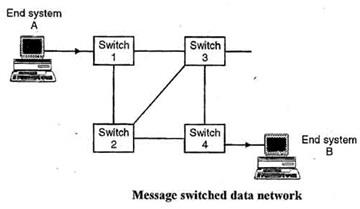
Image from: http://ecomputernotes.com/images/Message-Switched-data-Network.jpg Packet Switching Refers to protocols in which messages are divided into packets before they are sent. Each packet is then transmitted individually and can even follow different routes to its destination. Once all the packets forming a message arrive at the destination, they are recompiled into the original message.
Packet Switching
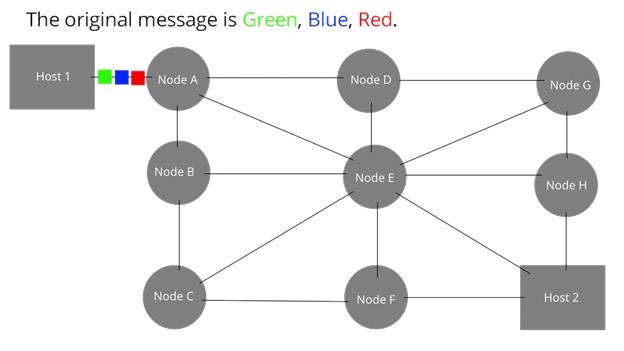
Image from: http://upload.wikimedia.org/wikipedia/commons/f/f6/Packet_Switching.gif Circuit Switching Circuit switching is a methodology of implementing a telecommunications network in which two network nodes establish a dedicated communications channel (circuit) through the network before the nodes may communicate.
The circuit guarantees the full bandwidth of the channel and remains connected for the duration of the session. The circuit functions as if the nodes were physically connected similar to an electrical circuit.
The defining example of a circuit-switched network is the early analog telephone network. When a call is made from one telephone to another, switches within the telephone exchanges create a continuous wire circuit between the two telephones, for as long as the call lasts.
In circuit switching, the bit delay is constant during a connection, as opposed to packet switching, where packet queues may cause varying and potentially indefinitely long packet transfer delays. No circuit can be degraded by competing users because it is protected from use by other callers until the circuit is released and a new connection is set up. Even if no actual communication is taking place, the channel remains reserved and protected from competing users.
Circuit Switching
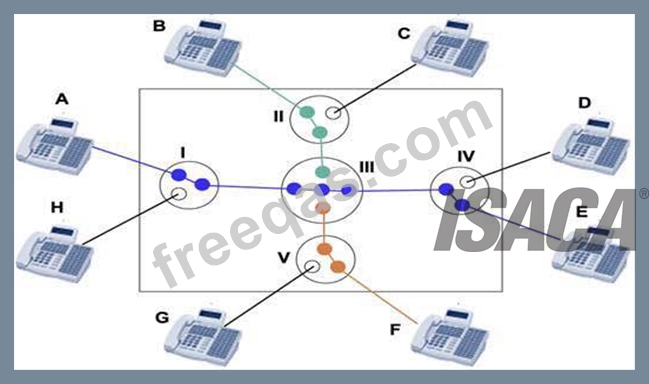
Image from: http://www.louiewong.com/wp-content/uploads/2010/09/Circuit_Switching.jpg See a table below comparing Circuit Switched versus Packet Switched networks:
Difference between Circuit and packet switching
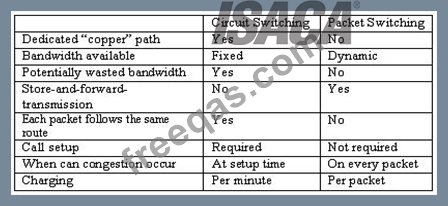
Image from:http://www.hardware-one.com/reviews/network-guide-2/images/packet-vs-circuit.gif Virtual circuit In telecommunications and computer networks, a virtual circuit (VC), synonymous with virtual connection and virtual channel, is a connection oriented communication service that is delivered by means of packet mode communication.
After a connection or virtual circuit is established between two nodes or application processes, a bit stream or byte stream may be delivered between the nodes; a virtual circuit protocol allows higher level protocols to avoid dealing with the division of data into segments, packets, or frames.
Virtual circuit communication resembles circuit switching, since both are connection oriented, meaning that in both cases data is delivered in correct order, and signaling overhead is required during a connection establishment phase. However, circuit switching provides constant bit rate and latency, while these may vary in a virtual circuit service due to factors such as:
varying packet queue lengths in the network nodes,
varying bit rate generated by the application,
varying load from other users sharing the same network resources by means of statistical multiplexing, etc.
The following were incorrect answers:
The other options presented correctly describes about circuit switching.
The following reference(s) were/was used to create this question:
CISA review manual 2014 Page number 265
insert code
  • ««
  • «
  • …
  • 164
  • 165
  • 166
  • 167
  • 168
  • 169
  • 170
  • 171
  • 172
  • 173
  • …
  • »
  • »»
[×]

Download PDF File

Enter your email address to download ISACA.CISA.v2024-03-31.q980 Dumps

Email:

FreeQAs

Our website provides the Largest and the most Latest vendors Certification Exam materials around the world.

Using dumps we provide to Pass the Exam, we has the Valid Dumps with passing guranteed just which you need.

  • DMCA
  • About
  • Contact Us
  • Privacy Policy
  • Terms & Conditions
©2026 FreeQAs

www.freeqas.com materials do not contain actual questions and answers from Cisco's certification exams.
