FreeQAs
 Request Exam  Contact
  • Home
  • View All Exams
  • New QA's
  • Upload
PRACTICE EXAMS:
  • Oracle
  • Fortinet
  • Juniper
  • Microsoft
  • Cisco
  • Citrix
  • CompTIA
  • VMware
  • SAP
  • EMC
  • PMI
  • HP
  • Salesforce
  • Other
  • Oracle
    Oracle
  • Fortinet
    Fortinet
  • Juniper
    Juniper
  • Microsoft
    Microsoft
  • Cisco
    Cisco
  • Citrix
    Citrix
  • CompTIA
    CompTIA
  • VMware
    VMware
  • SAP
    SAP
  • EMC
    EMC
  • PMI
    PMI
  • HP
    HP
  • Salesforce
    Salesforce
  1. Home
  2. ISACA Certification
  3. CISA Exam
  4. ISACA.CISA.v2024-12-27.q999 Dumps
  • ««
  • «
  • …
  • 6
  • 7
  • 8
  • 9
  • 10
  • 11
  • 12
  • 13
  • 14
  • 15
  • …
  • »
  • »»
Download Now

Question 46

Which of the following is the protocol data unit (PDU) of application layer in TCP/IP model?

Correct Answer: A
Section: Information System Operations, Maintenance and Support
Explanation:
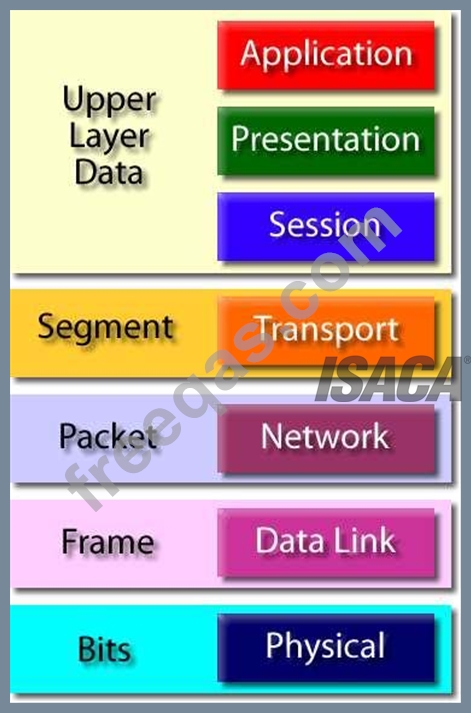
Application layer's PDU is data.
For your exam you should know below information about TCP/IP model:
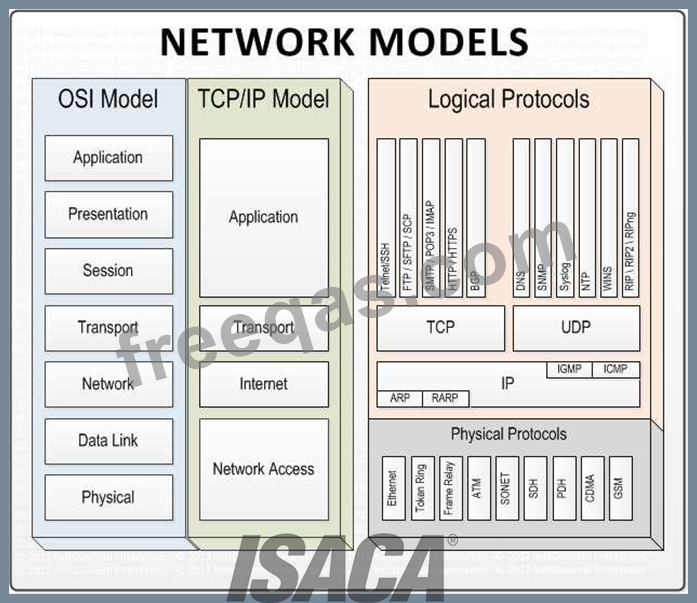
Network models
Layer 4. Application Layer
Application layer is the top most layer of four layer TCP/IP model. Application layer is present on the top of the Transport layer. Application layer defines TCP/IP application protocols and how host programs interface with Transport layer services to use the network.
Application layer includes all the higher-level protocols like DNS (Domain Naming System), HTTP (Hypertext Transfer Protocol), Telnet, SSH, FTP (File Transfer Protocol), TFTP (Trivial File Transfer Protocol), SNMP (Simple Network Management Protocol), SMTP (Simple Mail Transfer Protocol) , DHCP (Dynamic Host Configuration Protocol), X Windows, RDP (Remote Desktop Protocol) etc.
Layer 3. Transport Layer
Transport Layer is the third layer of the four layer TCP/IP model. The position of the Transport layer is between Application layer and Internet layer. The purpose of Transport layer is to permit devices on the source and destination hosts to carry on a conversation. Transport layer defines the level of service and status of the connection used when transporting data.
The main protocols included at Transport layer are TCP (Transmission Control Protocol) and UDP (User Datagram Protocol).
Layer 2. Internet Layer
Internet Layer is the second layer of the four layer TCP/IP model. The position of Internet layer is between Network Access Layer and Transport layer. Internet layer pack data into data packets known as IP datagram's, which contain source and destination address (logical address or IP address) information that is used to forward the datagram's between hosts and across networks. The Internet layer is also responsible for routing of IP datagram's.
Packet switching network depends upon a connectionless internetwork layer. This layer is known as Internet layer. Its job is to allow hosts to insert packets into any network and have them to deliver independently to the destination. At the destination side data packets may appear in a different order than they were sent. It is the job of the higher layers to rearrange them in order to deliver them to proper network applications operating at the Application layer.
The main protocols included at Internet layer are IP (Internet Protocol), ICMP (Internet Control Message Protocol), ARP (Address Resolution Protocol), RARP (Reverse Address Resolution Protocol) and IGMP (Internet Group Management Protocol).
Layer 1. Network Access Layer
Network Access Layer is the first layer of the four layer TCP/IP model. Network Access Layer defines details of how data is physically sent through the network, including how bits are electrically or optically signaled by hardware devices that interface directly with a network medium, such as coaxial cable, optical fiber, or twisted pair copper wire.
The protocols included in Network Access Layer are Ethernet, Token Ring, FDDI, X.25, Frame Relay etc.
The most popular LAN architecture among those listed above is Ethernet. Ethernet uses an Access Method called CSMA/CD (Carrier Sense Multiple Access/Collision Detection) to access the media, when Ethernet operates in a shared media. An Access Method determines how a host will place data on the medium.
IN CSMA/CD Access Method, every host has equal access to the medium and can place data on the wire when the wire is free from network traffic. When a host wants to place data on the wire, it will check the wire to find whether another host is already using the medium. If there is traffic already in the medium, the host will wait and if there is no traffic, it will place the data in the medium. But, if two systems place data on the medium at the same instance, they will collide with each other, destroying the data. If the data is destroyed during transmission, the data will need to be retransmitted. After collision, each host will wait for a small interval of time and again the data will be retransmitted.
Protocol Data Unit (PDU):
The following answers are incorrect:
Segment - Transport layer PDU
Packet - Network interface layer PDU
Frame/bit - LAN or WAN interface layer PDU
Reference:
CISA review manual 2014 page number 272
insert code

Question 47

ALL computer programming languages are vulnerable to command injection attack.

Correct Answer: B
Explanation/Reference:
Explanation:
The majority of software vulnerabilities result from a few known kinds of coding defects. Common software defects include buffer overflows, format string vulnerabilities, integer overflow, and code/command injection. Some common languages such as C and C++ are vulnerable to all of these defects. Languages such as Java are immune to some of these defects but are still prone to code/ command injection and other software defects which lead to software vulnerabilities.
insert code

Question 48

When reviewing a data classification scheme, it is MOST important for an IS auditor to determine if.

Correct Answer: B
Explanation
When reviewing a data classification scheme, it is most important for an IS auditor to determine if the security criteria are clearly documented for each classification. This will help the IS auditor to evaluate if the data classification scheme is consistent, comprehensive, and aligned with the organizational objectives and regulatory requirements. The security criteria should define the level of confidentiality, integrity, and availability for each data classification, as well as the corresponding controls such as access control, rights management, and cryptographic protection1. The other options are less important or incorrect because:
A: Each information asset is not necessarily assigned to a different classification. Data classification schemes usually have a limited number of categories, such as "Sensitive," "Confidential," and "Public," and multiple information assets can belong to the same category2.
C: Senior IT managers are not necessarily identified as information owners. Information owners are typically the business units or functions that create, use, or maintain the information assets, and they may or may not be senior IT managers3.
D: The information owner is not required to approve access to the asset. The information owner is responsible for defining the access requirements and rules for the asset, but the actual approval of access requests may be delegated to other roles, such as data custodians or administrators3. References:
Simplify and Contextualize Your Data Classification Efforts - ISACA, 3.7: Establish and Maintain a Data Classification Scheme, Data Classification and Practices - NIST, CISA Exam Content Outline | CISA Certification | ISACA
insert code

Question 49

An IS auditor attempting to determine whether access to program documentation is restricted to authorized
persons would MOST likely:

Correct Answer: B
Section: Protection of Information Assets
Explanation:
Asking programmers about the procedures currently being followed is useful in determining whether
access to program documentation is restricted to authorized persons. Evaluating the record retention plans
for off-premises storage tests the recovery procedures, not the
access control over program documentation. Testing utilization records or data files will not address access
security over program documentation.
insert code

Question 50

An organization has recently acquired and implemented intelligent-agent software for granting loans to customers. During the post implementation review, which of the following would be the KEY procedure for the IS auditor to perform?

Correct Answer: A
insert code
  • ««
  • «
  • …
  • 6
  • 7
  • 8
  • 9
  • 10
  • 11
  • 12
  • 13
  • 14
  • 15
  • …
  • »
  • »»
[×]

Download PDF File

Enter your email address to download ISACA.CISA.v2024-12-27.q999 Dumps

Email:

FreeQAs

Our website provides the Largest and the most Latest vendors Certification Exam materials around the world.

Using dumps we provide to Pass the Exam, we has the Valid Dumps with passing guranteed just which you need.

  • DMCA
  • About
  • Contact Us
  • Privacy Policy
  • Terms & Conditions
©2026 FreeQAs

www.freeqas.com materials do not contain actual questions and answers from Cisco's certification exams.
