FreeQAs
 Request Exam  Contact
  • Home
  • View All Exams
  • New QA's
  • Upload
PRACTICE EXAMS:
  • Oracle
  • Fortinet
  • Juniper
  • Microsoft
  • Cisco
  • Citrix
  • CompTIA
  • VMware
  • SAP
  • EMC
  • PMI
  • HP
  • Salesforce
  • Other
  • Oracle
    Oracle
  • Fortinet
    Fortinet
  • Juniper
    Juniper
  • Microsoft
    Microsoft
  • Cisco
    Cisco
  • Citrix
    Citrix
  • CompTIA
    CompTIA
  • VMware
    VMware
  • SAP
    SAP
  • EMC
    EMC
  • PMI
    PMI
  • HP
    HP
  • Salesforce
    Salesforce
  1. Home
  2. ISACA Certification
  3. CISA Exam
  4. ISACA.CISA.v2024-12-27.q999 Dumps
  • ««
  • «
  • …
  • 130
  • 131
  • 132
  • 133
  • 134
  • 135
  • 136
  • 137
  • 138
  • 139
  • …
  • »
  • »»
Download Now

Question 666

Which of the following step of PDCA implement the plan, execute the process and make product?

Correct Answer: B
Section: Governance and Management of IT
Explanation/Reference:
Do - Implement the plan, execute the process, make the product. Collect data for charting and analysis in
the following "CHECK" and "ACT" steps.
For your exam you should know the information below:
PDCA (plan-do-check-act or plan-do-check-adjust) is an iterative four-step management method used in
business for the control and continuous improvement of processes and products. It is also known as the
Deming circle/cycle/wheel, Stewart cycle, control circle/cycle, or plan-do-study-act (PDSA). Another
version of this PDCA cycle is OPDCA. The added "O" stands for observation or as some versions say
"Grasp the current condition."
The steps in each successive PDCA cycle are:
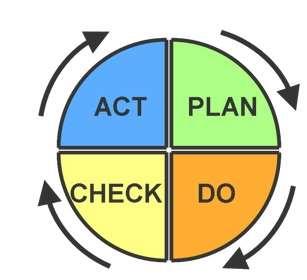
PLAN
Establish the objectives and processes necessary to deliver results in accordance with the expected output
(the target or goals). By establishing output expectations, the completeness and accuracy of the spec is
also a part of the targeted improvement. When possible start on a small scale to test possible effects.
DO
Implement the plan, execute the process, make the product. Collect data for charting and analysis in the
following "CHECK" and "ACT" steps.
CHECK
Study the actual results (measured and collected in "DO" above) and compare against the expected results
(targets or goals from the "PLAN") to ascertain any differences. Look for deviation in implementation from
the plan and also look for the appropriateness and completeness of the plan to enable the execution, i.e.,
"Do". Charting data can make this much easier to see trends over several PDCA cycles and in order to
convert the collected data into information. Information is what you need for the next step "ACT".
ACT
Request corrective actions on significant differences between actual and planned results. Analyze the
differences to determine their root causes. Determine where to apply changes that will include
improvement of the process or product. When a pass through these four steps does not result in the need
to improve, the scope to which PDCA is applied may be refined to plan and improve with more detail in the
next iteration of the cycle, or attention needs to be placed in a different stage of the process.
The following answers are incorrect:
PLAN - Establish the objectives and processes necessary to deliver results in accordance with the
expected output (the target or goals).
CHECK - Study the actual results (measured and collected in "DO" above) and compare against the
expected results (targets or goals from the "PLAN") to ascertain any differences
ACT -Request corrective actions on significant differences between actual and planned results. Analyze the
differences to determine their root causes. Determine where to apply changes that will include
improvement of the process or product
The following reference(s) were/was used to create this question:
CISA review manual 2014 page number 107
insert code

Question 667

An IS auditor is verifying the adequacy of an organization's internal controls and is concerned about potential circumvention of regulations. Which of the following is the BEST sampling method to use?

Correct Answer: B
The best sampling method to use for verifying the adequacy of an organization's internal controls and being concerned about potential circumvention of regulations is B. Random sampling. Random sampling is a method of selecting a sample from a population in which each item has an equal and independent chance of being selected1. Random sampling reduces the risk of bias or manipulation in the sample selection, and ensures that the sample is representative of the population. Random sampling can be used for both attribute and variable sampling, which are two types of audit sampling that test for the occurrence rate or the monetary value of errors, respectively2.
insert code

Question 668

During an IT operations audit multiple unencrypted backup tapes containing sensitive credit card information cannot be found Which of the following presents the GREATEST risk to the organization?

Correct Answer: D
insert code

Question 669

Documentation of a business case used in an IT development project should be retained until:

Correct Answer: A
A business case can and should be used throughout the life cycle of the product. It serves as an anchor for new (management) personnel, helps to maintain focus and provides valuable information on estimates vs. actuals . Questions like, 'why dowe do that,"what was the original intent' and 'how did we perform against the plan' can be answered, and lessons for developing future business cases can be learned. During the development phase of a project one shouldalways validate the business case, as it is a good management instrument. After finishing a project and entering production, the business case and all the completed research are valuable sources of information that should be kept for further reference
insert code

Question 670

The application systems of an organization using open-source software have no single recognized developer producing patches. Which of the following would be the MOST secure way of updating open- source software?

Correct Answer: D
Section: Protection of Information Assets
Explanation:
Suitable patches from the existing developers should be selected and tested before applying them.
Rewriting the patches and applying them is not a correct answer because it would require skilled resources and time to rewrite the patches. Code review could be possible but tests need to be performed before applying the patches. Since the system was developed outside the organization, the IT department may not have the necessary skills and resources to develop patches.
insert code
  • ««
  • «
  • …
  • 130
  • 131
  • 132
  • 133
  • 134
  • 135
  • 136
  • 137
  • 138
  • 139
  • …
  • »
  • »»
[×]

Download PDF File

Enter your email address to download ISACA.CISA.v2024-12-27.q999 Dumps

Email:

FreeQAs

Our website provides the Largest and the most Latest vendors Certification Exam materials around the world.

Using dumps we provide to Pass the Exam, we has the Valid Dumps with passing guranteed just which you need.

  • DMCA
  • About
  • Contact Us
  • Privacy Policy
  • Terms & Conditions
©2026 FreeQAs

www.freeqas.com materials do not contain actual questions and answers from Cisco's certification exams.
