FreeQAs
 Request Exam  Contact
  • Home
  • View All Exams
  • New QA's
  • Upload
PRACTICE EXAMS:
  • Oracle
  • Fortinet
  • Juniper
  • Microsoft
  • Cisco
  • Citrix
  • CompTIA
  • VMware
  • SAP
  • EMC
  • PMI
  • HP
  • Salesforce
  • Other
  • Oracle
    Oracle
  • Fortinet
    Fortinet
  • Juniper
    Juniper
  • Microsoft
    Microsoft
  • Cisco
    Cisco
  • Citrix
    Citrix
  • CompTIA
    CompTIA
  • VMware
    VMware
  • SAP
    SAP
  • EMC
    EMC
  • PMI
    PMI
  • HP
    HP
  • Salesforce
    Salesforce
  1. Home
  2. ISACA Certification
  3. CISA Exam
  4. ISACA.CISA.v2024-12-27.q999 Dumps
  • ««
  • «
  • …
  • 151
  • 152
  • 153
  • 154
  • 155
  • 156
  • 157
  • 158
  • 159
  • 160
  • …
  • »
  • »»
Download Now

Question 771

The development of an IS security policy is ultimately the responsibility of the:

Correct Answer: D
Section: Protection of Information Assets
Explanation:
Normally, the designing of an information systems security policy is the responsibility of top management or the board of directors. The IS department is responsible for the execution of the policy, having no authority in framing the policy. The security committee also functions within the broad security policy framed by the board of directors. The security administrator is responsible for implementing, monitoring and enforcing the security rules that management has established and authorized.
insert code

Question 772

An IS auditor is assigned to perform a post implementation review of an application system. Which pf the following situations may have impaired the independence of the IS auditor? The IS auditor:

Correct Answer: A
Section: Protection of Information Assets
Explanation:
Independence may be impaired if an IS auditor is, or has been, actively involved in the development, acquisition and implementation of the application system. Choices B and C are situations that do not impair an IS auditor's independence. Choice D is incorrect because an IS auditor's independence is not impaired by providing advice on known best practices.
insert code

Question 773

Which of the following term in business continuity determines the maximum acceptable amount of data loss measured in time?

Correct Answer: A
Section: Information System Operations, Maintenance and Support
Explanation:
A recovery point objective, or "RPO", is defined by business continuity planning. It is the maximum tolerable period in which data might be lost from an IT service due to a major incident. The RPO gives systems designers a limit to work to. For instance, if the RPO is set to four hours, then in practice, off-site mirrored backups must be continuously maintained - a daily off-site backup on tape will not suffice. Care must be taken to avoid two common mistakes around the use and definition of RPO. Firstly, BC staff use business impact analysis to determine RPO for each service - RPO is not determined by the existent backup regime. Secondly, when any level of preparation of off-site data is required, rather than at the time the backups are offsite, the period during which data is lost very often starts near the time of the beginning of the work to prepare backups which are eventually offsite.
For your exam you should know below information about RPO, RTO, WRT and MTD:
Stage 1: Business as usual
Business as usual
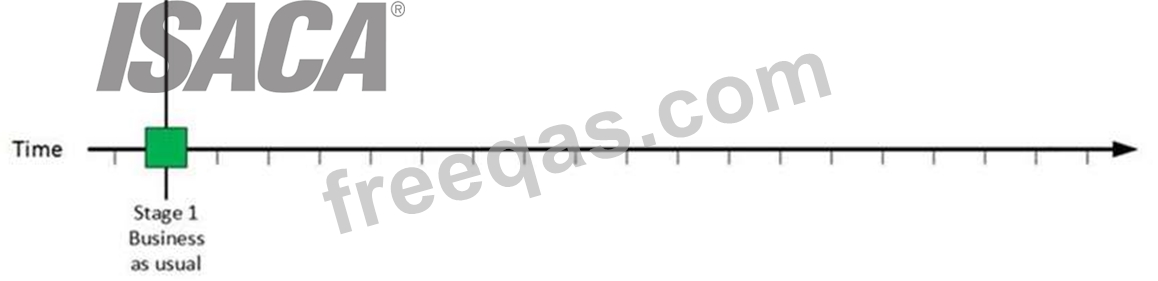
At this stage all systems are running production and working correctly.
Stage 2: Disaster occurs
Disaster Occurs

On a given point in time, disaster occurs and systems needs to be recovered. At this point the Recovery Point Objective (RPO) determines the maximum acceptable amount of data loss measured in time. For example, the maximum tolerable data loss is 15 minutes.
Stage 3: Recovery
Recovery

At this stage the system are recovered and back online but not ready for production yet. The Recovery Time Objective (RTO) determines the maximum tolerable amount of time needed to bring all critical systems back online. This covers, for example, restore data from back-up or fix of a failure. In most cases this part is carried out by system administrator, network administrator, storage administrator etc.
Stage 4: Resume Production
Resume Production
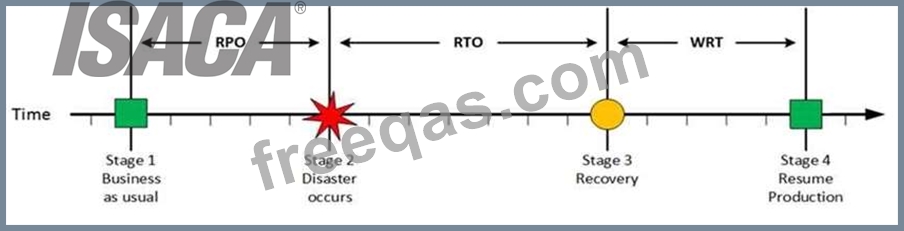
At this stage all systems are recovered, integrity of the system or data is verified and all critical systems can resume normal operations. The Work Recovery Time (WRT) determines the maximum tolerable amount of time that is needed to verify the system and/or data integrity. This could be, for example, checking the databases and logs, making sure the applications or services are running and are available. In most cases those tasks are performed by application administrator, database administrator etc. When all systems affected by the disaster are verified and/or recovered, the environment is ready to resume the production again.
MTD
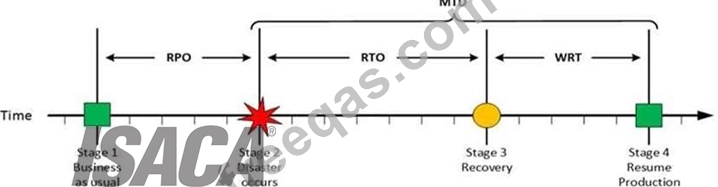
The sum of RTO and WRT is defined as the Maximum Tolerable Downtime (MTD) which defines the total amount of time that a business process can be disrupted without causing any unacceptable consequences.
This value should be defined by the business management team or someone like CTO, CIO or IT manager.
The following answers are incorrect:
RTO - The Recovery Time Objective (RTO) determines the maximum tolerable amount of time needed to bring all critical systems back online. This covers, for example, restore data from back-up or fix of a failure.
In most cases this part is carried out by system administrator, network administrator, storage administrator etc.
WRT - The Work Recovery Time (WRT) determines the maximum tolerable amount of time that is needed to verify the system and/or data integrity. This could be, for example, checking the databases and logs, making sure the applications or services are running and are available. In most cases those tasks are performed by application administrator, database administrator etc. When all systems affected by the disaster are verified and/or recovered, the environment is ready to resume the production again.
MTD - The sum of RTO and WRT is defined as the Maximum Tolerable Downtime (MTD) which defines the total amount of time that a business process can be disrupted without causing any unacceptable consequences. This value should be defined by the business management team or someone like CTO, CIO or IT manager.
Reference:
CISA review manual 2014 page number 284
http://en.wikipedia.org/wiki/Recovery_point_objective
http://defaultreasoning.com/2013/12/10/rpo-rto-wrt-mtdwth/
insert code

Question 774

What is the first step in a business process re-engineering project?

Correct Answer: C
Explanation/Reference:
Explanation: Defining the scope of areas to be reviewed is the first step in a business process re- engineering project.
insert code

Question 775

Which of the following should be of GREATEST concern to an IS auditor who is assessing an organization's configuration and release management process?

Correct Answer: B
The greatest concern to an IS auditor who is assessing an organization's configuration and release management process is that changes and change approvals are not documented. This is because documentation is essential for ensuring the traceability, accountability, and quality of the changes made to the configuration items (CIs) and the releases deployed to the production environment. Without documentation, it would be difficult to verify the authenticity, validity, and authorization of the changes, as well as to identify and resolve any issues or incidents that may arise from the changes. Documentation also helps to maintain compliance with internal and external standards and regulations, as well as to facilitate audits and reviews.
The other options are not as concerning as option B, although they may also indicate some weaknesses in the configuration and release management process. The organization does not use an industry-recognized methodology, but this does not necessarily mean that their process is ineffective or inefficient. The organization may have developed their own methodology that suits their specific needs and context. However, using an industry-recognized methodology could help them adopt best practices and improve their process maturity. All changes require middle and senior management approval, but this may not be a problem if the organization has a clear and streamlined approval process that does not cause delays or bottlenecks in the change implementation. However, requiring too many approvals could also introduce unnecessary complexity and bureaucracy in the process. There is no centralized configuration management database (CMDB), but this does not mean that the organization does not have a way of managing their CIs and their relationships. The organization may use other tools or methods to store and access their configuration data, such as spreadsheets, documents, or repositories. However, having a centralized CMDB could help them improve their visibility, accuracy, and consistency of their configuration data.
References:
* 1: The Essential Guide to Release Management | Smartsheet
* 2: 5 steps to a successful release management process - Lucidchart
* 3: Configuration Management process overview - Micro Focus
* 4: Release and Deployment Management process overview - Micro Focus
insert code
  • ««
  • «
  • …
  • 151
  • 152
  • 153
  • 154
  • 155
  • 156
  • 157
  • 158
  • 159
  • 160
  • …
  • »
  • »»
[×]

Download PDF File

Enter your email address to download ISACA.CISA.v2024-12-27.q999 Dumps

Email:

FreeQAs

Our website provides the Largest and the most Latest vendors Certification Exam materials around the world.

Using dumps we provide to Pass the Exam, we has the Valid Dumps with passing guranteed just which you need.

  • DMCA
  • About
  • Contact Us
  • Privacy Policy
  • Terms & Conditions
©2026 FreeQAs

www.freeqas.com materials do not contain actual questions and answers from Cisco's certification exams.
