FreeQAs
 Request Exam  Contact
  • Home
  • View All Exams
  • New QA's
  • Upload
PRACTICE EXAMS:
  • Oracle
  • Fortinet
  • IBM
  • Juniper
  • Microsoft
  • Cisco
  • Citrix
  • CompTIA
  • VMware
  • ISC
  • SAP
  • EMC
  • PMI
  • HP
  • Salesforce
  • Other
  • Oracle
    Oracle
  • Fortinet
    Fortinet
  • IBM
    IBM
  • Juniper
    Juniper
  • Microsoft
    Microsoft
  • Cisco
    Cisco
  • Citrix
    Citrix
  • CompTIA
    CompTIA
  • VMware
    VMware
  • ISC
    ISC
  • SAP
    SAP
  • EMC
    EMC
  • PMI
    PMI
  • HP
    HP
  • Salesforce
    Salesforce
  1. Home
  2. ISQI Certification
  3. CTAL-TM_Syll2012 Exam
  4. ISQI.CTAL-TM_Syll2012.v2024-08-20.q103 Dumps
  • ««
  • «
  • …
  • 4
  • 5
  • 6
  • 7
  • 8
  • 9
  • 10
  • 11
  • 12
  • 13
  • …
  • »
  • »»
Download Now

Question 36

People Skills - Team Composition
Your test team consists of four members (Mary, Bob, Mark, Dave) with different interpersonal skills.
The following skills assessment spreadsheet shows the characteristics of the team members with respect to a list of interpersonal-skills (for each characteristic only the member with the highest level of that characteristic is indicated and marked with 'X'):
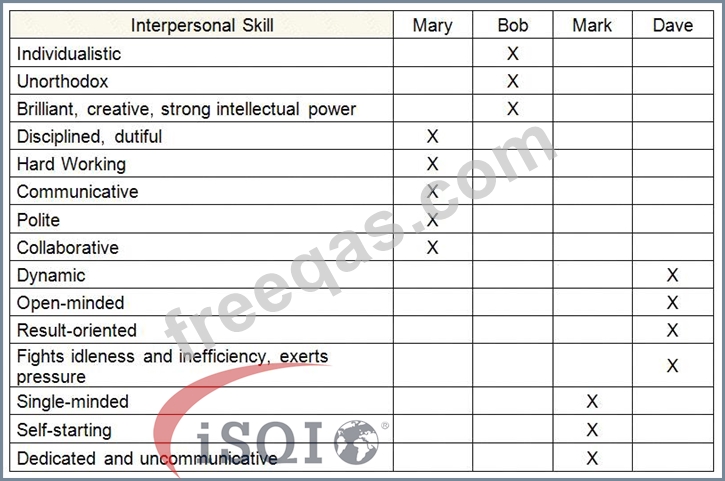
On the next project a member of your test team will have to perform some routine tasks requiring collaboration with other teams.
Who in your test team would you expect to be most suitable at doing these tasks?
Number of correct responses: 1
K43 credits

Correct Answer: A
insert code

Question 37

You are the Test Manager for a project to develop a client-server application that allows wine vendors to order custom-assorted packages of wines of several winemakers to sell special packages in their wine shops.
You decide to apply a blended risk-based and reactive testing strategy. Below the exit criteria for the system testinG.
EXCR1- Each "critical" quality risk item must be covered by at least one test condition
EXCR2- Each "critical" requirement must be covered by at least one test condition
The following are the "critical" requirements of the application:
REQ-SEL-1. The application shall allow the user to order only one package at a time
REQ-SEL-2. The application shall allow the user to select between four different packages (2bottles, 6-bottles, 12-bottles, 15-bottles)
REQ-SEL-3. The application shall allow the user to order a package containing at least 1 bottle and no more bottles than the package size. No error messages shall be displayed if the user selects a valid number of bottles (at least 1 bottle and no more than the package size)
REQ-SEL-4. The application shall display an error message "Invalid number of bottles" if an invalid number of bottles is selected by the user (zero bottles or a number higher than the package size)
REQ-PAY-1. The application shall allow the user to pay with the three accepted credit cards (Visa, MasterCard, American Express)
REQ-PAY-2. The application shall display an error message "Invalid credit card" if invalid credit card data are given by the user
The following is the unique "critical" quality risk item that has been identified:
CR-RSK-1. The GUI of the application might accept non-integer values for the input field designed to get the number of bottles from the user Test analysis for system testing has just begun and the following test conditions have been identified.
TC-SEL-2. Test the selection of the package sizes
TC-SEL-4. Test wrong numbers of bottles for an order
TC-CR-RSK-1. Test the accepted values from the input field designed to get the number of bottles from the user
What is the MINIMUM number of test conditions that must be added to fulfill both the EXCR1 and EXCR2 exit criteria?
K3 2 credits

Correct Answer: A
insert code

Question 38

You have been carefully monitoring the progress of testing for your project. You have been using the established traceability to verify that the requirements and test conditions are being adequately addressed. The test team is proceeding well in their test case execution and you can see that you are achieving about 80% coverage of the test conditions per the traceability mapping in your test management system. You have seen a number of defects being logged against test conditions that are failing, but you do not see a mapping of the test cases to those conditions.
What is likely to be occurring in the testing area that is causing the traceability to break down? [2]

Correct Answer: D
The most likely cause of the traceability breakdown in the testing area is that the testers are not updating the test execution information in the test management system. This is because the test management system is a tool that supports the test process, and it can store and manage the test documentation, such as the requirements, the test conditions, the test cases, and the test results. If the testers do not update the test execution information in the test management system, such as the test cases that are run, the test results that are obtained, and the defects that are found, the traceability between the test cases and the test conditions will be lost or inaccurate. This can affect the test analysis and reporting, and the test coverage measurement. Test Management - ISTQB not-for-profit association References: Certified Tester Advanced Level Test Manager (CTAL-TM) - ISTQB not-for-profit association, ISTQB Test Manager Certification - ISTQB Exams Worldwide - ISTQB Official Registration, Test Management - ISTQB not-for-profit association
insert code

Question 39

Test results are reported as "Requirements tested, passed, and failed".
What test strategy are you using?[1]

Correct Answer: C
An analytical test strategy is a test strategy that is based on the analysis of the factors that affect the quality of the software under test, such as the requirements, the risks, the complexity, or the criticality1. An analytical test strategy uses these factors to define the test objectives, scope, approach, and techniques, as well as to prioritize and allocate the test resources2. Reporting the test results as "Requirements tested, passed, and failed" implies that the testing is driven by the requirements, which are the specifications of the desired features and functions of the software under test. Testing based on the requirements is an example of an analytical test strategy, as it uses the requirements as the main factor to guide the testing activities. Therefore, option C is the correct answer. Option A is incorrect because a model-based test strategy is a test strategy that uses models to represent the desired behavior and structure of the software under test, and to derive test cases, test data, test procedures, and test oracles. A model-based test strategy does not necessarily report the test results as "Requirements tested, passed, and failed", as it may use other types of models, such as state diagrams, data flow diagrams, or decision tables, to generate and execute the tests. Option B is incorrect because an exploratory test strategy is a test strategy that uses the tester's knowledge, skills, and creativity to design and execute tests dynamically, without predefined test cases or test procedures. An exploratory test strategy does not report the test results as "Requirements tested, passed, and failed", as it does not follow a formal or structured testing process, but rather relies on the tester's intuition, experience, and feedback. Option D is incorrect because a reactive test strategy is a test strategy that uses the actual behavior and results of the software under test to design and execute tests, without prior knowledge or documentation of the software. A reactive test strategy does not report the test results as "Requirements tested, passed, and failed", as it does not have any requirements or specifications to compare the software against, but rather uses the software itself as the test basis. References: 1: ISTQB Glossary, Analytical Test Strategy 2: ISTQB Advanced Level Test Manager Syllabus, Section 1.1.1 : ISTQB Glossary, Requirement : ISTQB Advanced Level Test Manager Syllabus, Section 1.1.1 : ISTQB Glossary, Model-Based Testing : ISTQB Advanced Level Test Manager Syllabus, Section 1.1.1 : ISTQB Glossary, Exploratory Testing : ISTQB Advanced Level Test Manager Syllabus, Section 1.1.1 : ISTQB Glossary, Reactive Test Strategy : ISTQB Advanced Level Test Manager Syllabus, Section 1.1.1 : Test Strategy | ISTQB Glossary : Test Strategy - ISTQB not-for-profit association
insert code

Question 40

Test Management
The following chart plots the cumulative number of defects opened against the cumulative number of defects closed during system testing of a software product.

Which of the following statements is true?
Number of correct responses: 1
K2 1 credit

Correct Answer: B
insert code
  • ««
  • «
  • …
  • 4
  • 5
  • 6
  • 7
  • 8
  • 9
  • 10
  • 11
  • 12
  • 13
  • …
  • »
  • »»
[×]

Download PDF File

Enter your email address to download ISQI.CTAL-TM_Syll2012.v2024-08-20.q103 Dumps

Email:

FreeQAs

Our website provides the Largest and the most Latest vendors Certification Exam materials around the world.

Using dumps we provide to Pass the Exam, we has the Valid Dumps with passing guranteed just which you need.

  • DMCA
  • About
  • Contact Us
  • Privacy Policy
  • Terms & Conditions
©2026 FreeQAs

www.freeqas.com materials do not contain actual questions and answers from Cisco's certification exams.
