Fill in the blank. Which directive in a Nginx server configuration block defines the TCP ports on which the virtual host will be available, and which protocols it will use? (Specify ONLY the option name without any values.)
Correct Answer:
listen
Question 7
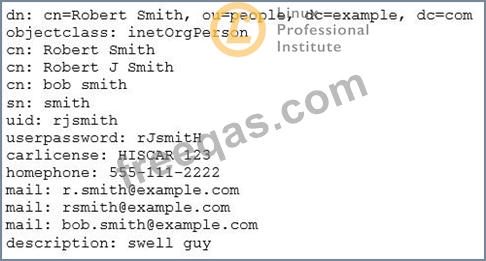
According to this LDIF excerpt, which organizational unit is Robert Smith part of? (Specify only the organizational unit.)
Correct Answer:
people Explanation: The LDIF excerpt shows the distinguished name (dn) of Robert Smith as "cn=Robert Smith, ou=people, dc=example, dc=com". The organizational unit (ou) attribute is used to represent an organizational unit in which an entry resides. In this case, Robert Smith is part of the "people" organizational unit. References: [OpenLDAP Software 2.6 Administrator's Guide: The LDIF File Format]: The official documentation of OpenLDAP on the LDIF file format, which explains the syntax and structure of LDIF entries and attributes. [LDAP Data Interchange Format (LDIF) - Version 1]: The RFC 2849 document that defines the LDAP Data Interchange Format (LDIF), which is a common format for exchanging LDAP data.
Question 8
Which of the following information has to be submitted to a certification authority in order to request a web server certificate?
For what purpose is TCP/IP stack fingerprinting used by nmap?
Correct Answer: A
Explanation TCP/IP stack fingerprinting is a technique that allows nmap to remotely detect the characteristics of a TCP/IP stack implementation on a target host. By sending a series of probes (such as TCP and UDP packets) and analyzing the responses, nmap can infer the operating system (OS) of the target host based on a database of known OS fingerprints. Each OS has a unique way of setting certain parameters and flags in the TCP/IP headers, such as the initial packet size, the initial TTL, the window size, the max segment size, the window scaling value, and the "don't fragment", "sackOK", and "nop" flags. These values can be combined to form a signature or a fingerprint for the target host, which can then be compared to the nmap-os-db database that contains more than 2,600 OS fingerprints. If there is a match, nmap will print out the OS details, such as the name, the version, and the vendor. If there is no match, nmap will print out a message asking the user to submit the fingerprint to the nmap project for further analysis. TCP/IP stack fingerprinting is useful for several purposes, such as network mapping, security auditing, vulnerability scanning, and penetration testing. By knowing the OS of the target host, nmap can tailor its scanning techniques and exploit the weaknesses of the specific OS. TCP/IP stack fingerprinting can also help identify rogue or unauthorized devices on a network, or detect OS spoofing attempts by the target host. References: OS Detection | Nmap Network Scanning TCP/IP stack fingerprinting - Wikipedia Cybersecurity | Nmap | OS Detection | Codecademy
Question 10
Which of these tools provides DNS information in the following format?