Note: This question is part of a series of questions that present the same scenario. Each question in the series contains a unique solution that might meet the stated goals. Some question sets might have more than one correct solution, while others might not have a correct solution.
After you answer a question in this section, you will NOT be able to return to it. As a result, these questions will not appear in the review screen.
You develop an application to identify species of flowers by training a Custom Vision model. You receive images of new flower species.
You need to add the new images to the classifier.
Solution: You add the new images and labels to the existing model. You retrain the model, and then publish the model.
Does this meet the goal?
You are building a natural language model.
You need to enable active learning.
What should you do?
You are developing a text processing solution.
You develop the following method.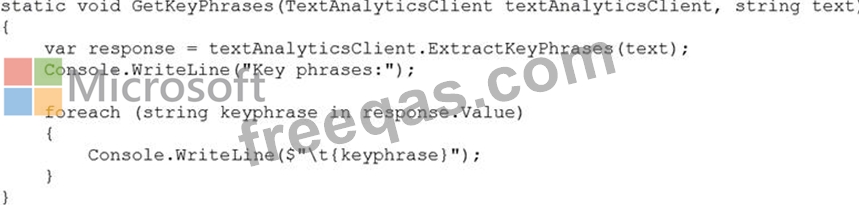
You call the method by using the following code.
GetKeyPhrases(textAnalyticsClient, "the cat sat on the mat");
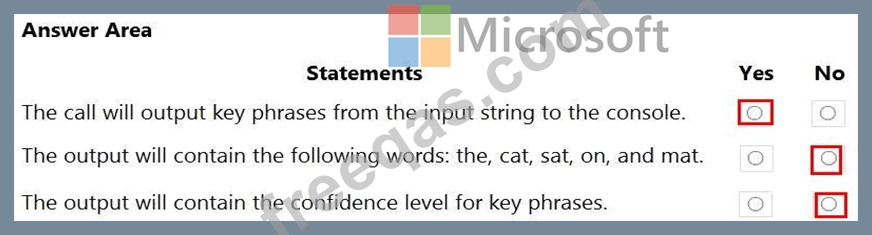
For each of the following statements, select Yes if the statement is true. Otherwise, select No.
NOTE: Each correct selection is worth one point.
You are developing a method for an application that uses the Translator API.
The method will receive the content of a webpage, and then translate the content into Greek (el). The result will also contain a transliteration that uses the Roman alphabet.
You need to create the URI for the call to the Translator API. You have the following URI.
https://api.cognitive.microsofttranslator.com/translate?api-version=3.0 Which three additional query parameters should you include in the URI? Each correct answer presents part of the solution. (Choose three.) NOTE: Each correct selection is worth one point.
You are developing an application to recognize employees' faces by using the Face Recognition API. Images of the faces will be accessible from a URI endpoint.
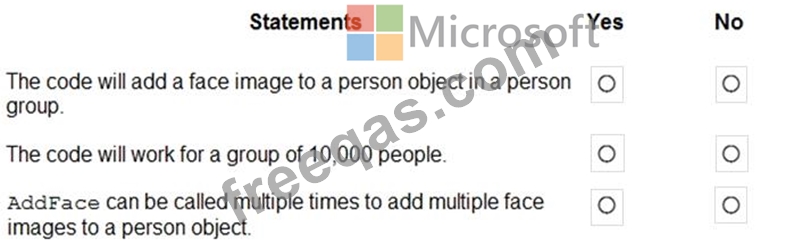
The application has the following code.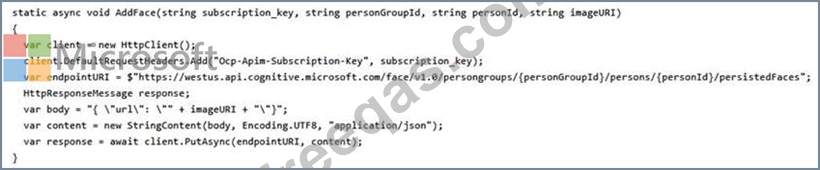
For each of the following statements, select Yes if the statement is true. Otherwise, select No.
NOTE: Each correct selection is worth one point.