FreeQAs
 Request Exam  Contact
  • Home
  • View All Exams
  • New QA's
  • Upload
PRACTICE EXAMS:
  • Oracle
  • Fortinet
  • IBM
  • Juniper
  • Microsoft
  • Cisco
  • Citrix
  • CompTIA
  • VMware
  • ISC
  • SAP
  • EMC
  • PMI
  • HP
  • Salesforce
  • Other
  • Oracle
    Oracle
  • Fortinet
    Fortinet
  • IBM
    IBM
  • Juniper
    Juniper
  • Microsoft
    Microsoft
  • Cisco
    Cisco
  • Citrix
    Citrix
  • CompTIA
    CompTIA
  • VMware
    VMware
  • ISC
    ISC
  • SAP
    SAP
  • EMC
    EMC
  • PMI
    PMI
  • HP
    HP
  • Salesforce
    Salesforce
  1. Home
  2. Microsoft Certification
  3. AZ-104 Exam
  4. Microsoft.AZ-104.v2024-03-20.q140 Dumps
  • ««
  • «
  • …
  • 9
  • 10
  • 11
  • 12
  • 13
  • 14
  • 15
  • 16
  • 17
  • 18
  • …
  • »
  • »»
Download Now

Question 61

You have an Azure subscription that contains the virtual networks shown in the following table.

The subscription contains the virtual machines shown in the following table.

Each virtual machine contains only a private IP address.
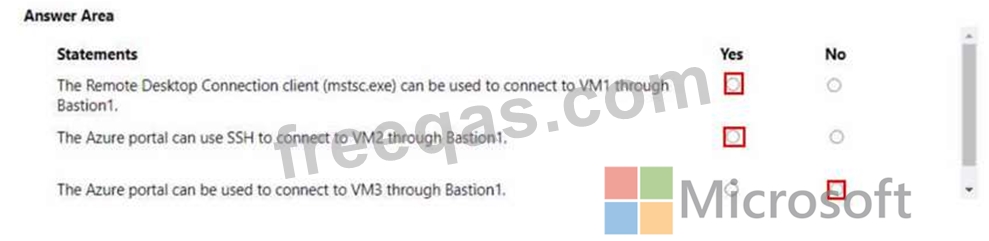
You create an Azure bastion for VNet1 as shown in the following exhibit.

For each of the following statements, select Yes if the statement is true. Otherwise, select No.
NOTE: Each correct selection is worth one point.
Correct Answer:
insert code

Question 62

You have an Azure subscription named Subcription1 that contains a resource group named RG1.
In RG1. you create an internal load balancer named LB1 and a public load balancer named 162.
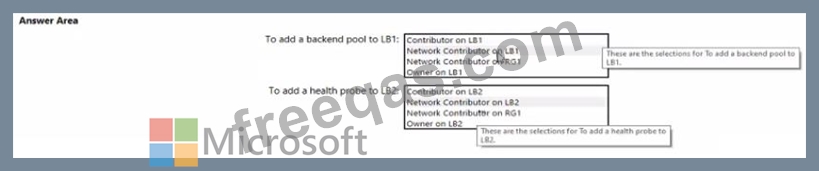
You need to ensure that an administrator named Admin 1 can manage LB1 and LB2. The solution must follow the principle of least privilege.
Which role should you assign to Admin1 for each task? To answer, select the appropriate options in the answer area.
NOTE: Each correct selection is worth one point.
Correct Answer:

Reference:
https://docs.microsoft.com/en-us/azure/role-based-access-control/built-in-roles
insert code

Question 63

You have an Azure subscription that contains an Azure SQL database named DB1.
You plan to use Azure Monitor to monitor the performance of DB1. You must be able to run queries to analyze log data.
Which destination should you configure in the Diagnostic settings of DB 1?

Correct Answer: A
According to the Microsoft documentation, Azure Monitor collects and analyzes monitoring data from Azure resources, including Azure SQL databases. You can use Azure Monitor to monitor the performance of DB1 and run queries to analyze log data.
To use Azure Monitor, you need to configure the diagnostic settings of DB1, which define the sources and destinations of the monitoring data. The sources are the types of metric and log data to send to the destinations, such as SQLInsights, Errors, Blocks, Deadlocks, etc. The destinations are one or more locations where you want to send the monitoring data, such as a Log Analytics workspace, a storage account, or an event hub.
A Log Analytics workspace is a unique environment for Azure Monitor log data. Each workspace has its own data repository and configuration, and data sources and solutions are configured to store their data in a particular workspace. You can use a Log Analytics workspace to run queries on the log data collected from DB1 and other resources using the Kusto query language. You can also create alerts, dashboards, and workbooks based on the log data in the workspace.
A storage account is a place where you can store large amounts of unstructured data, such as files, blobs, queues, tables, and disks. You can use a storage account to archive the monitoring data from DB1 for long-term retention or backup purposes. However, you cannot run queries on the log data in a storage account directly. You would need to use another tool or service to analyze the log data in a storage account.
An event hub is a service that enables you to ingest and process large volumes of streaming data from multiple sources. You can use an event hub to stream the monitoring data from DB1 to other applications or services that can consume and analyze the data in real time. However, you cannot run queries on the log data in an event hub directly. You would need to use another tool or service to analyze the log data in an event hub.
insert code

Question 64

You recently created a new Azure subscription that contains a user named Admin1.
Admin1
attempts to deploy an Azure Marketplace resource by using an Azure Resource Manager template. Admin1 deploys the template by using Azure PowerShell and receives the following error message: "User failed validation to purchase resources. Error message: "Legal terms have not been accepted for this item on this subscription. To accept legal terms, please go to the Azure portal (http://go.microsoft.com/fwlink/?LinkId=534873) and configure programmatic deployment for the Marketplace item or create it there for the first time." You need to ensure that Admin1 can deploy the Marketplace resource successfully.
What should you do?

Correct Answer: C
Reference:
https://docs.microsoft.com/en-us/powershell/module/az.marketplaceordering/set-azmarketplaceterms?view=azps
insert code

Question 65

You have an Azure subscription that contains the storage accounts shown in the following table.

You need to identify which storage account can be converted to zone-redundant storage (ZRS) replication by requesting a live migration from Azure support.
What should you identify?


Correct Answer: B
ZRS currently supports standard general-purpose v2, FileStorage and BlockBlobStorage storage account types.
Incorrect Answers:
A, not C: Live migration is supported only for storage accounts that use LRS replication. If your account uses GRS or RA-GRS, then you need to first change your account's replication type to LRS before proceeding. This intermediary step removes the secondary endpoint provided by GRS/RA-GRS.
Also, only standard storage account types support live migration. Premium storage accounts must be migrated manually.
D: ZRS currently supports standard general-purpose v2, FileStorage and BlockBlobStorage storage account types.
Reference:
https://docs.microsoft.com/en-us/azure/storage/common/storage-redundancy-zrs
https://docs.microsoft.com/en-us/azure/storage/common/storage-redundancy
insert code
  • ««
  • «
  • …
  • 9
  • 10
  • 11
  • 12
  • 13
  • 14
  • 15
  • 16
  • 17
  • 18
  • …
  • »
  • »»
[×]

Download PDF File

Enter your email address to download Microsoft.AZ-104.v2024-03-20.q140 Dumps

Email:

FreeQAs

Our website provides the Largest and the most Latest vendors Certification Exam materials around the world.

Using dumps we provide to Pass the Exam, we has the Valid Dumps with passing guranteed just which you need.

  • DMCA
  • About
  • Contact Us
  • Privacy Policy
  • Terms & Conditions
©2026 FreeQAs

www.freeqas.com materials do not contain actual questions and answers from Cisco's certification exams.