FreeQAs
 Request Exam  Contact
  • Home
  • View All Exams
  • New QA's
  • Upload
PRACTICE EXAMS:
  • Oracle
  • Fortinet
  • Juniper
  • Microsoft
  • Cisco
  • Citrix
  • CompTIA
  • VMware
  • ISC
  • SAP
  • EMC
  • PMI
  • HP
  • Salesforce
  • Other
  • Oracle
    Oracle
  • Fortinet
    Fortinet
  • Juniper
    Juniper
  • Microsoft
    Microsoft
  • Cisco
    Cisco
  • Citrix
    Citrix
  • CompTIA
    CompTIA
  • VMware
    VMware
  • ISC
    ISC
  • SAP
    SAP
  • EMC
    EMC
  • PMI
    PMI
  • HP
    HP
  • Salesforce
    Salesforce
  1. Home
  2. Microsoft Certification
  3. AZ-120 Exam
  4. Microsoft.AZ-120.v2025-09-18.q117 Dumps
  • «
  • 1
  • 2
  • 3
  • 4
  • 5
  • 6
  • 7
  • 8
  • 9
  • 10
  • …
  • »
  • »»
Download Now

Question 21

For each of the following statements, select Yes if the statement is true. Otherwise, select No.
NOTE: Each correct selection is worth one point.

Correct Answer:

Reference:
https://www.suse.com/media/guide/sap_hana_on_azure_101.pdf
insert code

Question 22

You deploy an SAP environment on Azure.
Your company has a Service Level Agreement (SLA) of 99.99% for SAP.
You implement Azure Availability Zones that have the following components:
* Redundant SAP application servers
* ASCS/ERS instances that use a failover cluster
* Database high availability that has a primary instance and a secondary instance You need to validate the load distribution to the application servers. What should you use?

Correct Answer: D
Explanation
Load balancers. These are used to distribute traffic to virtual machines in the application-tier subnet. For high availability, use the built-in SAP Web Dispatcher, Azure Load Balancer, or network appliances, depending on the traffic type (such as HTTP or SAPGUI) or the required network services, such as Secure Sockets Layer (SSL) termination.
Reference:
https://docs.microsoft.com/en-us/azure/architecture/reference-architectures/sap/sap-netweaver
insert code

Question 23

You have an Azure Active Directory (Azure AD) tenant and an SAP Cloud Platform Identity Authentication Service tenant.
You need to ensure that users can use their Azure AD credentials to authenticate to SAP applications and services that trust the SAP Cloud Platform Identity Authentication Service tenant.
In which order should you perform the actions? To answer, move all actions from the list of actions to the answer area and arrange them in the correct order.

Correct Answer:

1 - Create and configure an enterprise application in the Azure AD tentant
2 - Download the single sign-on (SSO) metadata from the Azure AD tenant.
3 - Create and configure a corporate identity provider.
4 - Download the SAP Cloud Platform Identity Authentication Service tenant metadata.
5 - Upload the SAP Cloud Platform Identity Authentication Service tenant metadata to Azure AD tenant.
Reference:
https://developers.sap.com/tutorials/cp-ias-azure-ad.html
insert code

Question 24

You are planning the Azure network infrastructure for an SAP environment.
For each of the following statements, select Yes if the statement is true. Otherwise, select No.
NOTE: Each correct selection is worth one point.
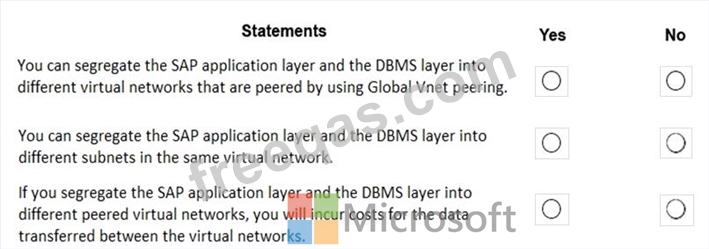
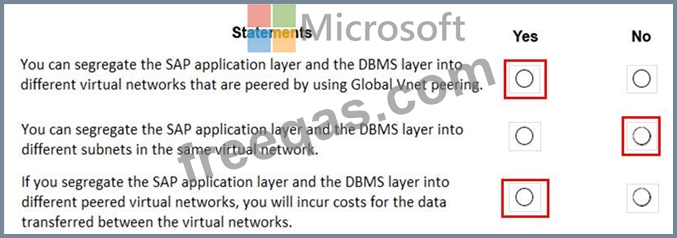
Correct Answer:

Explanation:
Box 1: Yes
Box 2: No
A design that's not supported is the segregation of the SAP application layer and the DBMS layer into different Azure virtual networks that aren't peered with each other. We recommend that you segregate the SAP application layer and DBMS layer by using subnets within an Azure virtual network instead of by using different Azure virtual networks.
Box 3: Yes
Be aware that network traffic between two peered Azure virtual networks is subject to transfer costs. Huge data volume that consists of many terabytes is exchanged between the SAP application layer and the DBMS layer. You can accumulate substantial costs if the SAP application layer and DBMS layer are segregated between two peered Azure virtual networks.
References:
https://docs.microsoft.com/en-us/azure/virtual-machines/workloads/sap/dbms_guide_general
insert code

Question 25

You have an on-premises SAP landscape and an Azure subscription that contains a virtual network named VNET1. VNET1 has the following settings.

You plan to migrate the landscape to Azure.
You need to configure VNET1 to support the SAP landscape.
Use the drop-down menus to select the answer choice that completes each statement based on the information presented in the settings.
NOTE: Each correct selection is worth one point.

Correct Answer:

Explanation:
Graphical user interface, text, application, table Description automatically generated

Box 1: add a virtual network gateway
Box 2: use remote gateways
Each virtual network, regardless of whether peered with another virtual network, can still have its own gateway to connect to an on-premises network. When you peer virtual networks, you can also configure the gateway in the peered virtual network as a transit point to an on-premises network. In this case, the virtual network that uses a remote gateway cannot have its own gateway. A virtual network can have only one gateway that can be either a local or remote gateway (in the peered virtual network).
Reference:
https://docs.microsoft.com/en-us/azure/virtual-network/virtual-network-peering-overview
insert code
  • «
  • 1
  • 2
  • 3
  • 4
  • 5
  • 6
  • 7
  • 8
  • 9
  • 10
  • …
  • »
  • »»
[×]

Download PDF File

Enter your email address to download Microsoft.AZ-120.v2025-09-18.q117 Dumps

Email:

FreeQAs

Our website provides the Largest and the most Latest vendors Certification Exam materials around the world.

Using dumps we provide to Pass the Exam, we has the Valid Dumps with passing guranteed just which you need.

  • DMCA
  • About
  • Contact Us
  • Privacy Policy
  • Terms & Conditions
©2026 FreeQAs

www.freeqas.com materials do not contain actual questions and answers from Cisco's certification exams.
