FreeQAs
 Request Exam  Contact
  • Home
  • View All Exams
  • New QA's
  • Upload
PRACTICE EXAMS:
  • Oracle
  • Fortinet
  • Juniper
  • Microsoft
  • Cisco
  • Citrix
  • CompTIA
  • VMware
  • ISC
  • SAP
  • EMC
  • PMI
  • HP
  • Salesforce
  • Other
  • Oracle
    Oracle
  • Fortinet
    Fortinet
  • Juniper
    Juniper
  • Microsoft
    Microsoft
  • Cisco
    Cisco
  • Citrix
    Citrix
  • CompTIA
    CompTIA
  • VMware
    VMware
  • ISC
    ISC
  • SAP
    SAP
  • EMC
    EMC
  • PMI
    PMI
  • HP
    HP
  • Salesforce
    Salesforce
  1. Home
  2. Microsoft Certification
  3. AZ-220 Exam
  4. Microsoft.AZ-220.v2022-08-05.q131 Dumps
  • ««
  • «
  • …
  • 10
  • 11
  • 12
  • 13
  • 14
  • 15
  • 16
  • 17
  • 18
  • 19
  • …
  • »
  • »»
Download Now

Question 66

You have an Azure IoT hub named Hub1 and a root certification authority (CA) named CA1. Hub1 is configured to use X.509 certificate device authentication.
You and a custom manufacturing partner complete a proof of possession flow.
You plan to deploy IoT devices manufactured by the custom manufacturing partner. Each device will have a certificate generated by an intermediate CA. The devices will authenticate by using device certificates signed by the partner.
You need to ensure that the custom devices can connect successfully to Hub1.
Which three actions should you perform in sequence? To answer, move the appropriate actions from the list of actions to the answer area and arrange them in the correct order.

Correct Answer:

Explanation
Graphical user interface, text, application, chat or text message Description automatically generated

Box 1: Sign the intermediate CA certificate by using the CA1 certificate.
X.509 certificates are typically arranged in a certificate chain of trust in which each certificate in the chain is signed by the private key of the next higher certificate, and so on, terminating in a self-signed root certificate.
This arrangement establishes a delegated chain of trust from the root certificate generated by a trusted root certificate authority (CA) down through each intermediate CA to the end-entity "leaf" certificate installed on a device.
Box 2: Sign the device certificate by using the intermediate CA
An intermediate certificate is an X.509 certificate, which has been signed by the root certificate (or by another intermediate certificate with the root certificate in its chain). The last intermediate certificate in a chain is used to sign the leaf certificate. An intermediate certificate can also be referred to as an intermediate CA certificate.
Box 3: Deploy the certificate chain to the device.
The leaf certificate, or end-entity certificate, identifies the certificate holder. It has the root certificate in its certificate chain as well as zero or more intermediate certificates. The leaf certificate is not used to sign any other certificates. It uniquely identifies the device to the provisioning service and is sometimes referred to as the device certificate. During authentication, the device uses the private key associated with this certificate to respond to a proof of possession challenge from the service.
Reference:
https://docs.microsoft.com/en-us/azure/iot-dps/concepts-x509-attestation
insert code

Question 67

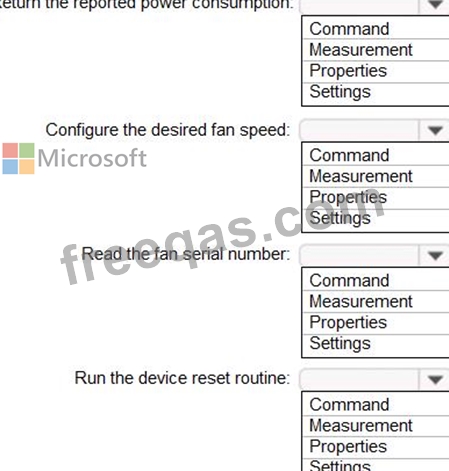
You have an Azure IoT Central application that has a custom device template.
You need to configure the device template to support the following activities:
* Return the reported power consumption.
* Configure the desired fan speed.
* Run the device reset routine.
* Read the fan serial number.
Which option should you use for each activity? Each correct answer presents part of the solution.
NOTE: Each correct selection is worth one point.
Correct Answer:

Explanation:
Box 1: Measurement
Telemetry/measurement is a stream of values sent from the device, typically from a sensor. For example, a sensor might report the ambient temperature.
Box 2: Property
The template can provide a writeable fan speed property
Properties represent point-in-time values. For example, a device can use a property to report the target temperature it's trying to reach. You can set writeable properties from IoT Central.
Box 3: Settings
Box 4: Command
You can call device commands from IoT Central. Commands optionally pass parameters to the device and receive a response from the device. For example, you can call a command to reboot a device in 10 seconds.
Reference:
https://docs.microsoft.com/en-us/azure/iot-central/core/howto-set-up-template
insert code

Question 68

Note: This question is part of a series of questions that present the same scenario. Each question in the series contains a unique solution that might meet the stated goals. Some question sets might have more than one correct solution, while others might not have a correct solution.
After you answer a question in this section, you will NOT be able to return to it. As a result, these questions will not appear in the review screen.
You have a Standard tier Azure IoT hub and a fleet of IoT devices.
The devices connect to the IoT hub by using either Message Queuing Telemetry Transport (MQTT) or Advanced Message Queuing Protocol (AMQP).
You need to send data to the IoT devices and each device must respond. Each device will require three minutes to process the data and respond.
Solution: You use cloud-to-device messages and watch the cloud-to-device feedback endpoint for successful acknowledgement.
Does this meet the goal?

Correct Answer: B
IoT Hub provides three options for device apps to expose functionality to a back-end app:
Twin's desired properties for long-running commands intended to put the device into a certain desired state. For example, set the telemetry send interval to 30 minutes.
Direct methods for communications that require immediate confirmation of the result. Direct methods are often used for interactive control of devices such as turning on a fan.
Cloud-to-device messages for one-way notifications to the device app.
Reference:
https://docs.microsoft.com/en-us/azure/iot-hub/iot-hub-devguide-c2d-guidance
insert code

Question 69

You create an Azure Stream Analytics job that has the following query.

The job is configured to have an Azure IoT Hub input and an output to an Azure function.
For each of the following statements, select Yes if the statement is true. Otherwise, select No.
NOTE: Each correct selection is worth one point.

Correct Answer:

Explanation

Box 1: Yes
All time handling operations in Azure Stream Analytics are in UTC.
Box 2: No
Tumbling windows are a series of fixed-sized, non-overlapping and contiguous time intervals.
Box 3: Yes
Reference:
https://docs.microsoft.com/en-us/stream-analytics-query/time-management-azure-stream-analytics
insert code

Question 70

You have an existing Azure IoT hub.
You use IoT Hub jobs to schedule long running tasks on connected devices.
Which three operations do the IoT Hub jobs support directly? Each correct answer presents a complete solution.
NOTE: Each correct selection is worth one point.


Correct Answer: B,C,F
Explanation
Consider using jobs when you need to schedule and track progress any of the following activities on a set of devices:
* Invoke direct methods
* Update desired properties
* Update tags
Reference:
https://docs.microsoft.com/en-us/azure/iot-hub/iot-hub-devguide-jobs
insert code
  • ««
  • «
  • …
  • 10
  • 11
  • 12
  • 13
  • 14
  • 15
  • 16
  • 17
  • 18
  • 19
  • …
  • »
  • »»
[×]

Download PDF File

Enter your email address to download Microsoft.AZ-220.v2022-08-05.q131 Dumps

Email:

FreeQAs

Our website provides the Largest and the most Latest vendors Certification Exam materials around the world.

Using dumps we provide to Pass the Exam, we has the Valid Dumps with passing guranteed just which you need.

  • DMCA
  • About
  • Contact Us
  • Privacy Policy
  • Terms & Conditions
©2026 FreeQAs

www.freeqas.com materials do not contain actual questions and answers from Cisco's certification exams.