FreeQAs
 Request Exam  Contact
  • Home
  • View All Exams
  • New QA's
  • Upload
PRACTICE EXAMS:
  • Oracle
  • Fortinet
  • Juniper
  • Microsoft
  • Cisco
  • Citrix
  • CompTIA
  • VMware
  • ISC
  • SAP
  • EMC
  • PMI
  • HP
  • Salesforce
  • Other
  • Oracle
    Oracle
  • Fortinet
    Fortinet
  • Juniper
    Juniper
  • Microsoft
    Microsoft
  • Cisco
    Cisco
  • Citrix
    Citrix
  • CompTIA
    CompTIA
  • VMware
    VMware
  • ISC
    ISC
  • SAP
    SAP
  • EMC
    EMC
  • PMI
    PMI
  • HP
    HP
  • Salesforce
    Salesforce
  1. Home
  2. Microsoft Certification
  3. AZ-220 Exam
  4. Microsoft.AZ-220.v2024-04-05.q140 Dumps
  • ««
  • «
  • …
  • 20
  • 21
  • 22
  • 23
  • 24
  • 25
  • 26
  • 27
  • 28
  • 29
  • »
Download Now

Question 131

You have an Azure loT solution that includes an Azure loT hub and a Device Provisioning Service instance.
Several enrolled devices are stolen.
You need to prevent the stolen devices from connecting to the loT solution. The solution must prevent the devices from re-enrollment and must be implemented as soon as possible.
What should you do?

Correct Answer: C
insert code

Question 132

You have an Azure subscription that contains an Azure IoT hub, an Azure IoT Edge gateway, and 1,000 leaf devices. The leaf devices use a custom communication protocol that is NOT supported by the IoT hub.
You need to configure the gateway to meet the following requirements:
* Minimize the number of connections between the gateway and the IoT hub.
* Support addressing cloud-to-device messages to individual leaf devices.
How should you configure the gateway? To answer, select the appropriate options in the answer area.
NOTE: Each correct selection is worth one point.

Correct Answer:

Explanation
Graphical user interface, text, application, table Description automatically generated

Box 1: Protocol translation
In the protocol translation gateway pattern, only the IoT Edge gateway has an identity with IoT Hub. The translation module receives messages from downstream devices, translates them into a supported protocol, and then the IoT Edge device sends the messages on behalf of the downstream devices.
Box 2: Advanced MessageQueuing Protocol (AMQP)
Connection multiplexing - All devices connecting to IoT Hub through an IoT Edge gateway can use the same underlying connection. This multiplexing capability requires that the IoT Edge gateway uses AMQP as its upstream protocol.
Reference:
https://docs.microsoft.com/en-us/azure/iot-edge/iot-edge-as-gateway
insert code

Question 133

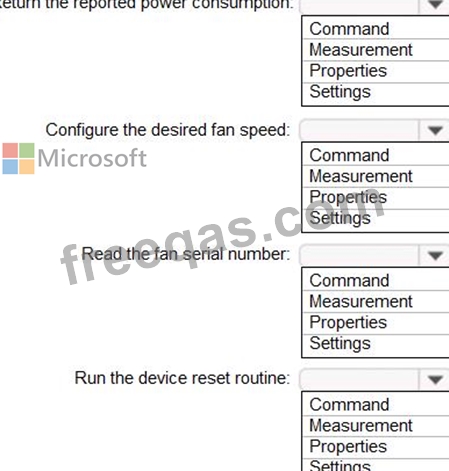
You have an Azure IoT Central application that has a custom device template.
You need to configure the device template to support the following activities:
* Return the reported power consumption.
* Configure the desired fan speed.
* Run the device reset routine.
* Read the fan serial number.
Which option should you use for each activity? Each correct answer presents part of the solution.
NOTE: Each correct selection is worth one point.
Correct Answer:

Explanation:
Box 1: Measurement
Telemetry/measurement is a stream of values sent from the device, typically from a sensor. For example, a sensor might report the ambient temperature.
Box 2: Property
The template can provide a writeable fan speed property
Properties represent point-in-time values. For example, a device can use a property to report the target temperature it's trying to reach. You can set writeable properties from IoT Central.
Box 3: Settings
Box 4: Command
You can call device commands from IoT Central. Commands optionally pass parameters to the device and receive a response from the device. For example, you can call a command to reboot a device in 10 seconds.
Reference:
https://docs.microsoft.com/en-us/azure/iot-central/core/howto-set-up-template
insert code

Question 134

You have an Azure IoT Central application.
You add an IoT device named Oven1 to the application. Oven1 uses an IoT Central template for industrial ovens.
You need to send an email to the managers group at your company as soon as the oven temperature falls below
400 degrees.
Which two actions should you perform? Each correct answer presents part of the solution.
NOTE: Each correct selection is worth one point.

Correct Answer: B,E
Explanation
Devices use telemetry to send numerical data from the device. A rule triggers when the selected telemetry crosses a specified threshold.
E: To create a telemetry rule, the device template must include at least one telemetry value. The rule monitors the temperature reported by the device and sends an email when it falls below 400 degrees.
B: Configure the rule conditions.
Conditions define the criteria that the rule monitors. In this tutorial, you configure the rule to fire when the temperature exceeds 70° F.
1. Select Temperature in the Telemetry dropdown.
2. Next, choose Is less than as the Operator and enter 400 as the Value.

3. Optionally, you can set a Time aggregation. When you select a time aggregation, you must also select an aggregation type, such as average or sum from the aggregation drop-down.
* Without aggregation, the rule triggers for each telemetry data point that meets the condition.
* With aggregation, the rule triggers if the aggregate value of the telemetry data points in the time window meets the condition.
Reference:
https://docs.microsoft.com/en-us/azure/iot-central/core/tutorial-create-telemetry-rules
insert code

Question 135

You have an Azure IoT Edge automatic deployment named D1 that deploys a temperature module to five IoT Edge devices.
D1 has a deployment priority of 10 and the following module configuration.

You need to create a new layered deployment that will add a new twin property named ReportingMode. The new deployment must not overwrite the existing module configurations set by D1.
How should you configure the deployment? To answer, select the appropriate options in the answer area.
NOTE: Each correct selection is worth one point.

Correct Answer:

Explanation
Text Description automatically generated with low confidence

Box 1: 1
A priority defines whether a deployment should be applied to a targeted device relative to other deployments.
A deployment priority is a positive integer, with larger numbers denoting higher priority. If an IoT Edge device is targeted by more than one deployment, the deployment with the highest priority applies.
Deployments with lower priorities are not applied, nor are they merged. If a device is targeted with two or more deployments with equal priority, the most recently created deployment (determined by the creation timestamp) applies.
Box 2: "properties.tags": {
You create a deployment manifest and then define which devices it applies to based on tags in the device twin.
Reference:
https://docs.microsoft.com/en-us/azure/iot-edge/module-deployment-monitoring
insert code
  • ««
  • «
  • …
  • 20
  • 21
  • 22
  • 23
  • 24
  • 25
  • 26
  • 27
  • 28
  • 29
  • »
[×]

Download PDF File

Enter your email address to download Microsoft.AZ-220.v2024-04-05.q140 Dumps

Email:

FreeQAs

Our website provides the Largest and the most Latest vendors Certification Exam materials around the world.

Using dumps we provide to Pass the Exam, we has the Valid Dumps with passing guranteed just which you need.

  • DMCA
  • About
  • Contact Us
  • Privacy Policy
  • Terms & Conditions
©2026 FreeQAs

www.freeqas.com materials do not contain actual questions and answers from Cisco's certification exams.
