FreeQAs
 Request Exam  Contact
  • Home
  • View All Exams
  • New QA's
  • Upload
PRACTICE EXAMS:
  • Oracle
  • Fortinet
  • Juniper
  • Microsoft
  • Cisco
  • Citrix
  • CompTIA
  • VMware
  • SAP
  • EMC
  • PMI
  • HP
  • Salesforce
  • Other
  • Oracle
    Oracle
  • Fortinet
    Fortinet
  • Juniper
    Juniper
  • Microsoft
    Microsoft
  • Cisco
    Cisco
  • Citrix
    Citrix
  • CompTIA
    CompTIA
  • VMware
    VMware
  • SAP
    SAP
  • EMC
    EMC
  • PMI
    PMI
  • HP
    HP
  • Salesforce
    Salesforce
  1. Home
  2. Microsoft Certification
  3. AZ-304 Exam
  4. Microsoft.AZ-304.v2022-04-25.q111 Dumps
  • ««
  • «
  • …
  • 9
  • 10
  • 11
  • 12
  • 13
  • 14
  • 15
  • 16
  • 17
  • 18
  • …
  • »
  • »»
Download Now

Question 61

You configure the Diagnostics settings for an Azure SQL database as shown in the following exhibit.

Use the drop-down menus to select the answer choice that completes each statement based on the information presented in the graphic.
NOTE: Each correct selection is worth one point.

Correct Answer:
insert code

Question 62

You have an Azure subscription that contains the resources shown in the following table.

You create an Azure SQL database named DB1 that is hosted in the East US region.
To DB1, you add a diagnostic setting named Settings1. Settings1 archives SQLInsights to storage1 and sends SQLInsights to Workspace1.
For each of the following statements, select Yes if the statement is true. Otherwise, select No.
NOTE: Each correct selections is worth one point.

Correct Answer:

Explanation:
Box 1: No
You archive logs only to Azure Storage accounts.
Box 2: Yes
Box 3: Yes
Sending logs to Event Hubs allows you to stream data to external systems such as third-party SIEMs and other log analytics solutions.
Note: A single diagnostic setting can define no more than one of each of the destinations. If you want to send data to more than one of a particular destination type (for example, two different Log Analytics workspaces), then create multiple settings. Each resource can have up to 5 diagnostic settings.
References:
https://docs.microsoft.com/en-us/azure/azure-monitor/platform/diagnostic-settings
insert code

Question 63

You are building an application that will run in a virtual machine (VM). The application will use Azure Managed Identity.
The application uses Azure Key Vault, Azure SQL Database, and Azure Cosmos DB.
You need to ensure the application can use secure credentials to access these services.
Which authentication method should you recommend? To answer, select the appropriate options in the answer area.
NOTE: Each correct selection is worth one point.

Correct Answer:

Reference:
https://docs.microsoft.com/en-us/azure/active-directory/managed-identities-azure-resources/overview
insert code

Question 64

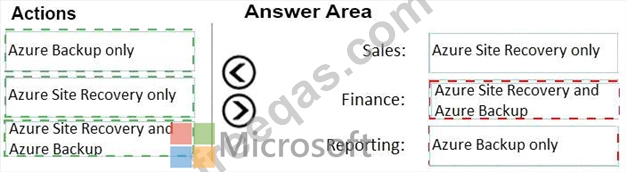
Your company identifies the following business continuity and disaster recovery objectives for virtual machines that host sales, finance, and reporting application in the company's on-premises data center.
*The finance application requires that data be retained for seven years. In the event of a disaster, the application must be able to run from Azure. The recovery in objective (RTO) is 10 minutes,
* The reporting application must be able to recover point in-time data al a daily granularity. The RTO is eight hours.
*The sales application must be able to fail over to second on-premises data center.
You need to recommend which Azure services meet the business community and disaster recovery objectives. The solution must minimize costs.
What should you recommend for each application? To answer, drag the appropriate services to the correct application. Each service may be used owe. More than once not at an You may need to drag the spin bar between panes or scroll 10 view content.
Correct Answer:

Explanation
1) Sales: Azure Site Recovery only
2) Finance: Azure Site Recovery and Azure Backup
3) Reporting: Azure Backup only
insert code

Question 65

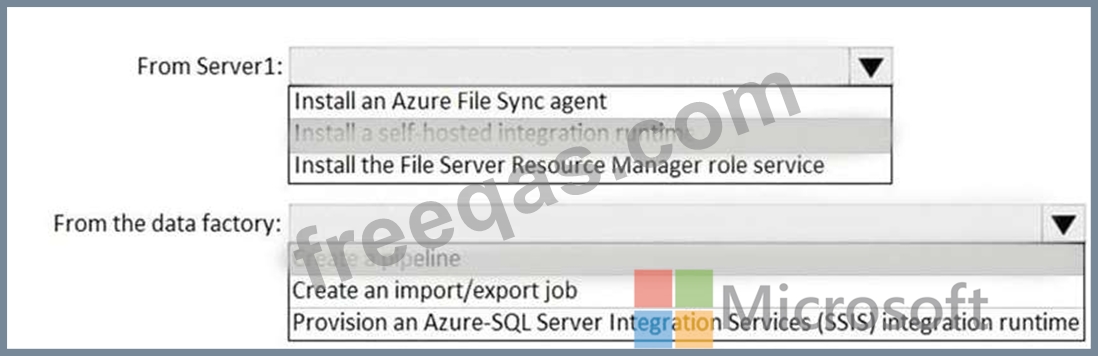
Your on-premises network contains a file server named Server1 that stores 500 GB of data.
You need to use Azure Data Factory to copy the data from Server1 to Azure Storage.
You add a new data factory.
What should you do next? To answer, select the appropriate options in the answer area.
NOTE: Each correct selection is worth one point.

Correct Answer:

Explanation

Box 1: Install a self-hosted integration runtime
The Integration Runtime is a customer-managed data integration infrastructure used by Azure Data Factory to provide data integration capabilities across different network environments.
Box 2: Create a pipeline
With ADF, existing data processing services can be composed into data pipelines that are highly available and managed in the cloud. These data pipelines can be scheduled to ingest, prepare, transform, analyze, and publish data, and ADF manages and orchestrates the complex data and processing dependencies References:
https://docs.microsoft.com/en-us/azure/machine-learning/team-data-science-process/move-sql-azure-adf
insert code
  • ««
  • «
  • …
  • 9
  • 10
  • 11
  • 12
  • 13
  • 14
  • 15
  • 16
  • 17
  • 18
  • …
  • »
  • »»
[×]

Download PDF File

Enter your email address to download Microsoft.AZ-304.v2022-04-25.q111 Dumps

Email:

FreeQAs

Our website provides the Largest and the most Latest vendors Certification Exam materials around the world.

Using dumps we provide to Pass the Exam, we has the Valid Dumps with passing guranteed just which you need.

  • DMCA
  • About
  • Contact Us
  • Privacy Policy
  • Terms & Conditions
©2025 FreeQAs

www.freeqas.com materials do not contain actual questions and answers from Cisco's certification exams.
