FreeQAs
 Request Exam  Contact
  • Home
  • View All Exams
  • New QA's
  • Upload
PRACTICE EXAMS:
  • Oracle
  • Fortinet
  • IBM
  • Juniper
  • Microsoft
  • Cisco
  • Citrix
  • CompTIA
  • VMware
  • ISC
  • SAP
  • EMC
  • PMI
  • HP
  • Salesforce
  • Other
  • Oracle
    Oracle
  • Fortinet
    Fortinet
  • IBM
    IBM
  • Juniper
    Juniper
  • Microsoft
    Microsoft
  • Cisco
    Cisco
  • Citrix
    Citrix
  • CompTIA
    CompTIA
  • VMware
    VMware
  • ISC
    ISC
  • SAP
    SAP
  • EMC
    EMC
  • PMI
    PMI
  • HP
    HP
  • Salesforce
    Salesforce
  1. Home
  2. Microsoft Certification
  3. AZ-304 Exam
  4. Microsoft.AZ-304.v2022-04-25.q111 Dumps
  • «
  • 1
  • 2
  • 3
  • 4
  • 5
  • 6
  • 7
  • 8
  • 9
  • 10
  • …
  • »
  • »»
Download Now

Question 11

Your company wants to use an Azure Active Directory (Azure AD) hybrid identity solution.
You need to ensure that users can authenticate if the internet connection is unavailable. The solution must minimize authentication prompts for the users.
What should you include in the solution?

Correct Answer: B
insert code

Question 12

You migrate App1 to Azure.
You need to ensure that the data storage for App1 meets the security and compliance requirement What should you do?

Correct Answer: D
Azure Active Directory (Azure AD) authorizes access rights to secured resources through Azure role-based access control (Azure RBAC). Azure Storage defines a set of Azure built-in roles that encompass common sets of permissions used to access blob data.
When an Azure role is assigned to an Azure AD security principal, Azure grants access to those resources for that security principal. An Azure AD security principal may be a user, a group, an application service principal, or a managed identity for Azure resources.
Scenario:
To access the resources in Azure, App1 must use the managed identity of the virtual machines that will host the app.
The Litware.com tenant contains a custom Azure role-based access control (Azure RBAC) role named Role1 that grants the DataActions read permission to the blobs and files in Azure Storage.
Litware identifies the following security and compliance requirements:
On-premises users and services must be able to access the Azure Storage account that will host the data in App1.
Reference:
https://docs.microsoft.com/en-us/azure/storage/blobs/assign-azure-role-data-access
insert code

Question 13

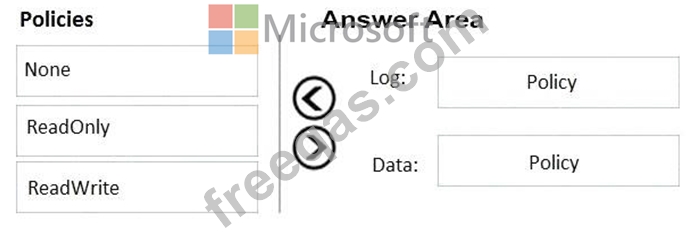
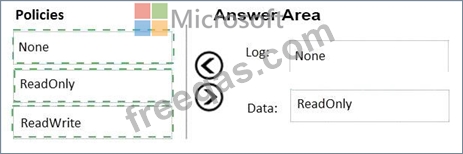
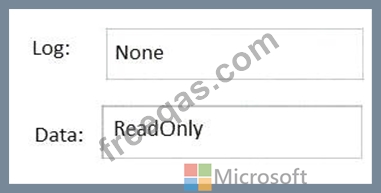
You are designing a virtual machine that will run Microsoft SQL Server and will contain two data disks. The first data disk will store log files, and the second data disk will store data. Both disks are P40 managed disks.
You need to recommend a caching policy for each disk. The policy must provide the best overall performance for the virtual machine.
Which caching policy should you recommend for each disk? To answer, drag the appropriate policies to the correct disks. Each policy may be used once, more than once, or not at all. You may need to drag the split bar between panes or scroll to view content.
NOTE: Each correct selection is worth one point.
Correct Answer:

Explanation

References:
https://docs.microsoft.com/en-us/azure/virtual-machines/windows/sql/virtual-machines-windows-sql-performanc
insert code

Question 14

You are designing a microservices architecture that will support a web application.
The solution must meet the following requirements:
* Allow independent upgrades to each microservice.
* Deploy the solution on-premises and to Azure.
* Set policies for performing automatic repairs to the microservices.
* Support low-latency and hyper-scale operations.
You need to recommend a technology.

Correct Answer: C
Azure Service Fabric is a distributed systems platform that makes it easy to package, deploy, and manage scalable and reliable microservices and containers.
You can use Azure Service Fabric to create Service Fabric clusters on any virtual machines or computers running Windows Server.
Reference:
https://docs.microsoft.com/en-us/azure/service-fabric/service-fabric-overview
insert code

Question 15

HOTSPOT
You have five .NET Core applications that run on 10 Azure virtual machines in the same subscription.
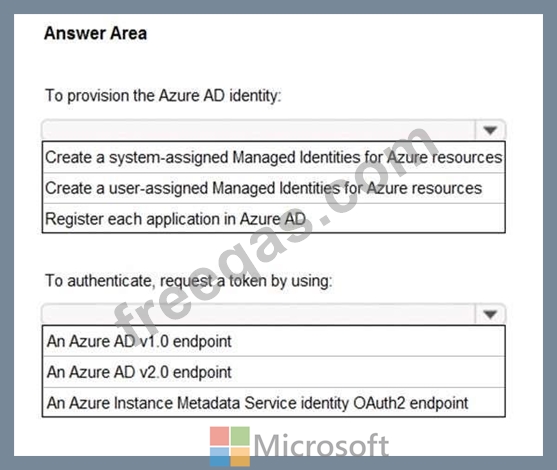
You need to recommend a solution to ensure that the applications can authenticate by using the same Azure Active Directory (Azure AD) identity. The solution must meet the following requirements:
* Ensure that the applications can authenticate only when running on the 10 virtual machines.
* Minimize administrative effort.
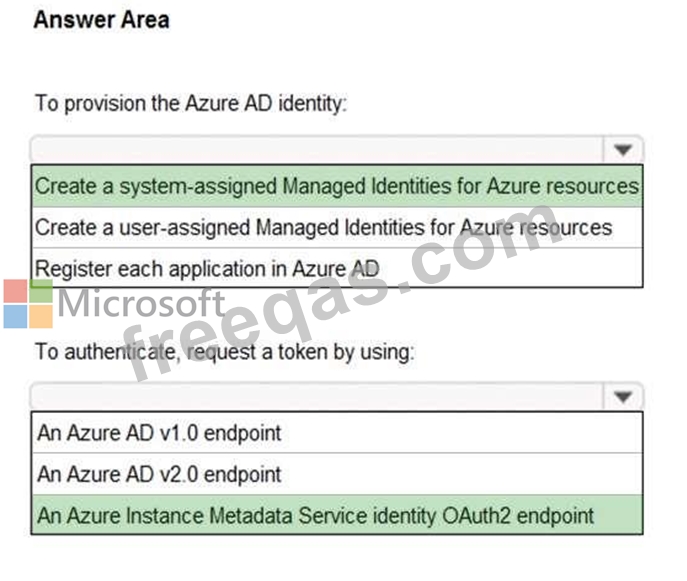
What should you include in the recommendation? To answer, select the appropriate options in the answer area.
Hot Area:
Correct Answer:

Explanation:
Box 1: Create a system-assigned Managed Identities for Azure resource
The managed identities for Azure resources feature in Azure Active Directory (Azure AD) feature provides Azure services with an automatically managed identity in Azure AD. You can use the identity to authenticate to any service that supports Azure AD authentication, including Key Vault, without any credentials in your code.
A system-assigned managed identity is enabled directly on an Azure service instance. When the identity is enabled, Azure creates an identity for the instance in the Azure AD tenant that's trusted by the subscription of the instance. After the identity is created, the credentials are provisioned onto the instance.
Box 2: An Azure Instance Metadata Service Identity
See step 3 and 5 below.
How a system-assigned managed identity works with an Azure VM
1. Azure Resource Manager receives a request to enable the system-assigned managed identity on a VM.
2. Azure Resource Manager creates a service principal in Azure AD for the identity of the VM. The service principal is created in the Azure AD tenant that's trusted by the subscription.
3. Azure Resource Manager configures the identity on the VM by updating the Azure Instance Metadata Service identity endpoint with the service principal client ID and certificate.
4. After the VM has an identity, use the service principal information to grant the VM access to Azure resources. To call Azure Resource Manager, use role-based access control (RBAC) in Azure AD to assign the appropriate role to the VM service principal. To call Key Vault, grant your code access to the specific secret or key in Key Vault.
5. Your code that's running on the VM can request a token from the Azure Instance Metadata service endpoint, accessible only from within the VM Reference:
https://docs.microsoft.com/en-us/azure/active-directory/managed-identities-azure-resources/overview
insert code
  • «
  • 1
  • 2
  • 3
  • 4
  • 5
  • 6
  • 7
  • 8
  • 9
  • 10
  • …
  • »
  • »»
[×]

Download PDF File

Enter your email address to download Microsoft.AZ-304.v2022-04-25.q111 Dumps

Email:

FreeQAs

Our website provides the Largest and the most Latest vendors Certification Exam materials around the world.

Using dumps we provide to Pass the Exam, we has the Valid Dumps with passing guranteed just which you need.

  • DMCA
  • About
  • Contact Us
  • Privacy Policy
  • Terms & Conditions
©2026 FreeQAs

www.freeqas.com materials do not contain actual questions and answers from Cisco's certification exams.
